Low Sexual Desire in Women: Do Supplements Help?
Some herbs have been studied, but the findings don’t establish a reliable supplement treatment for low desire in women.
No supplement here has convincing evidence of reliably increasing women’s desire. A review describes limited, emerging research on maca, tribulus, and ginseng, while a menopause-related study measured a broader sexual quality-of-life score rather than desire alone. Medicines, discomfort, menopause-related concerns, and what you want from intimacy are also worth separating from the label “low libido.” 45
A change in sexual desire can be worth understanding, but desire varies and a change alone doesn’t mean something is wrong. It helps to separate wanting sex from arousal, comfort, and distress: they can overlap, but a study measuring one hasn’t necessarily shown a benefit in another.
What the herb studies do, and don’t, show
A review of “natural aphrodisiacs” describes limited but emerging data for maca, tribulus, and ginseng. It also says randomized trial evidence is often lacking and raises concerns about interactions, product purity, reliability, and safety. That isn’t evidence that one of these herbs reliably increases desire in women. 4
A separate review discusses ways to test nutritional supplements for sexual problems. It mentions small trials involving female sexual dysfunction, but its abstract does not establish those as trials demonstrating that supplements increase women’s desire. It’s better read as a discussion of research methods than as proof that a supplement works. 3
One randomized, double-blind, placebo-controlled study enrolled 138 women aged 40-55 with menopausal symptoms and tested a standardized Eurycoma longifolia extract over 12 weeks. The researchers reported an improvement from baseline in the sexual domain of a menopause-related quality-of-life measure in one group. That domain is broader than desire alone, and the reported results don’t establish that its improvement was greater than placebo. The study also doesn’t tell us whether results differed between perimenopausal and postmenopausal participants; the study report says participants weren’t stratified by menopausal status. 5
So, a product’s “sexual function” or “menopause wellness” claim shouldn’t be treated as a demonstrated libido benefit. Findings about one standardized extract also don’t establish that other products containing the same plant have the same effects. 45
A useful check before choosing a product
Before spending money, try to name what has changed and what outcome you actually want. These prompts can help you make that distinction:
- Desire or arousal? Are you less interested in sex, or is interest there but arousal different? A product study that measures general sexual function may not answer a desire-specific question.
- Comfort? Has sex become painful or uncomfortable? Pain is a concern in its own right, not simply another word for low desire. A menopause-study protocol measured sexual function and pain separately, though a protocol does not show what causes either one. 6
- Medicines? Some medicines can affect sexual desire or performance. SSRIs and SNRIs can have reduced sex drive as a side effect. If you noticed a change after starting or changing a medicine, ask the prescriber about the possible tradeoffs rather than stopping it on your own. 12
- Mood treatment? Antidepressants may be used for diagnosed depression or anxiety, and some can affect sex drive. That makes it useful to discuss both the reason for treatment and any sexual side effects, rather than assuming a supplement is the answer. 2
- Menopause or intimacy? If you’re experiencing menopause-related symptoms, mention those alongside the change in desire. You might also consider whether your concern is about desire itself or about intimacy and connection; sexual intimacy can matter to relationship well-being, but an herb study can’t answer what is happening in your relationship. 15
This isn’t a diagnostic checklist. It’s a way to clarify the problem you want help with. If you’re still considering a supplement, look for human research on the exact product and formulation in women like you, measuring the outcome you care about. A pharmacist or prescriber can help you check a specific product for potential interactions, which matters because supplement quality and safety concerns have been raised in reviews. 4
If the change is bothering you, you can ask for help with the particular issue, whether that’s desire, discomfort, a medication side effect, or menopause-related symptoms. You don’t have to call normal variation a disorder, and you don’t have to treat discomfort as the same thing as low desire.
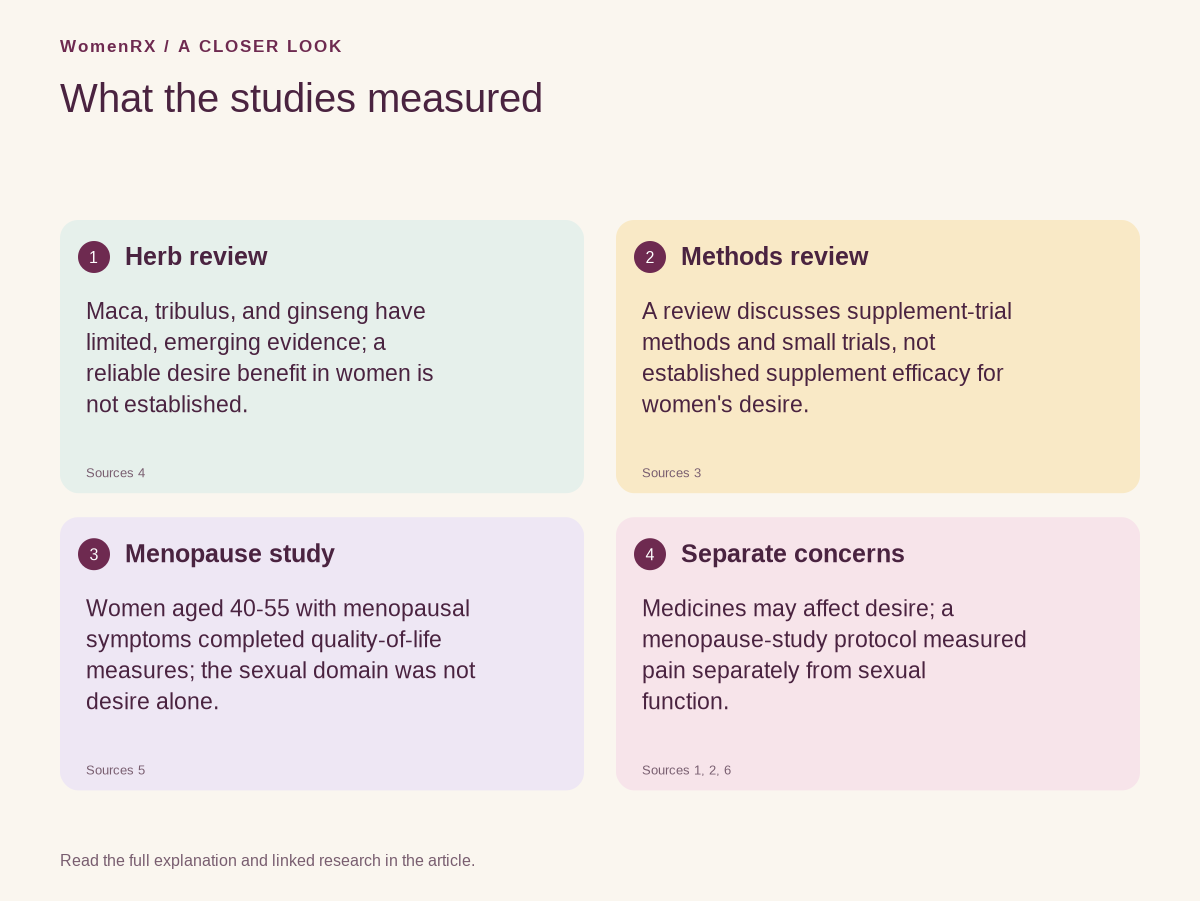
What the studies measured
Herb review: Maca, tribulus, and ginseng have limited, emerging evidence; a reliable desire benefit in women is not established.4
Methods review: A review discusses supplement-trial methods and small trials, not established supplement efficacy for women's desire.3
Menopause study: Women aged 40-55 with menopausal symptoms completed quality-of-life measures; the sexual domain was not desire alone.5
Separate concerns: Medicines may affect desire; a menopause-study protocol measured pain separately from sexual function.126
Read the figure as text
The findings vary by product, population, and outcome. A broad sexual-function score is not the same as a measured increase in desire.- Herb review: Maca, tribulus, and ginseng have limited, emerging evidence; a reliable desire benefit in women is not established.4
- Methods review: A review discusses supplement-trial methods and small trials, not established supplement efficacy for women's desire.3
- Menopause study: Women aged 40-55 with menopausal symptoms completed quality-of-life measures; the sexual domain was not desire alone.5
- Separate concerns: Medicines may affect desire; a menopause-study protocol measured pain separately from sexual function.126
Sources you can check
- Sexual Health | MedlinePlusAccessed 2026-09-25Return to first citation
- Other medicines for menopause symptoms - NHSAccessed 2026-09-25Return to first citation
- Exo-Clinical Trials of Nutritional Supplements for Sexual Dysfunction: Precedents, Principles, and Protocols.Pyke RE. · Sexual medicine reviews · 2019Return to first citation
- Natural Aphrodisiacs-A Review of Selected Sexual Enhancers.West E, Krychman M. · Sexual medicine reviews · 2015Return to first citation
- Effect of Eurycoma longifolia water extract (Physta®) on menopausal quality of life and mood states.Muniandy S, Yahya HM, Shahar S, Kamisan Atan I, Mahdy ZA, Rajab NF, Mohd Rasdi HF, George A, Chinnappan SM. · World journal of clinical cases · 2025Return to first citation
- Effects of Eurycoma longifolia Jack standardised water extract (Physta) on well-being of perimenopausal and postmenopausal women: protocol for a randomised, double-blinded, placebo-controlled, parallel group study.Muniandy S, Yahya HM, Shahar S, Kamisan Atan I, Mahdy ZA, Rajab NF, George A, Chinnappan SM. · BMJ open · 2023Return to first citation