Libido Supplements: What the Evidence Can and Can’t Tell You
A result in men with erectile dysfunction or in a small study of women may not predict what an over-the-counter product will do for your desire.
Evidence for libido supplements in women is limited and depends on the ingredient, the people studied, and what researchers measured. A small trial found better overall sexual-function scores with saffron plus vitamin E than with vitamin E alone in reproductive-age women, but it cannot show that saffron by itself reliably increases desire. Findings in men with erectile dysfunction don’t establish benefits for women. 3 6
First, decide what you want to change
“Low libido” can mean less interest in sex, difficulty becoming aroused, trouble reaching orgasm, or sex that feels uncomfortable. Those are different experiences, and a study showing improvement in one area doesn’t establish improvement in all of them. Sexual desire can also be affected by medicines and chronic health conditions, so the circumstances around the change matter too. 1 4
That makes a supplement claim hard to interpret unless it tells you who was studied and which outcome changed. Ask yourself whether you’re hoping for more interest, easier arousal, less distress, or something else. A product tested for erectile function in men, for example, isn’t automatically a good match for a woman whose main concern is desire.
What studies in women have found
Saffron: One randomized trial studied 50 reproductive-age women with sexual dysfunction over eight weeks. The group taking saffron alongside vitamin E had better overall sexual-function scores than the group taking vitamin E alone; scores for desire, arousal, orgasm, and satisfaction were also higher. But this was a small trial of a combination, not proof that saffron alone works, and the researchers said more study was needed. 6
Maca: A systematic review found only four randomized trials, across different populations and concerns. One reported a positive effect on sexual dysfunction in healthy menopausal women; a positive sexual-desire finding came from a separate trial in healthy adult men. The overall evidence was limited by the small number and size of trials and their methodological quality. These results aren’t a reliable promise for women at other life stages or with different causes of low desire. 5
Herbal blends: A review of plants commonly found in aphrodisiac products marketed in the United States found little to no clinical evidence to support claims for female desire disorders. It also described a basic research problem: botanical ingredients and preparations can vary, making results difficult to compare. A long ingredient list or a confident label claim doesn’t fill that evidence gap. 7
Why findings in men don’t settle the question
A 2026 review pooled 14 randomized trials involving 1,227 men with erectile dysfunction. It reported improvements in several sexual-function measures, including desire, and ingredient-specific findings for ginseng and saffron. But these participants were men being treated for erectile dysfunction. The results don’t establish that these ingredients improve women’s desire, or that they help when a woman’s main concern is unrelated to erectile function. 3
The distinction matters because “sexual function” is not one outcome. Desire, arousal, orgasm, satisfaction, and erectile function are measured separately in research. Look for the exact outcome and population behind a claim, not just the phrase “clinically studied.” 3 4
A practical label and safety check
Before trying a product, use its label to make a short inventory: the ingredient names, amounts, and whether it combines several herbs or other supplements. Then check that full list against your prescription and over-the-counter medicines with a pharmacist or prescriber. Herbal products can interact with medicines, and “natural” doesn’t guarantee safety. They also don’t go through the same testing as drugs. 2
Be especially cautious about treating a supplement as a substitute for reviewing a medicine that may be affecting your sex life. If your desire changed after starting or changing a medicine, including an antidepressant, bring up the timing and the effect that bothers you with the prescriber. Medicines are one recognized factor in sexual health, and the right next step depends on the medicine and your health situation. 1 4
For antidepressant-related sexual problems specifically, a review of 11 studies involving 859 women found low-quality evidence overall. Bupropion improved some sexual-function measures compared with placebo in the two studies that could be combined, but that is prescription-treatment research, not evidence for an over-the-counter herb or an answer about your current prescription. 4
A useful next move is to match the question to the evidence: “Has this ingredient been tested in women like me, for the change I want, and as the same product I’m considering?” If the answer is no or unclear, treat the promised benefit as uncertain rather than assuming a general libido claim applies to you.
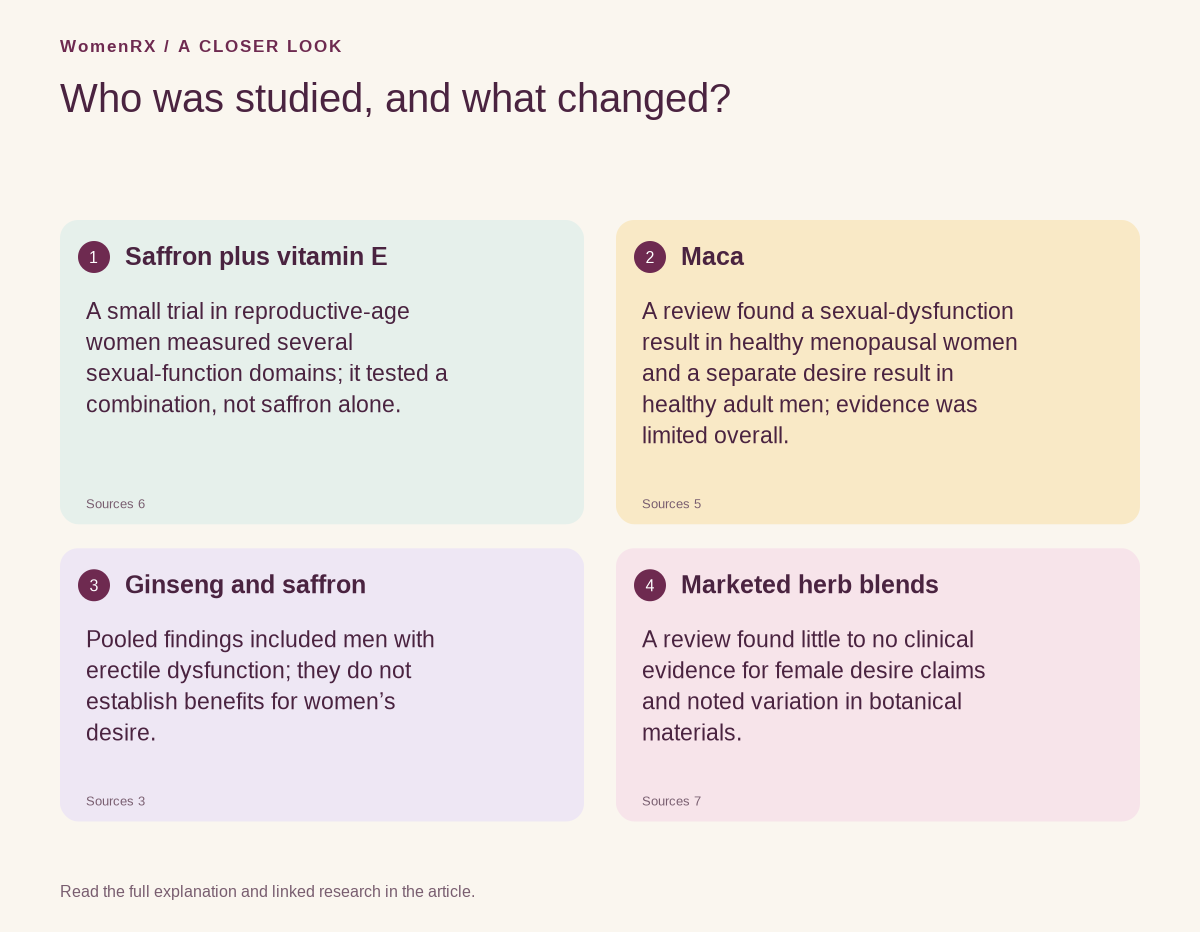
Who was studied, and what changed?
Saffron plus vitamin E: A small trial in reproductive-age women measured several sexual-function domains; it tested a combination, not saffron alone.6
Maca: A review found a sexual-dysfunction result in healthy menopausal women and a separate desire result in healthy adult men; evidence was limited overall.5
Ginseng and saffron: Pooled findings included men with erectile dysfunction; they do not establish benefits for women’s desire.3
Marketed herb blends: A review found little to no clinical evidence for female desire claims and noted variation in botanical materials.7
Read the figure as text
The ingredient name alone doesn’t tell you whether a result applies to your concern. Compare the study population and outcome before weighing a product claim.- Saffron plus vitamin E: A small trial in reproductive-age women measured several sexual-function domains; it tested a combination, not saffron alone.6
- Maca: A review found a sexual-dysfunction result in healthy menopausal women and a separate desire result in healthy adult men; evidence was limited overall.5
- Ginseng and saffron: Pooled findings included men with erectile dysfunction; they do not establish benefits for women’s desire.3
- Marketed herb blends: A review found little to no clinical evidence for female desire claims and noted variation in botanical materials.7
More questions, answered
Does “natural” mean a libido supplement is safe?
No. Herbal products can interact with prescription or over-the-counter medicines, and they don’t go through the same testing as drugs. Check the complete ingredient list against your medicines rather than relying on “natural” as a safety signal. 2
If my desire changed after starting an antidepressant, should I stop it?
Antidepressant-related sexual concerns in women have been studied, but the treatment evidence is low quality. Tell the prescriber what changed and when so you can discuss options that account for both sexual function and the reason you take the medicine. 4
Sources you can check
- Sexual Health | MedlinePlusAccessed 2026-09-25Return to first citation
- Herbal Medicine: MedlinePlusAccessed 2026-09-25Return to first citation
- Herbal dietary supplements for erectile dysfunction: A systematic review and meta-analysis of randomized-controlled trials.Ho CY, Hsu CH, Chien TJ. · Journal of traditional and complementary medicine · 2026Return to first citation
- Pharmacological treatment of antidepressant-induced sexual dysfunction in women: A systematic review and meta-analysis of randomized clinical trials.de Aquino ACQ, Sarmento ACA, Teixeira RLA, Batista TN, de Freitas CL, Mármol JMP, Lara LAS, Gonçalves AK. · Clinics (Sao Paulo, Brazil) · 2025Return to first citation
- Maca (L. meyenii) for improving sexual function: a systematic review.Shin BC, Lee MS, Yang EJ, Lim HS, Ernst E. · BMC complementary and alternative medicine · 2010Return to first citation
- Effect of vitamin E with and without saffron on the sexual function in women of reproductive age with sexual dysfunction: a randomized controlled trial.Izadi S, Mohammad-Alizadeh-Charandabi S, Yadollahi P, Mirghafourvand M. · BMC women's health · 2024Return to first citation
- Medicinal plants/herbal supplements as female aphrodisiacs: Does any evidence exist to support their inclusion or potential in the treatment of FSD?Prescott H, Khan I. · Journal of ethnopharmacology · 2020Return to first citation