Maca for Menopause: What the Evidence Can, and Can’t, Tell You
A small study offers a reason for interest, but it doesn’t establish that maca works or is safe for every woman or every product.
Maca has limited menopause-specific research, including a small pilot study in early postmenopausal women. That study can’t establish broad effectiveness or safety, and it doesn’t tell us whether products with different preparations work the same way. For hot flashes and night sweats, the North American Menopause Society does not recommend supplements or herbal remedies as a group; consider discussing better-supported options if symptoms are bothersome. 2 4
What the maca studies actually show
There is a small amount of human research on maca during menopause, but it leaves important questions open. One double-blind pilot study involved 20 healthy Caucasian women in early postmenopause over three months, and a separate trial involved eight women over nine months. Participants took a specific gelatinized maca root powder. The researchers reported reduced menopausal discomfort, alongside changes in some hormone measurements, but also described a notable placebo effect. A study this small can’t show that maca reliably relieves symptoms, changes hormones in a predictable way, or is safe for a broad range of women. 2
A 2014 review reported that randomized trials had found reductions in vasomotor symptoms with maca. But that finding sits alongside a later, evidence-based North American Menopause Society statement that does not recommend supplements and herbal remedies for hot flashes and night sweats. The practical takeaway is not that one source proves maca works and the other proves it never can. It’s that the evidence has not led the menopause guideline panel to recommend supplements as a dependable treatment for these symptoms. 1 4
The pilot focused on women who were already postmenopausal. It doesn’t establish what maca does during perimenopause, when menstrual cycles and symptoms may still be changing. Nor do the reported hormone changes show that maca can replace hormone therapy or produce the same benefits. 2 3
A study product is not every maca product
The pilot tested gelatinized maca root powder in capsules. Its findings shouldn’t automatically be applied to raw powder, extracts, blends, or products with different ingredients. The study describes one preparation; it doesn’t establish that other forms are equivalent. 2
If you’re weighing a product, check whether its label clearly identifies the maca ingredient and preparation, and whether it contains other active ingredients. These details help you and a pharmacist or clinician discuss what you’re considering. They don’t prove that a product matches the one in the study or that it will help.
Safety and medicines: what to ask
The menopause study was too small to settle safety for people with different health histories or medication regimens. It also doesn’t provide a reliable list of medicines that do or don’t interact with maca. That means it’s better not to treat “natural” or traditional use as proof that a supplement is safe for you, or to assume an interaction is established when it isn’t.
Before trying maca, bring the exact product label and a current list of prescription medicines, over-the-counter medicines, and other supplements to a pharmacist or clinician. Include relevant health conditions and your menopause stage. Ask whether the ingredients raise a concern for you and whether they could complicate a treatment you already use. The point is to check your particular situation, not to suggest that maca is known to interact with every medicine.
Choose based on the symptom you want to treat
If hot flashes or night sweats are bothering you, maca is not among the supplement approaches recommended by the North American Menopause Society. The statement lists cognitive behavioral therapy, clinical hypnosis, several prescription options, and weight loss among evidence-supported approaches, with evidence levels varying by option. Hormone therapy remains the most effective treatment for vasomotor symptoms; its benefits and risks depend on personal factors and should be considered individually. 3 4
For vaginal or urinary symptoms associated with menopause, the hormone therapy position statement discusses options that differ from treatments for hot flashes. If those symptoms are your main concern, say so when you discuss care rather than assuming a supplement studied for general menopausal discomfort will address them. 3
If your symptoms are bothersome, are changing, or you’re unsure whether they fit the menopause transition, a clinician can help assess the cause and discuss options. You don’t have to try maca first. A useful question is: “Given my symptoms, health history, and medicines, what benefits and tradeoffs should I compare with this supplement?”
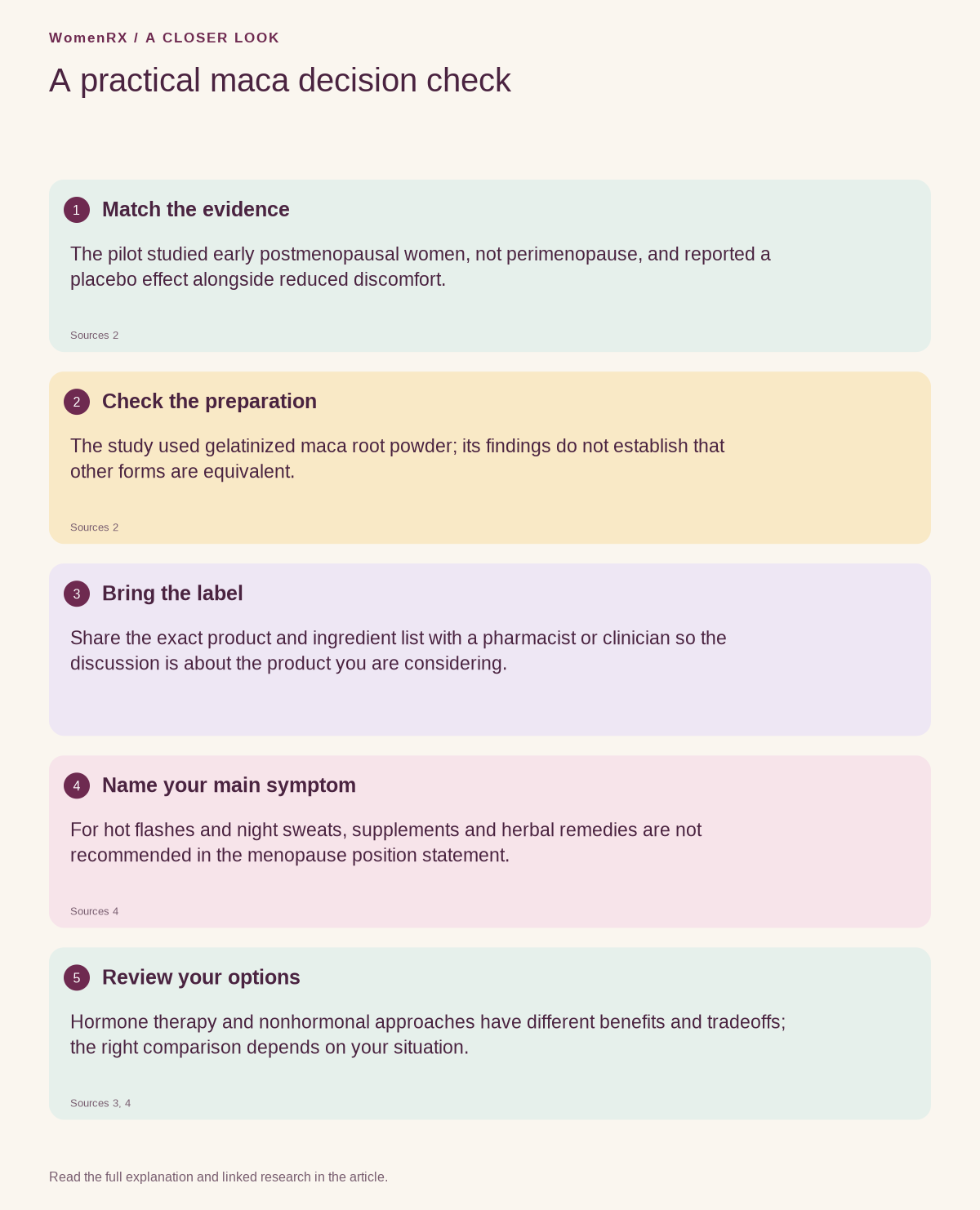
A practical maca decision check
Match the evidence: The pilot studied early postmenopausal women, not perimenopause, and reported a placebo effect alongside reduced discomfort.2
Check the preparation: The study used gelatinized maca root powder; its findings do not establish that other forms are equivalent.2
Bring the label: Share the exact product and ingredient list with a pharmacist or clinician so the discussion is about the product you are considering.
Name your main symptom: For hot flashes and night sweats, supplements and herbal remedies are not recommended in the menopause position statement.4
Review your options: Hormone therapy and nonhormonal approaches have different benefits and tradeoffs; the right comparison depends on your situation.34
Read the figure as text
Use these questions to separate what the menopause evidence shows from what still needs a personal discussion.- Match the evidence: The pilot studied early postmenopausal women, not perimenopause, and reported a placebo effect alongside reduced discomfort.2
- Check the preparation: The study used gelatinized maca root powder; its findings do not establish that other forms are equivalent.2
- Bring the label: Share the exact product and ingredient list with a pharmacist or clinician so the discussion is about the product you are considering.
- Name your main symptom: For hot flashes and night sweats, supplements and herbal remedies are not recommended in the menopause position statement.4
- Review your options: Hormone therapy and nonhormonal approaches have different benefits and tradeoffs; the right comparison depends on your situation.34
More questions, answered
Can maca replace menopause hormone therapy?
The maca pilot does not show that maca can replace hormone therapy. The North American Menopause Society identifies hormone therapy as the most effective treatment for vasomotor symptoms and recommends individualizing decisions about its benefits and risks. 2 3
Does maca work for perimenopause?
The small menopause pilot studied women in early postmenopause, so it does not establish whether maca helps during perimenopause. 2
Sources you can check
- Herbal preparations for the menopause: beyond isoflavones and black cohosh.Depypere HT, Comhaire FH. · Maturitas · 2014Return to first citation
- Use of gelatinized maca (lepidium peruvianum) in early postmenopausal women.Meissner HO, Kapczynski W, Mscisz A, Lutomski J. · International journal of biomedical science : IJBS · 2005Return to first citation
- The 2022 hormone therapy position statement of The North American Menopause Society.“The 2022 Hormone Therapy Position Statement of The North American Menopause Society” Advisory Panel. · Menopause (New York, N.Y.) · 2022Return to first citation
- The 2023 nonhormone therapy position statement of The North American Menopause Society.Menopause (New York, N.Y.) · 2023Return to first citation