Does Maca Help With Menopause Symptoms?
Small studies suggest possible changes in some symptom scores, but they don’t establish maca as a reliable treatment for hot flashes.
Maca has been tested in small studies of perimenopausal and postmenopausal women. Some reported improvements in overall menopause scores, psychological symptoms, or sexual-function measures, but the evidence is too limited to show dependable relief for a specific symptom such as hot flashes. Two small postmenopausal trials reported no differences in the hormone levels they measured. 1 2 3
What maca has been tested for
Maca is a plant supplement, but the menopause research doesn’t show one clear, well-established effect. A systematic review found four randomized trials in healthy perimenopausal and early- or late-postmenopausal women. The studies used broad menopause questionnaires, including the Kupperman Menopausal Index and Greene Climacteric Scale, and the review found favorable changes in scores. But the trials were few, small overall, and limited in quality, so the reviewers said the evidence wasn’t strong enough for firm conclusions. 2
That distinction matters: an improved score across a broad questionnaire doesn’t tell you that maca reliably eases a particular symptom. The evidence doesn’t establish how consistently women experienced relief from hot flashes, sleep problems, or other individual concerns.
What the smaller trials found
In one randomized, placebo-controlled crossover trial, 14 postmenopausal women took maca and placebo in separate six-week periods. Their scores for psychological symptoms, including anxiety and depression, and sexual dysfunction improved during maca compared with both their baseline and placebo scores. The trial did not find differences in measured estradiol, follicle-stimulating hormone, luteinizing hormone, or sex hormone-binding globulin. 1
A second crossover trial involved 29 postmenopausal women in Hong Kong. It measured menopause symptoms and quality of life using several questionnaires. The researchers reported a decrease in depression after maca treatment, but the study’s reported findings don’t establish that depression scores were lower than during placebo. It also reported no differences in several measured hormones, including estradiol and follicle-stimulating hormone. 3
These findings are signals worth distinguishing from proof. The studies were small, and their results don’t establish that maca treats depression or sexual concerns in menopause. They also don’t establish how the findings apply if you’re already using hormone therapy or another treatment.
Hot flashes are the key evidence gap
A review describes randomized trials as finding reductions in vasomotor symptoms, the term that includes hot flashes and night sweats. 4 However, a systematic review found only four eligible trials and judged the overall evidence too limited to draw firm conclusions. 2 The North American Menopause Society’s 2023 nonhormone therapy statement does not recommend supplements or herbal remedies for vasomotor symptoms. 6
So if hot flashes are the reason you’re considering maca, the evidence doesn’t support counting on it for dependable relief. This doesn’t prove maca cannot help any individual; it means the research hasn’t established a reliable benefit for this symptom.
How it compares with established options
For bothersome hot flashes, hormone therapy remains the most effective treatment, and its benefits and risks depend on individual factors such as age, time since menopause, and health history. 5 If hormone therapy isn’t a fit or isn’t your preference, the 2023 North American Menopause Society statement recommends several evidence-supported nonhormone options, including cognitive behavioral therapy, clinical hypnosis, certain prescription medicines, and weight loss for some people. 6
Maca shouldn’t be treated as a substitute for these options. Safety has not been established well enough in the small menopause trials to assume a supplement is harmless or suitable for everyone. 2 If you’re weighing it, the useful question is not simply whether maca is “for menopause,” but which symptom you want to address and whether that symptom has been shown to improve in a controlled trial.
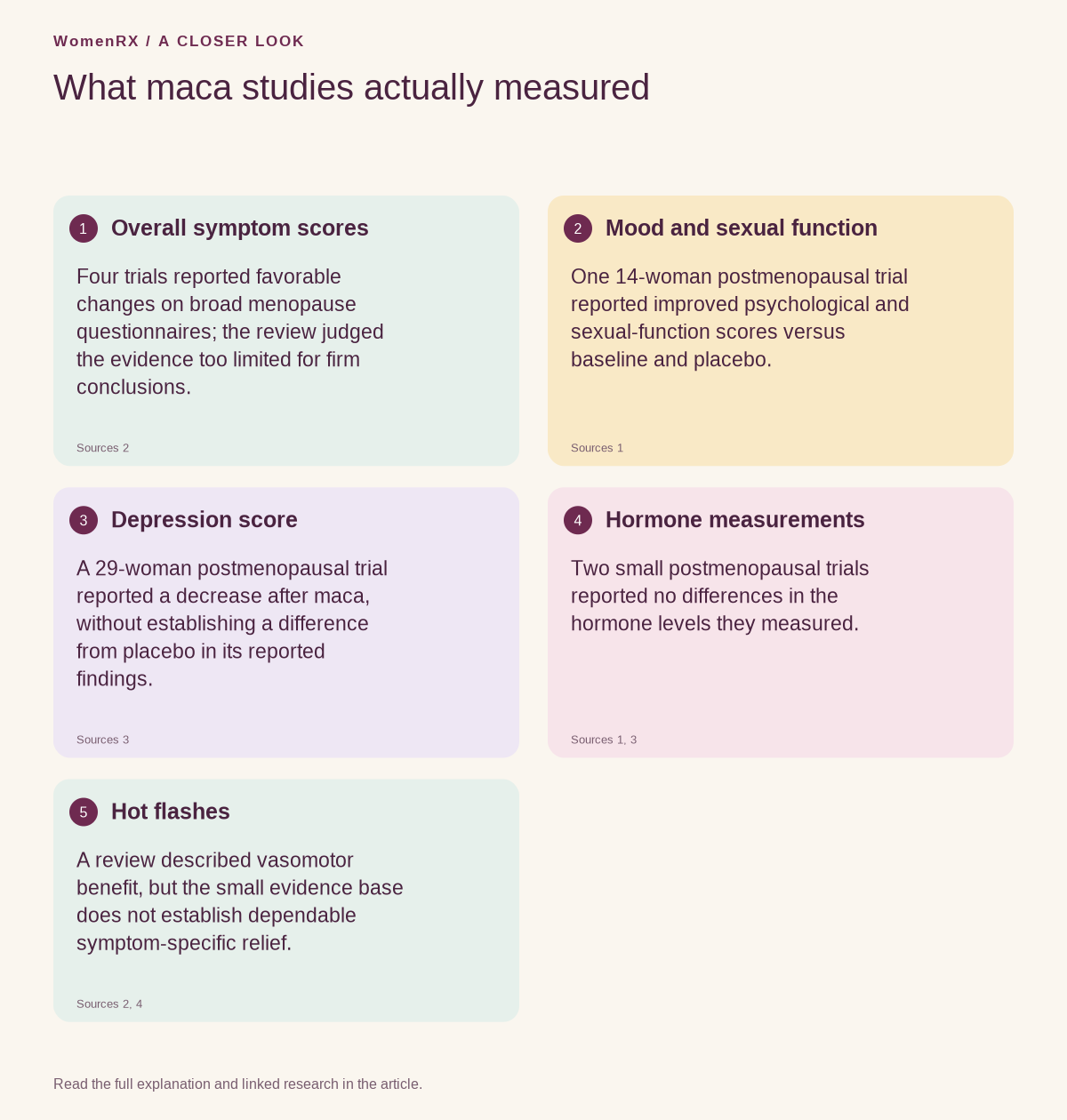
What maca studies actually measured
Overall symptom scores: Four trials reported favorable changes on broad menopause questionnaires; the review judged the evidence too limited for firm conclusions.2
Mood and sexual function: One 14-woman postmenopausal trial reported improved psychological and sexual-function scores versus baseline and placebo.1
Depression score: A 29-woman postmenopausal trial reported a decrease after maca, without establishing a difference from placebo in its reported findings.3
Hormone measurements: Two small postmenopausal trials reported no differences in the hormone levels they measured.13
Hot flashes: A review described vasomotor benefit, but the small evidence base does not establish dependable symptom-specific relief.24
Read the figure as text
The menopause evidence includes broad symptom scores and a few specific outcomes, but the measures don’t establish reliable relief for each symptom.- Overall symptom scores: Four trials reported favorable changes on broad menopause questionnaires; the review judged the evidence too limited for firm conclusions.2
- Mood and sexual function: One 14-woman postmenopausal trial reported improved psychological and sexual-function scores versus baseline and placebo.1
- Depression score: A 29-woman postmenopausal trial reported a decrease after maca, without establishing a difference from placebo in its reported findings.3
- Hormone measurements: Two small postmenopausal trials reported no differences in the hormone levels they measured.13
- Hot flashes: A review described vasomotor benefit, but the small evidence base does not establish dependable symptom-specific relief.24
More questions, answered
Does maca raise estrogen levels?
In two small postmenopausal trials, researchers reported no differences in the hormone levels they measured, including estradiol. That doesn’t establish how every maca product affects every person, but these trial findings don’t support describing maca as a proven way to raise estrogen. 1 3
Is maca recommended for hot flashes?
The 2023 North American Menopause Society statement does not recommend supplements or herbal remedies for vasomotor symptoms. It lists other hormone and nonhormone options, including hormone therapy, cognitive behavioral therapy, clinical hypnosis, and certain prescription medicines. 5 6
Sources you can check
- Beneficial effects of Lepidium meyenii (Maca) on psychological symptoms and measures of sexual dysfunction in postmenopausal women are not related to estrogen or androgen content.Brooks NA, Wilcox G, Walker KZ, Ashton JF, Cox MB, Stojanovska L. · Menopause (New York, N.Y.) · 2008Return to first citation
- Maca (Lepidium meyenii) for treatment of menopausal symptoms: A systematic review.Lee MS, Shin BC, Yang EJ, Lim HJ, Ernst E. · Maturitas · 2011Return to first citation
- Maca reduces blood pressure and depression, in a pilot study in postmenopausal women.Stojanovska L, Law C, Lai B, Chung T, Nelson K, Day S, Apostolopoulos V, Haines C. · Climacteric : the journal of the International Menopause Society · 2015Return to first citation
- Herbal preparations for the menopause: beyond isoflavones and black cohosh.Depypere HT, Comhaire FH. · Maturitas · 2014Return to first citation
- The 2022 hormone therapy position statement of The North American Menopause Society.“The 2022 Hormone Therapy Position Statement of The North American Menopause Society” Advisory Panel. · Menopause (New York, N.Y.) · 2022Return to first citation
- The 2023 nonhormone therapy position statement of The North American Menopause Society.Menopause (New York, N.Y.) · 2023Return to first citation