Does Maca Change Hormone Levels in Women?
A small trial in postmenopausal women found no measurable change in several hormones, even though it assessed symptoms too.
Maca hasn’t been shown to “balance” hormone levels in women. In a small placebo-controlled study of postmenopausal women, researchers measured estradiol, FSH, SHBG and TSH and found no significant differences with maca. A change in a symptom, such as mood, wouldn’t by itself show that hormone levels changed. Evidence in other reproductive stages is not established by this study. 5
What the women’s study actually measured
The most directly relevant human study in women was a randomized, double-blind, placebo-controlled crossover trial in 29 postmenopausal Chinese women. Participants received maca or placebo for six weeks each. Researchers measured estradiol, follicle-stimulating hormone (FSH), sex hormone-binding globulin (SHBG) and thyroid-stimulating hormone (TSH), alongside menopausal symptoms and quality-of-life measures. They found no significant differences in those hormone measurements between maca and placebo. 5
The trial did report lower diastolic blood pressure and depression scores after maca. Those are findings about outcomes the study measured, not evidence that maca changed hormones. The study was small and short, so its results don’t settle every possible effect, but they don’t support a claim that maca corrected hormone levels in the women studied. 5
Hormone effects and symptom effects aren’t interchangeable
“Hormone balance” can sound like one clear, measurable result, but it isn’t a specific clinical outcome. A study can test whether a particular hormone changes, whether a symptom improves, or both. In the postmenopausal trial, the researchers assessed both: the measured hormones did not differ significantly, while some symptom scores did. That distinction matters if you’re considering maca specifically to change estrogen, progesterone or another hormone. The trial did not measure progesterone. 5
A symptom change alone can’t tell you what happened to a hormone. Mood, sleep, sexual well-being and other experiences can have more than one influence. The study’s reported depression-score finding, for example, doesn’t establish an endocrine mechanism. 5
What studies in men add, and what they can’t answer
Two small human trials in men also measured reproductive hormones and found no significant hormone changes with maca. One randomized trial followed healthy men for 12 weeks and measured hormones including testosterone, estradiol, LH and FSH; a pilot trial in 20 healthy men measured reproductive and thyroid hormones over 12 weeks. These findings are consistent with no demonstrated hormone effect in those men, but they cannot establish what happens in women. 1 3
The women’s postmenopausal trial is more relevant to the question about women, but it doesn’t represent every stage of life. This evidence doesn’t establish effects in people who are still cycling, in perimenopause, during pregnancy or postpartum. Nor does one small postmenopausal study show that every maca preparation has the same effect. 5
Why animal findings don’t prove a human hormone benefit
Some animal studies have reported changes in reproductive hormones. For example, a study in female rats found higher LH and FSH under particular experimental conditions, while a study in ovariectomized rats reported changes in some hormone measurements after a specific ethanol extract. These findings may suggest questions for research, but they are not results in women. The animals, preparations and study conditions differ from a human supplement trial, so they can’t show that maca raises or balances hormones in women. 2 4
The practical takeaway
If your reason for considering maca is a specific hormone change, the evidence in women doesn’t currently show that it delivers one. If your goal is relief from a symptom, keep that question separate: the small postmenopausal study reported some symptom-score changes, but it did not show that those changes came from altered hormones, and the results don’t establish benefits across reproductive stages. 5
So, the clearest answer is narrow: maca did not significantly change the hormones measured in one small study of postmenopausal women. That is different from proving it can never affect any hormone, and it is not evidence that it balances estrogen or progesterone.
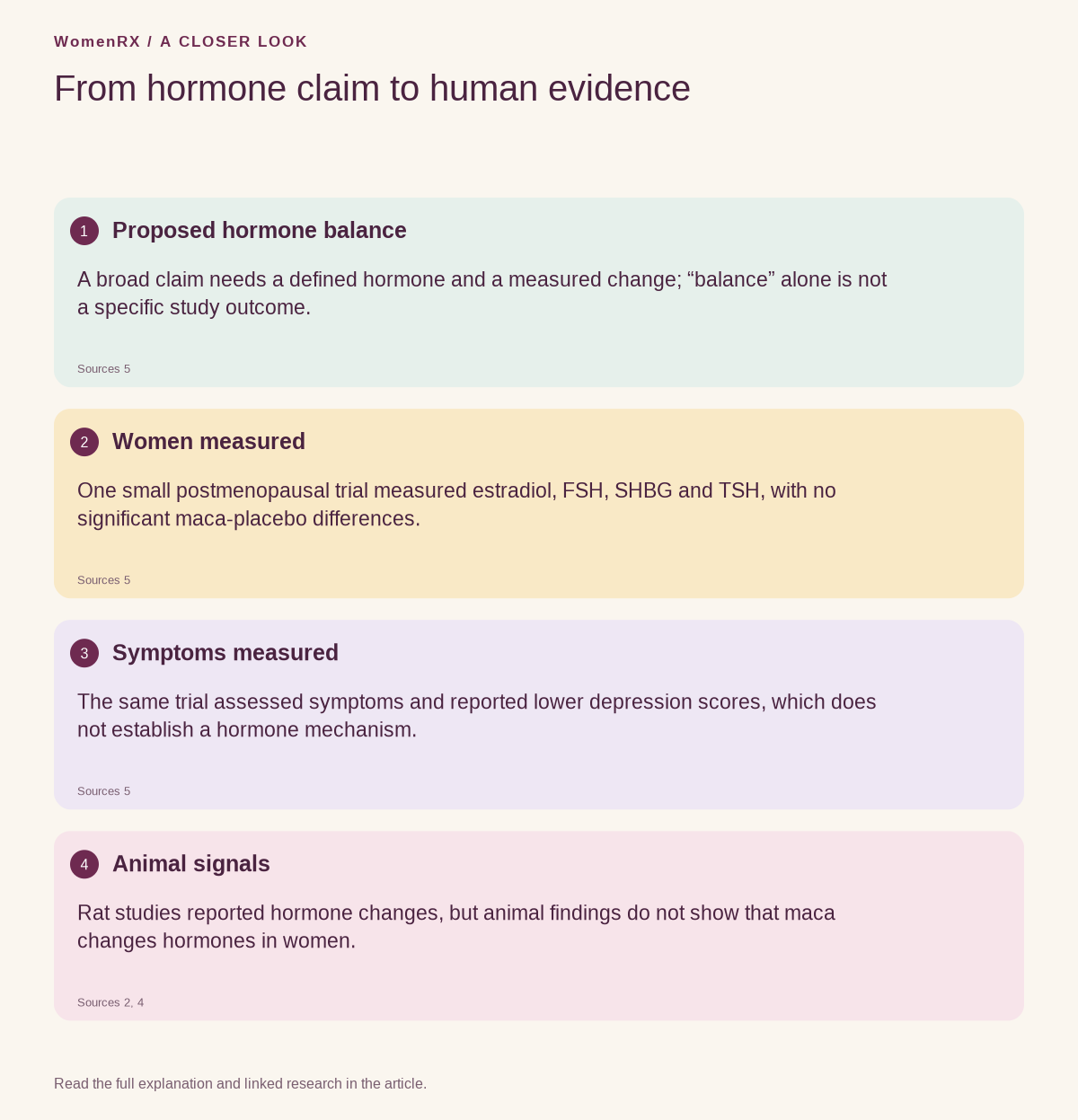
From hormone claim to human evidence
Proposed hormone balance: A broad claim needs a defined hormone and a measured change; “balance” alone is not a specific study outcome.5
Women measured: One small postmenopausal trial measured estradiol, FSH, SHBG and TSH, with no significant maca-placebo differences.5
Symptoms measured: The same trial assessed symptoms and reported lower depression scores, which does not establish a hormone mechanism.5
Animal signals: Rat studies reported hormone changes, but animal findings do not show that maca changes hormones in women.24
Read the figure as text
A simple map of the gap between a proposed endocrine effect and the outcomes actually tested in people.- Proposed hormone balance: A broad claim needs a defined hormone and a measured change; “balance” alone is not a specific study outcome.5
- Women measured: One small postmenopausal trial measured estradiol, FSH, SHBG and TSH, with no significant maca-placebo differences.5
- Symptoms measured: The same trial assessed symptoms and reported lower depression scores, which does not establish a hormone mechanism.5
- Animal signals: Rat studies reported hormone changes, but animal findings do not show that maca changes hormones in women.24
More questions, answered
Did the study in postmenopausal women measure progesterone?
No. It measured estradiol, FSH, SHBG and TSH, among other outcomes; progesterone was not listed among the hormones measured. 5
Does a change in mood mean maca changed hormones?
Not by itself. In the postmenopausal trial, depression scores changed while the measured hormone levels did not differ significantly between maca and placebo. The study did not establish why the score changed. 5
Sources you can check
- Effect of Lepidium meyenii (Maca), a root with aphrodisiac and fertility-enhancing properties, on serum reproductive hormone levels in adult healthy men.Gonzales GF, Córdova A, Vega K, Chung A, Villena A, Góñez C. · The Journal of endocrinology · 2003Return to first citation
- Effect of ethanolic extract of Lepidium meyenii Walp on serum hormone levels in ovariectomized rats.Zhang Y, Yu L, Jin W, Ao M. · Indian journal of pharmacology · 2014Return to first citation
- Effect of Lepidium meyenii Walp. on Semen Parameters and Serum Hormone Levels in Healthy Adult Men: A Double-Blind, Randomized, Placebo-Controlled Pilot Study.Melnikovova I, Fait T, Kolarova M, Fernandez EC, Milella L. · Evidence-based complementary and alternative medicine : eCAM · 2015Return to first citation
- Lepidium meyenii (Maca) enhances the serum levels of luteinising hormone in female rats.Uchiyama F, Jikyo T, Takeda R, Ogata M. · Journal of ethnopharmacology · 2014Return to first citation
- Maca reduces blood pressure and depression, in a pilot study in postmenopausal women.Stojanovska L, Law C, Lai B, Chung T, Nelson K, Day S, Apostolopoulos V, Haines C. · Climacteric : the journal of the International Menopause Society · 2015Return to first citation