Maca After 40: What Menopause Studies Actually Show
A few studies tested one specific maca preparation in early-postmenopausal women, but that’s not the same as proving maca benefits everyone over 40.
The human evidence is narrow: studies in early-postmenopausal women found that a specific pre-gelatinized maca preparation was associated with improved menopause symptom scores over a few months. The findings don’t establish that other maca products work, that maca helps during perimenopause, or that age 40 is a reason to take it. 1 2
Maca has been studied in women at a similar life stage to some people over 40, but the evidence doesn’t support a general “maca for women over 40” benefit. The most relevant trials enrolled women described as early-postmenopausal and tested one particular processed preparation. Their results are a limited signal for menopause symptoms, not proof that maca is an established treatment or that it works for every product or concern.
Who was actually studied?
A relevant human study enrolled 168 Caucasian women described as early-postmenopausal, all older than 49 and meeting the study’s blood-hormone criteria. A total of 124 completed the study. Participants were assigned to different monthly treatment sequences involving both pre-gelatinized organic maca, called Maca-GO, and placebo over three or four months. 1
That’s more specific than simply enrolling women “over 40.” The results don’t tell us whether maca helps women in their 40s who are still cycling, or whether any effect differs between perimenopause and postmenopause. A smaller earlier pilot also focused on early-postmenopausal women. 2
What did the trials measure?
The larger trial used questionnaires to assess menopause symptoms, including hot flashes and night sweating, and reported improvement in symptom scores during maca treatment compared with placebo. Researchers also measured blood hormone levels. Those measurements are not, by themselves, proof that a product “balances hormones” in a way that reliably improves health or symptoms. 1
It’s also worth noticing that symptoms improved during some placebo periods. In the smaller pilot, the researchers described a placebo effect as well as reductions in reported discomfort. That doesn’t rule out a maca effect, but it makes the comparison with placebo especially important when interpreting the results. 1 2
The preparation matters
These studies tested Maca-GO, a specific pre-gelatinized powder preparation. They don’t establish that raw maca, a different processed powder, an extract, or a supplement with a different formulation will have the same effects. The results also don’t show that a typical product label can be treated as equivalent to the preparation used in the trials. 1 2
This is the practical tradeoff: the research gives a reason to ask further questions about this specific preparation and menopause symptoms, but not a solid basis for choosing maca generally or expecting an age-related benefit.
Is it worth considering after 40?
If you’re considering maca for hot flashes or night sweats after menopause, these studies are more relevant than research in animals or in unrelated groups. Still, the human findings come from a narrow set of studies published in 2005 and 2006, largely within the same research program. They don’t establish maca as a proven menopause treatment. 1 2
If you’re in perimenopause, these trials don’t directly answer whether maca helps you. And if your reason is energy, libido, weight, bone health, or “hormone balance,” these menopause-symptom studies don’t establish a benefit for those goals. The useful question isn’t just whether a bottle says maca; it’s whether research tested the same life stage, preparation, and outcome you care about.
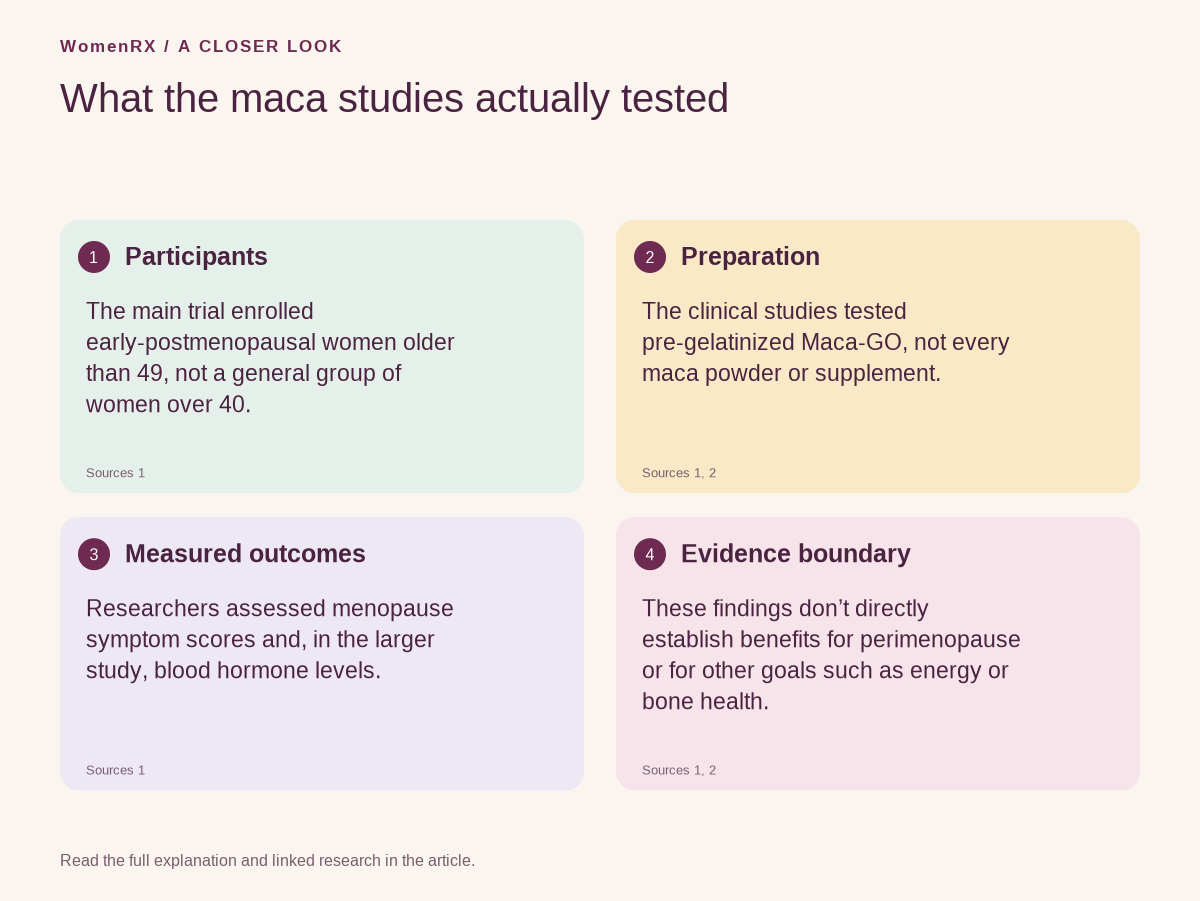
What the maca studies actually tested
Participants: The main trial enrolled early-postmenopausal women older than 49, not a general group of women over 40.1
Preparation: The clinical studies tested pre-gelatinized Maca-GO, not every maca powder or supplement.12
Measured outcomes: Researchers assessed menopause symptom scores and, in the larger study, blood hormone levels.1
Evidence boundary: These findings don’t directly establish benefits for perimenopause or for other goals such as energy or bone health.12
Read the figure as text
The research is tied to a particular life stage, preparation, and set of menopause symptoms.- Participants: The main trial enrolled early-postmenopausal women older than 49, not a general group of women over 40.1
- Preparation: The clinical studies tested pre-gelatinized Maca-GO, not every maca powder or supplement.12
- Measured outcomes: Researchers assessed menopause symptom scores and, in the larger study, blood hormone levels.1
- Evidence boundary: These findings don’t directly establish benefits for perimenopause or for other goals such as energy or bone health.12
More questions, answered
Does the evidence apply to perimenopause?
The human studies described here enrolled early-postmenopausal women. They don’t directly establish whether maca helps during perimenopause. 1 2
Did the studies test maca supplements generally?
No. The studies tested a particular pre-gelatinized preparation called Maca-GO, so their findings can’t automatically be applied to every powder, extract, or supplement sold as maca. 1 2
Sources you can check
- Hormone-Balancing Effect of Pre-Gelatinized Organic Maca (Lepidium peruvianum Chacon): (II) Physiological and Symptomatic Responses of Early-Postmenopausal Women to Standardized doses of Maca in Double Blind, Randomized, Placebo-Controlled, Multi-Centre Clinical Study.Meissner HO, Mscisz A, Reich-Bilinska H, Kapczynski W, Mrozikiewicz P, Bobkiewicz-Kozlowska T, Kedzia B, Lowicka A, Barchia I. · International journal of biomedical science : IJBS · 2006Return to first citation
- Use of gelatinized maca (lepidium peruvianum) in early postmenopausal women.Meissner HO, Kapczynski W, Mscisz A, Lutomski J. · International journal of biomedical science : IJBS · 2005Return to first citation