Maca Root and Weight: What Human Studies Show
Human studies haven’t shown that maca reliably changes body weight, and the small study in perimenopausal women gives mixed results.
The human evidence doesn’t establish maca as a way to lose or gain weight. In a 12-week randomized trial in men, weight change wasn’t significantly different between maca and placebo. A small perimenopausal-women pilot’s abstract describes a weight reduction, but its fuller results say a specific crossover comparison was not statistically significant. The studies don’t establish effects on appetite or body composition. 2 3
What the human weight studies found
The clearest comparison comes from a randomized, placebo-controlled trial of gelatinized maca in men with symptoms of late-onset hypogonadism. Eighty men completed the 12-week study. Researchers measured body weight and waist circumference, but the change in body weight did not differ significantly between the maca and placebo groups. This trial doesn’t show that maca caused weight loss or gain. 2
The study was designed to evaluate symptoms related to late-onset hypogonadism, not to test maca as a weight-management treatment. Its participants were men, so it cannot tell you whether women respond differently. 2
A much smaller pilot study did include women: 20 perimenopausal participants, ages 41-50, took pre-gelatinized maca and placebo in a four-month crossover trial. The abstract describes a reduction in body weight during maca use. The fuller results, however, say that the crossover did not significantly affect weight compared with the pre-crossover measurement; they describe only a tendency for weight to decrease with maca and increase with placebo. These are different descriptions of the weight findings, so the study doesn’t establish an overall weight effect in perimenopausal women. 3
Weight isn’t the same as body composition
A scale measures total body mass. It can’t tell you how much of that mass is fat, muscle, bone, or water. 1 The men’s trial also measured waist circumference, but the human studies don’t establish that maca changes body fat, muscle, or appetite. A change in one measurement shouldn’t be taken as proof of a change in another. 2 3
That distinction matters when interpreting claims about “fat loss.” The available human findings don’t demonstrate that maca changes body composition, even if a product or a general claim connects maca with energy, hormones, or another outcome. Those are separate questions from whether people lose weight while taking it.
What animal results can and can’t tell you
A study in male and female rats reported different weight patterns depending on sex, dose, and study duration. That is a preclinical finding in animals. It can’t establish that maca changes weight in women or men. 4 Human weight findings need to come from human studies, not from assuming an animal result will apply to people.
A practical way to read the claim
If you’re considering maca specifically to change your weight, the human studies here don’t provide a reliable reason to expect that result. The women’s pilot is very small, and its abstract and fuller results describe weight findings differently. The larger randomized trial in men found no significant difference in weight change between groups. 2 3
If your weight is changing without you trying, maca research doesn’t explain the cause. Body weight can reflect several things, and an unexpected change is worth discussing with your care team, as MedlinePlus advises. 1
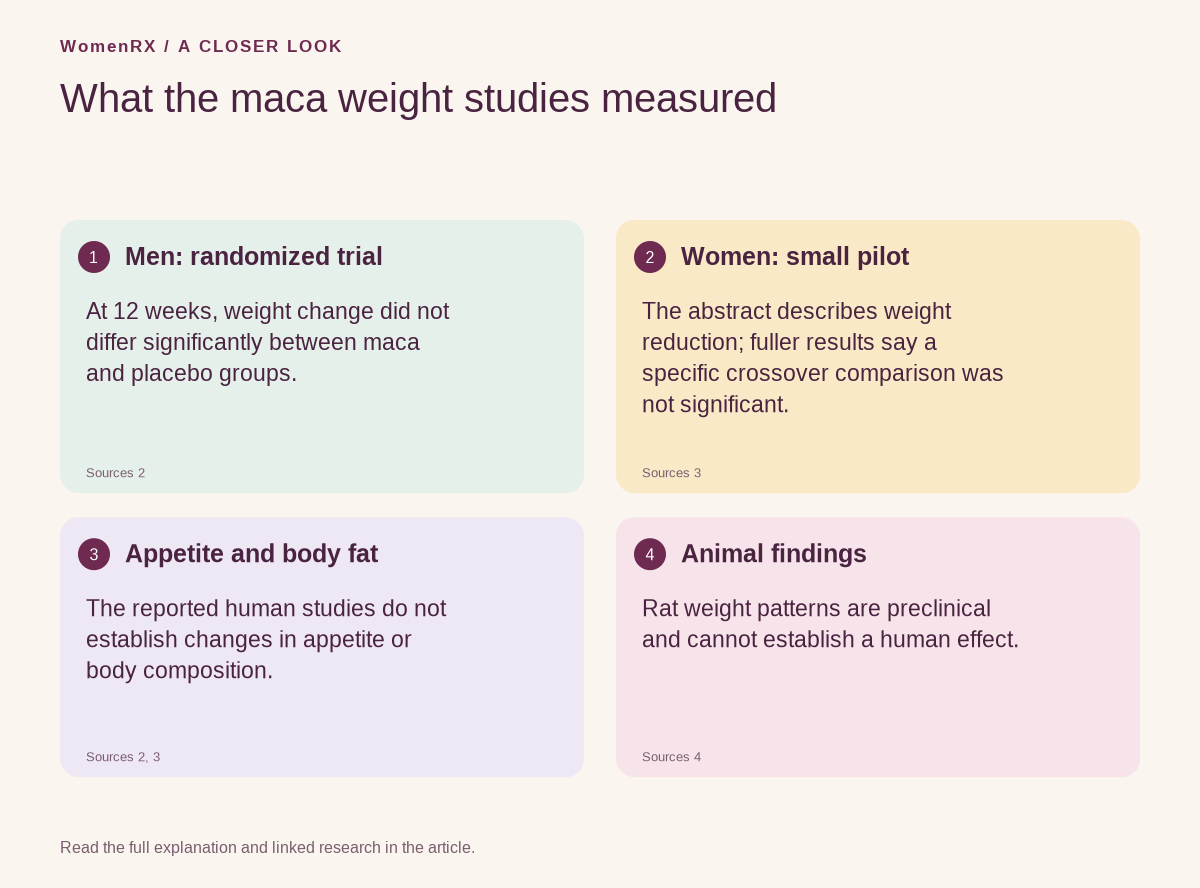
What the maca weight studies measured
Men: randomized trial: At 12 weeks, weight change did not differ significantly between maca and placebo groups.2
Women: small pilot: The abstract describes weight reduction; fuller results say a specific crossover comparison was not significant.3
Appetite and body fat: The reported human studies do not establish changes in appetite or body composition.23
Animal findings: Rat weight patterns are preclinical and cannot establish a human effect.4
Read the figure as text
This evidence map distinguishes the human studies from animal findings and shows what their measurements can, and can’t, answer.- Men: randomized trial: At 12 weeks, weight change did not differ significantly between maca and placebo groups.2
- Women: small pilot: The abstract describes weight reduction; fuller results say a specific crossover comparison was not significant.3
- Appetite and body fat: The reported human studies do not establish changes in appetite or body composition.23
- Animal findings: Rat weight patterns are preclinical and cannot establish a human effect.4
More questions, answered
Has maca been shown to reduce appetite?
The human weight studies described here don’t establish an appetite effect. They report weight measurements; the men’s trial also measured waist circumference. These studies don’t show that maca reliably changes how much people eat. 2 3
Sources you can check
- Body Weight: MedlinePlusAccessed 2026-09-25Return to first citation
- Efficacy and Safety of Maca (Lepidium meyenii) in Patients with Symptoms of Late-Onset Hypogonadism: A Randomized, Double-Blind, Placebo-Controlled Clinical Trial.Shin D, Jeon SH, Piao J, Park HJ, Tian WJ, Moon DG, Ahn ST, Jeon KH, Zhu GQ, Park I, Park HJ, Bae WJ, Cho HJ, Hong SH, Kim SW. · The world journal of men's health · 2023Return to first citation
- Therapeutic Effects of Pre-Gelatinized Maca (Lepidium Peruvianum Chacon) used as a Non-Hormonal Alternative to HRT in Perimenopausal Women - Clinical Pilot Study.Meissner HO, Reich-Bilinska H, Mscisz A, Kedzia B. · International journal of biomedical science : IJBS · 2006Return to first citation
- Short and long-term physiological responses of male and female rats to two dietary levels of pre-gelatinized maca (lepidium peruvianum chacon).Meissner HO, Kedzia B, Mrozikiewicz PM, Mscisz A. · International journal of biomedical science : IJBS · 2006Return to first citation