Maca Root Benefits: What Human Studies Actually Tested
Maca has been studied most directly for menopause symptoms, but the findings come from a small set of trials using a particular preparation.
Human studies have tested maca for menopause symptoms and measured hormone levels, mainly in small or older trials of a specific pre-gelatinized product. One early-postmenopausal study reported a Kupperman’s Index change from 22 to 10; a small perimenopausal pilot reported improvement in menopause-related discomfort. These group-level findings don’t predict an individual response or establish maca as a reliable treatment. 46
What about claims that maca helps energy, mood, sex drive, fertility, or menopause symptoms? Human research has tested some of those ideas more directly than others. The clearest women-specific studies focus on menopause symptoms, and their results deserve a closer look rather than a broad promise.
Menopause symptoms: promising reports, limited footing
A 2006 randomized, double-blind, placebo-controlled multicenter study enrolled 168 early-postmenopausal women. Participants received pre-gelatinized organic maca or placebo for three or four months; 124 completed the study. The researchers assessed symptoms with menopause scoring tools and reported improvements, including in hot flashes and night sweats, among women taking maca. They also reported changes in some measured hormone levels. 6
A separate 2006 crossover pilot study involved 20 perimenopausal women, ages 41 to 50, and lasted four months. It reported improvements in menopause-related discomfort during maca treatment. A further crossover study in 34 early-postmenopausal women also reported symptom improvement. 47
The early-postmenopausal study reported that the Kupperman’s Index fell from 22 to 10. The perimenopausal pilot also reported symptom improvement, but its abstract does not give a clear, interpretable estimate of how large that improvement was. These are group-level study findings, not the benefit a particular woman should expect or proof that the changes were clinically meaningful for her. The trials were small or had substantial loss to follow-up, and they studied a particular pre-gelatinized maca preparation, not every powder, capsule, or blend sold as maca. 46
There’s another important distinction: researchers measured changes in hormones in some studies, but that is not the same as proving that maca “balances hormones,” or that a hormone change caused symptom relief. Those studies can’t support a general promise that maca restores hormones to an ideal level. 467
For hot flashes and night sweats, the North American Menopause Society’s 2023 evidence statement does not recommend supplements or herbal remedies. That broader recommendation helps put the older maca reports in context: they haven’t established maca as a reliable option for these symptoms. 2
Energy and mood: claims outpace the research
The women’s trials described above assessed menopause symptoms and, in some cases, hormone measurements. They don’t establish maca as a treatment for low energy or mood problems in women. A study that includes symptoms such as nervousness or depression within a menopause questionnaire is not the same as a focused trial showing that maca treats depression or persistent fatigue. 46
That difference matters when choosing what to make of a supplement claim. A product might be promoted for “energy,” but that broad word doesn’t tell you whether a study measured everyday tiredness, exercise performance, or a menopause-related symptom score. These aren’t interchangeable outcomes.
Sexual wellbeing and fertility: don’t borrow results from men
Some maca trials have studied sexual function or fertility in men. For example, a small randomized trial in men with mild erectile dysfunction measured sexual-function and wellbeing scores; another male study assessed semen measures. Those results do not show that maca improves sexual desire, sexual function, or fertility in women. 35
The cited women-specific trials don’t directly test those claims. So if maca is being promoted to improve a woman’s sex life or chances of pregnancy, the menopause findings don’t answer that question. Sexual wellbeing can also be affected by health conditions, medicines, and other factors. 1
A practical way to read the label claims
Ask what outcome the claim actually means. “Menopause support” might refer to a symptom score in an early trial; it doesn’t prove relief for every menopause symptom. “Hormone balancing” may refer to measured hormone changes, but those changes alone don’t show a health benefit. “Energy,” “libido,” and “fertility” are separate claims and need studies in women that measure those outcomes directly.
The most accurate takeaway is narrow: a few older human studies of one pre-gelatinized maca preparation reported improvement in menopause symptom scores, but the evidence does not establish maca as a reliable treatment or validate the broader promises often attached to it.
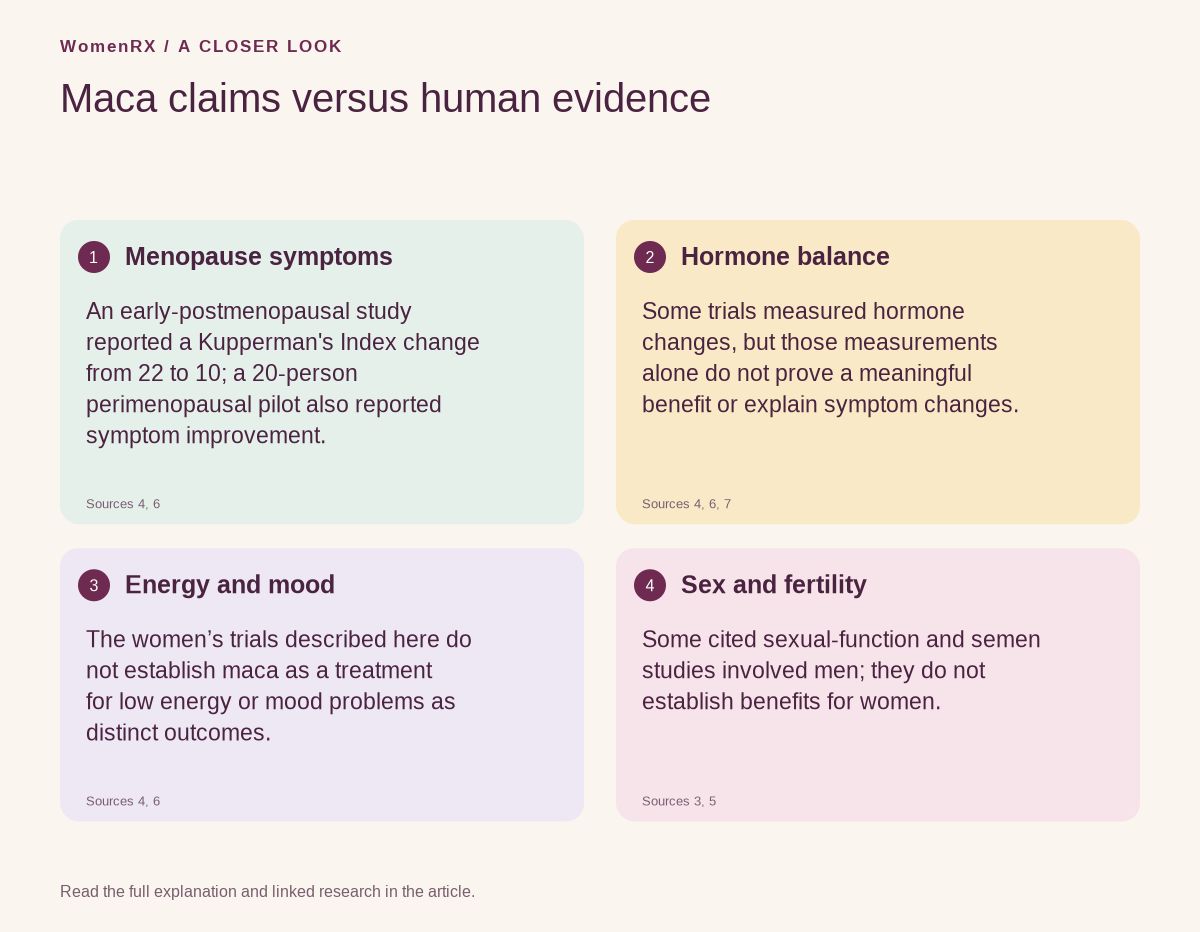
Maca claims versus human evidence
Menopause symptoms: An early-postmenopausal study reported a Kupperman's Index change from 22 to 10; a 20-person perimenopausal pilot also reported symptom improvement.46
Hormone balance: Some trials measured hormone changes, but those measurements alone do not prove a meaningful benefit or explain symptom changes.467
Energy and mood: The women’s trials described here do not establish maca as a treatment for low energy or mood problems as distinct outcomes.46
Sex and fertility: Some cited sexual-function and semen studies involved men; they do not establish benefits for women.35
Read the figure as text
The studies in women mainly concern menopause symptoms; other popular claims require evidence from women and outcomes that directly match the claim.- Menopause symptoms: An early-postmenopausal study reported a Kupperman's Index change from 22 to 10; a 20-person perimenopausal pilot also reported symptom improvement.46
- Hormone balance: Some trials measured hormone changes, but those measurements alone do not prove a meaningful benefit or explain symptom changes.467
- Energy and mood: The women’s trials described here do not establish maca as a treatment for low energy or mood problems as distinct outcomes.46
- Sex and fertility: Some cited sexual-function and semen studies involved men; they do not establish benefits for women.35
Sources you can check
- Sexual Health | MedlinePlusAccessed 2026-09-25Return to first citation
- The 2023 nonhormone therapy position statement of The North American Menopause Society.Menopause (New York, N.Y.) · 2023Return to first citation
- Subjective effects of Lepidium meyenii (Maca) extract on well-being and sexual performances in patients with mild erectile dysfunction: a randomised, double-blind clinical trial.Zenico T, Cicero AF, Valmorri L, Mercuriali M, Bercovich E. · Andrologia · 2009Return to first citation
- Therapeutic Effects of Pre-Gelatinized Maca (Lepidium Peruvianum Chacon) used as a Non-Hormonal Alternative to HRT in Perimenopausal Women - Clinical Pilot Study.Meissner HO, Reich-Bilinska H, Mscisz A, Kedzia B. · International journal of biomedical science : IJBS · 2006Return to first citation
- Does Lepidium meyenii (Maca) improve seminal quality?Alcalde AM, Rabasa J. · Andrologia · 2020Return to first citation
- Hormone-Balancing Effect of Pre-Gelatinized Organic Maca (Lepidium peruvianum Chacon): (II) Physiological and Symptomatic Responses of Early-Postmenopausal Women to Standardized doses of Maca in Double Blind, Randomized, Placebo-Controlled, Multi-Centre Clinical Study.Meissner HO, Mscisz A, Reich-Bilinska H, Kapczynski W, Mrozikiewicz P, Bobkiewicz-Kozlowska T, Kedzia B, Lowicka A, Barchia I. · International journal of biomedical science : IJBS · 2006Return to first citation
- Hormone-Balancing Effect of Pre-Gelatinized Organic Maca (Lepidium peruvianum Chacon): (III) Clinical responses of early-postmenopausal women to Maca in double blind, randomized, Placebo-controlled, crossover configuration, outpatient study.Meissner HO, Mscisz A, Reich-Bilinska H, Mrozikiewicz P, Bobkiewicz-Kozlowska T, Kedzia B, Lowicka A, Barchia I. · International journal of biomedical science : IJBS · 2006Return to first citation