Maca Root: Match the Product to the Research
Maca studies tested specific preparations in specific groups of women, so the ingredient name alone can’t tell you whether a product matches the evidence.
Start with the change you want, then check whether a trial measured that outcome in women at your life stage. A small postmenopausal trial tested 3.5 grams daily of maca powder; menopause studies tested 2 grams daily of a named pre-gelatinized preparation. Those are study amounts, not recommendations, and neither result applies automatically to another product. 1 2 3
First, name the change you’re hoping for
A maca label may promise support for “hormone balance,” energy, mood, or sexual health. Those aren’t interchangeable outcomes. If hot flashes are your concern, a study that measured sexual-function questionnaire scores won’t answer your main question.
In one randomized crossover trial, 14 postmenopausal women completed six weeks taking maca powder and six weeks taking placebo. The researchers reported better scores for psychological symptoms and measures of sexual dysfunction during maca use. That’s a preliminary finding in a small group, not evidence that maca treats every cause of low desire or mood changes. 1
Other researchers studied a named preparation, pre-gelatinized Maca-GO. A pilot trial enrolled 20 perimenopausal women and reported improvement in a menopause symptom index. A larger multicenter study enrolled 168 early-postmenopausal women, 124 of whom completed it, and reported improvements in menopause symptom measures, particularly hot flashes and night sweats. These Maca-GO reports are part of a related research series, not independent confirmations by separate research groups. 2 3
Read the preparation and amount together
The 14-woman trial tested 3.5 grams per day of maca powder. The perimenopausal pilot and larger early-postmenopausal study each tested 2 grams per day of pre-gelatinized Maca-GO. These figures describe what the researchers studied. They aren’t instructions for taking maca, and the different amounts can’t be compared as though the preparations were identical. 1 2 3
When you look at a product, check whether its label identifies a plain powder, a pre-gelatinized preparation, an extract, or a blend. Then check how much of that preparation the label identifies. A product that simply says “maca,” or gives an amount for a blend without making maca’s contribution clear, leaves you unable to make a close study-to-label comparison. Even a matching description and amount wouldn’t guarantee the same result for you.
Life stage matters just as much as the label. The pilot involved perimenopausal women, the larger Maca-GO study involved early-postmenopausal women, and the small powder trial described its participants as postmenopausal without specifying that narrower early-postmenopausal group. Don’t treat those populations as one identical group. 1 2 3
Be wary of a simple “hormone-balancing” claim
In the small powder trial, measured estradiol, follicle-stimulating hormone (FSH), luteinizing hormone, and sex hormone-binding globulin did not differ between maca and placebo, despite the reported changes in some symptom scores. Maca-GO studies reported hormone changes, but their findings weren’t wholly consistent: the perimenopausal pilot reported an increase in FSH, while the larger early-postmenopausal study reported a decrease. Different populations and preparations make a single predictable hormone effect an especially poor takeaway. 1 2 3
Nor did these trials establish maca as a replacement for hormone therapy. Their comparisons were with placebo, not a test of whether maca offers the same symptom relief, other benefits, or risks as hormone therapy. 1 2 3
Put safety questions beside the product label
The cited trials involved perimenopausal or postmenopausal women. They don’t establish safety during pregnancy or breastfeeding. If you’re pregnant, breastfeeding, or considering maca while trying to conceive, raise the exact preparation and amount with a clinician before using it rather than relying on its history as a food or plant product. 1 2 3
Long-term safety is also unsettled. One pilot report followed just eight women through a longer maca-use period of eight months; that’s too small to establish what extended use means for a broad range of women. 4
The most useful question to bring to a conversation about maca is specific: “Has this form been studied for the outcome I want, in someone at my life stage?” Bring the label, including any other ingredients, and mention medicines and supplements you already take. These trials don’t establish a reliable interaction profile for every maca preparation, so an unreported interaction shouldn’t be mistaken for a proven absence of one.
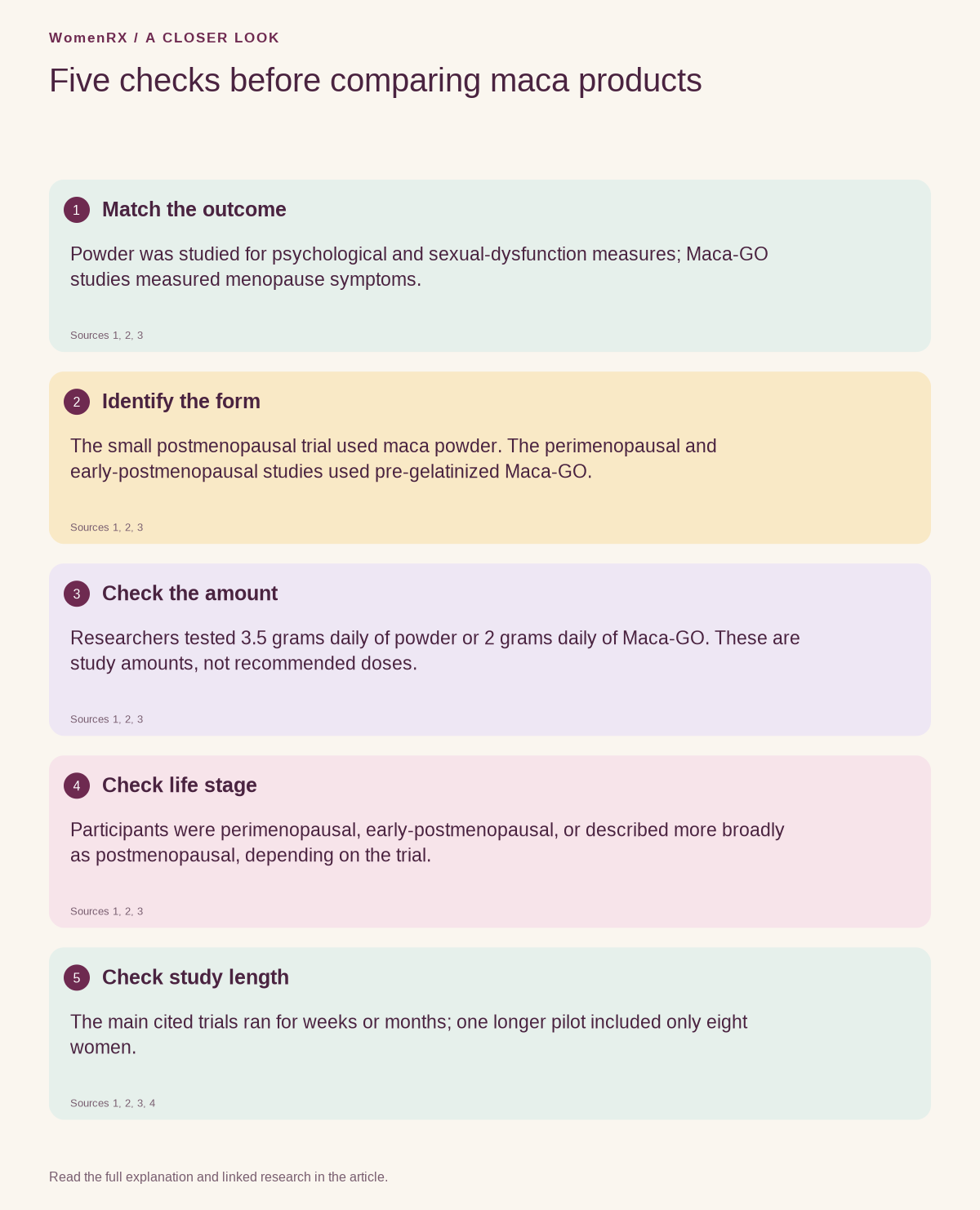
Five checks before comparing maca products
Match the outcome: Powder was studied for psychological and sexual-dysfunction measures; Maca-GO studies measured menopause symptoms.123
Identify the form: The small postmenopausal trial used maca powder. The perimenopausal and early-postmenopausal studies used pre-gelatinized Maca-GO.123
Check the amount: Researchers tested 3.5 grams daily of powder or 2 grams daily of Maca-GO. These are study amounts, not recommended doses.123
Check life stage: Participants were perimenopausal, early-postmenopausal, or described more broadly as postmenopausal, depending on the trial.123
Check study length: The main cited trials ran for weeks or months; one longer pilot included only eight women.1234
Read the figure as text
Use the intended outcome and the product label to see how closely a preparation resembles one studied in women.- Match the outcome: Powder was studied for psychological and sexual-dysfunction measures; Maca-GO studies measured menopause symptoms.123
- Identify the form: The small postmenopausal trial used maca powder. The perimenopausal and early-postmenopausal studies used pre-gelatinized Maca-GO.123
- Check the amount: Researchers tested 3.5 grams daily of powder or 2 grams daily of Maca-GO. These are study amounts, not recommended doses.123
- Check life stage: Participants were perimenopausal, early-postmenopausal, or described more broadly as postmenopausal, depending on the trial.123
- Check study length: The main cited trials ran for weeks or months; one longer pilot included only eight women.1234
Sources you can check
- Beneficial effects of Lepidium meyenii (Maca) on psychological symptoms and measures of sexual dysfunction in postmenopausal women are not related to estrogen or androgen content.Brooks NA, Wilcox G, Walker KZ, Ashton JF, Cox MB, Stojanovska L. · Menopause (New York, N.Y.) · 2008Return to first citation
- Therapeutic Effects of Pre-Gelatinized Maca (Lepidium Peruvianum Chacon) used as a Non-Hormonal Alternative to HRT in Perimenopausal Women - Clinical Pilot Study.Meissner HO, Reich-Bilinska H, Mscisz A, Kedzia B. · International journal of biomedical science : IJBS · 2006Return to first citation
- Hormone-Balancing Effect of Pre-Gelatinized Organic Maca (Lepidium peruvianum Chacon): (II) Physiological and Symptomatic Responses of Early-Postmenopausal Women to Standardized doses of Maca in Double Blind, Randomized, Placebo-Controlled, Multi-Centre Clinical Study.Meissner HO, Mscisz A, Reich-Bilinska H, Kapczynski W, Mrozikiewicz P, Bobkiewicz-Kozlowska T, Kedzia B, Lowicka A, Barchia I. · International journal of biomedical science : IJBS · 2006Return to first citation
- Use of gelatinized maca (lepidium peruvianum) in early postmenopausal women.Meissner HO, Kapczynski W, Mscisz A, Lutomski J. · International journal of biomedical science : IJBS · 2005Return to first citation