Maca Root: Study Doses, Product Labels, and Safety Checks
Maca products vary, and a dose studied in men is not a standard dose for women or for every preparation.
There isn’t one maca dose that applies across products. One 12-week trial in men studied gelatinized maca tablets at 1,000 mg three times a day, but that does not establish a dose for women or for raw powders and extracts. Check the product’s preparation and amount per serving, and remember that human evidence on reproductive benefits is inconclusive. 1 4
A study amount is not a personal dose
Maca is sold as powder, capsules, tablets, and extracts. 1 3 Those forms aren’t automatically interchangeable: growing conditions, plant variety, and processing can change maca’s composition. A label that says “maca” alone doesn’t tell you whether the product resembles one used in a particular study. 2
A randomized trial studied gelatinized maca in tablets for 12 weeks in men with symptoms of late-onset hypogonadism. The researchers randomized 88 men; 80 remained in the study at the end. Participants took 1,000 mg three times daily. This describes that trial’s protocol, not a recommended amount for women, a proven dose for fertility or menopause, or a standard that applies to other maca preparations. 1
A review of maca research also describes studies using different varieties and preparations, while noting that research often does not specify those details consistently. So comparing products by milligrams alone can give a false sense that they’re equivalent. 2
What to look for on the label
Before comparing amounts, see whether the label identifies:
- Preparation: Is it powder, gelatinized maca, or an extract? “Gelatinized” identifies a type of processing; it does not make a product equivalent to every other preparation.
- Amount per serving: Look for the quantity of maca itself, not just the total weight of a proprietary blend. Check how many capsules or scoops make up a serving.
- Plant and product details: The review describes variation by maca color, growing location, and processing, all of which can affect composition. More detail helps you judge how much the product is described, though it does not prove a health benefit. 2
- Alkaloid testing information: You can ask whether the finished product has been tested for alkaloid content. One analysis found that measured total alkaloids ranged from 56 to 598 mg/kg among the finished products it tested. That range describes those samples, not every maca product on the market. 3
That variation is a reason to take product information seriously, not proof that a particular product is harmful. Analytical researchers also describe challenges in measuring maca alkaloids, including limited availability of reference standards. 3
What the evidence says about women’s claims
Maca is marketed for libido, fertility, and menopause symptoms, but those claims shouldn’t be treated as established benefits. A review assessing reproductive-health claims found that clinical trials and animal studies had produced inconclusive results, with limitations including study methods and small sample sizes. A later review describes research involving pre- and postmenopausal women but also emphasizes gaps in studies distinguishing maca preparations and varieties. 4 2
The trial that provides the clearest dose example here enrolled men, not women. Its dose and findings therefore don’t establish a useful amount or effect for women. 1
Pregnancy and breastfeeding: what these findings establish
The trial described here enrolled men, so its protocol cannot establish whether maca supplements are safe during pregnancy or breastfeeding. The reproductive claims and maca research described in the reviews also do not establish safety in either situation. That limitation is not evidence that maca is safe or unsafe during pregnancy or breastfeeding. 1 2 4
The practical takeaway: compare the preparation first, then the amount, and don’t use a study dose as a shortcut to choosing your own. The evidence does not support a universal maca dose or a confident reproductive-health promise.
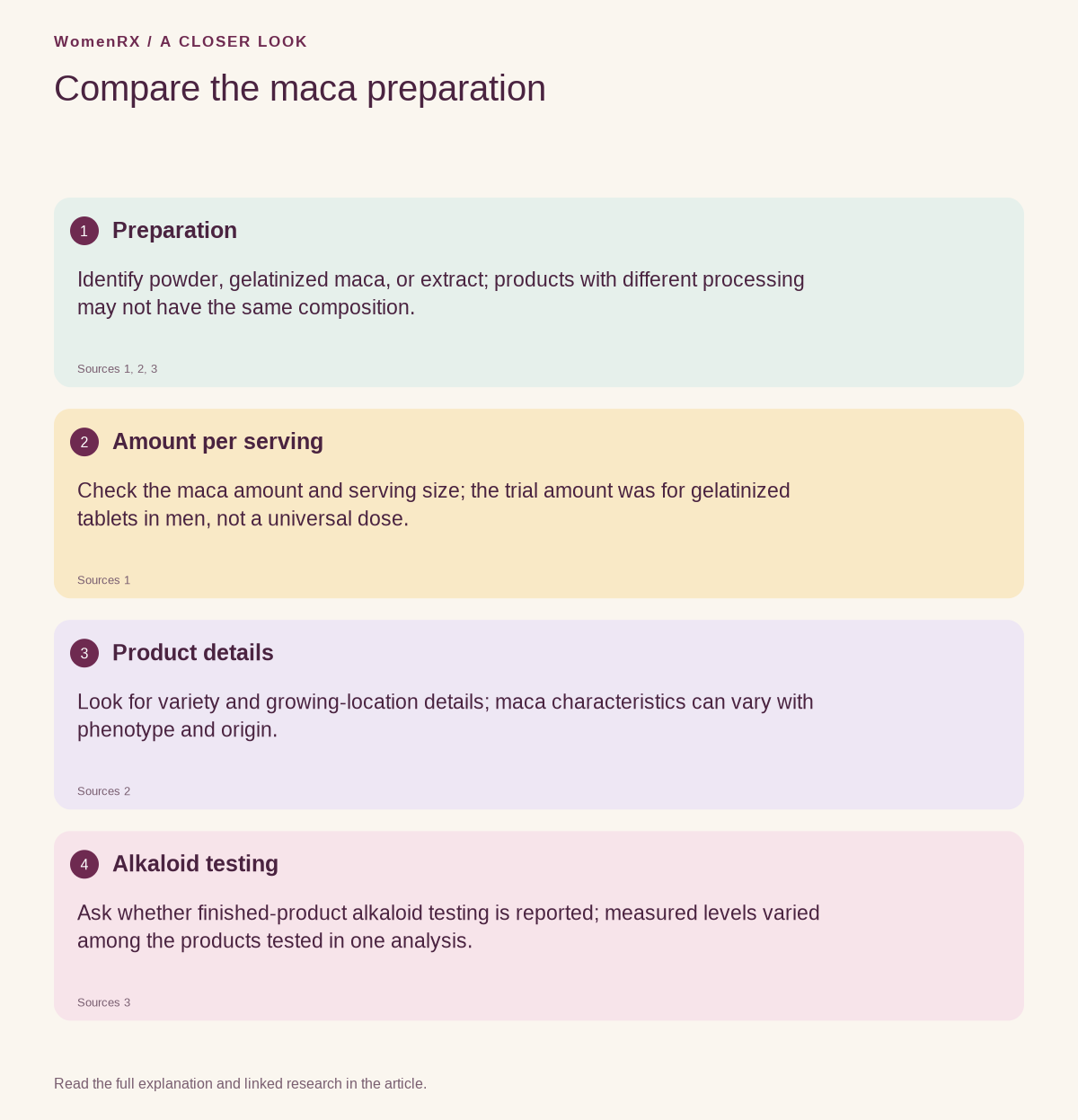
Compare the maca preparation
Preparation: Identify powder, gelatinized maca, or extract; products with different processing may not have the same composition.123
Amount per serving: Check the maca amount and serving size; the trial amount was for gelatinized tablets in men, not a universal dose.1
Product details: Look for variety and growing-location details; maca characteristics can vary with phenotype and origin.2
Alkaloid testing: Ask whether finished-product alkaloid testing is reported; measured levels varied among the products tested in one analysis.3
Read the figure as text
Use these label checks to distinguish a product from the specific preparation studied and to identify relevant product information.- Preparation: Identify powder, gelatinized maca, or extract; products with different processing may not have the same composition.123
- Amount per serving: Check the maca amount and serving size; the trial amount was for gelatinized tablets in men, not a universal dose.1
- Product details: Look for variety and growing-location details; maca characteristics can vary with phenotype and origin.2
- Alkaloid testing: Ask whether finished-product alkaloid testing is reported; measured levels varied among the products tested in one analysis.3
More questions, answered
Does the trial dose tell me how much maca to take?
No. The 1,000 mg three-times-daily protocol was used for gelatinized tablets in a 12-week trial in men. It does not establish a dose for women or for other preparations. 1
Are maca powders and extracts interchangeable?
Not necessarily. Processing and other product characteristics can change maca’s composition, and research does not consistently describe these details. Compare the preparation, not just the milligrams. 2
Sources you can check
- Efficacy and Safety of Maca (Lepidium meyenii) in Patients with Symptoms of Late-Onset Hypogonadism: A Randomized, Double-Blind, Placebo-Controlled Clinical Trial.Shin D, Jeon SH, Piao J, Park HJ, Tian WJ, Moon DG, Ahn ST, Jeon KH, Zhu GQ, Park I, Park HJ, Bae WJ, Cho HJ, Hong SH, Kim SW. · The world journal of men's health · 2023Return to first citation
- Not All Maca Is Created Equal: A Review of Colors, Nutrition, Phytochemicals, and Clinical Uses.Minich DM, Ross K, Frame J, Fahoum M, Warner W, Meissner HO. · Nutrients · 2024Return to first citation
- UPLC-TQD-MS/MS Method Validation for Quality Control of Alkaloid Content in Lepidium meyenii (Maca)-Containing Food and Dietary Supplements.Le NT, Foubert K, Theunis M, Naessens T, Bozdag M, Van Der Veken P, Pieters L, Tuenter E. · ACS omega · 2024Return to first citation
- Is the hype around the reproductive health claims of maca (Lepidium meyenii Walp.) justified?Beharry S, Heinrich M. · Journal of ethnopharmacology · 2018Return to first citation