Maca Root: What Women Should Know About Safety and Evidence
Maca has been studied for menopause symptoms and sexual health, but results in women are mixed and may not apply to every product.
Maca isn’t proven to relieve menopause symptoms or improve libido for women, and the evidence described for energy doesn’t establish a dependable benefit for women. Reviews report mixed women-only sexual-health results, while maca products differ in color, processing, and composition. Findings in adults also shouldn’t be taken as evidence that maca is safe during pregnancy or breastfeeding. 236
The claim matters as much as the ingredient
Maca, or Lepidium meyenii, is sold as powders, capsules, and extracts. It’s often promoted for menopause symptoms, libido, or energy, but those are separate outcomes. Evidence for one doesn’t confirm the others, and a finding with one maca preparation may not apply to a different product.
Reviews describe maca as promising for some menopausal symptoms, but the information available doesn’t establish that it reliably relieves hot flashes, sleep problems, mood changes, or other specific symptoms. It also doesn’t support the claim that maca “balances hormones.” That phrase promises more than the clinical evidence can show. 23
For sexual health, a 2026 review reports mixed results in studies of women, many of them postmenopausal. An earlier review concluded that maca needed further study for female sexual dysfunction and that the evidence for medicinal plants overall wasn’t strong enough to recommend one as treatment. These findings don’t mean maca can’t help an individual; they do mean a dependable benefit for women hasn’t been established. 56
Energy claims need the same caution. Maca has a history of traditional use for energy, and reviews discuss possible effects, but that history isn’t proof that a supplement will improve your energy. Those accounts don’t establish a dependable energy benefit for women. 23
Safety depends partly on the preparation
A 2024 review describes maca as generally well tolerated, with rare adverse effects reported. That’s reassuring, but it isn’t a guarantee that every product is safe or proof that long-term use is safe. The review also notes that no serious adverse events were identified for single-ingredient maca products in a USP evaluation, while purified extracts and other nontraditional preparations may differ and need further evaluation. 2
“Maca” on the label doesn’t tell you everything about what’s inside. The plant’s chemical composition can vary with its growing conditions and processing. Products may contain root powder, gelatinized powder, extracts, or combinations of ingredients; reviews caution that color and preparation can affect composition and may make results harder to compare. A study of one preparation doesn’t automatically establish the effects or safety of another. 23
If you’re comparing products, check whether the label identifies the maca preparation and lists other ingredients. Don’t assume a blend has the same evidence as maca alone. Dietary and herbal supplements can interact with medicines, so it’s useful to tell the person managing your medications what you’re considering. 1
There is a specific, limited interaction signal: a retrospective chart review listed restless legs associated with maca taken alongside the antidepressant mianserin. That finding can’t tell us how often this happens or establish that maca interacts with antidepressants as a group, but it’s a reason to flag maca if you take mianserin. 4
Pregnancy and breastfeeding need separate evidence
The maca research discussed here doesn’t answer whether maca is safe during pregnancy or breastfeeding. Findings about maca use in other contexts shouldn’t be treated as evidence for these stages. Herbal products aren’t automatically safe because they’re plant-based, and some can interact with medicines. If you’re pregnant or breastfeeding and considering maca, ask the clinician involved in your care about the specific product. 1
A useful way to weigh a product
Before trying maca, ask what you want it to do: ease a particular menopause symptom, affect sexual desire, or improve energy. Then look for evidence on that outcome in women, using a preparation like the one on the label. The current evidence doesn’t support treating these goals as interchangeable, or treating maca as a proven substitute for menopause care. If a product makes broad promises about hormones, fertility, libido, and energy all at once, those claims go beyond what the women-focused evidence establishes. 2356
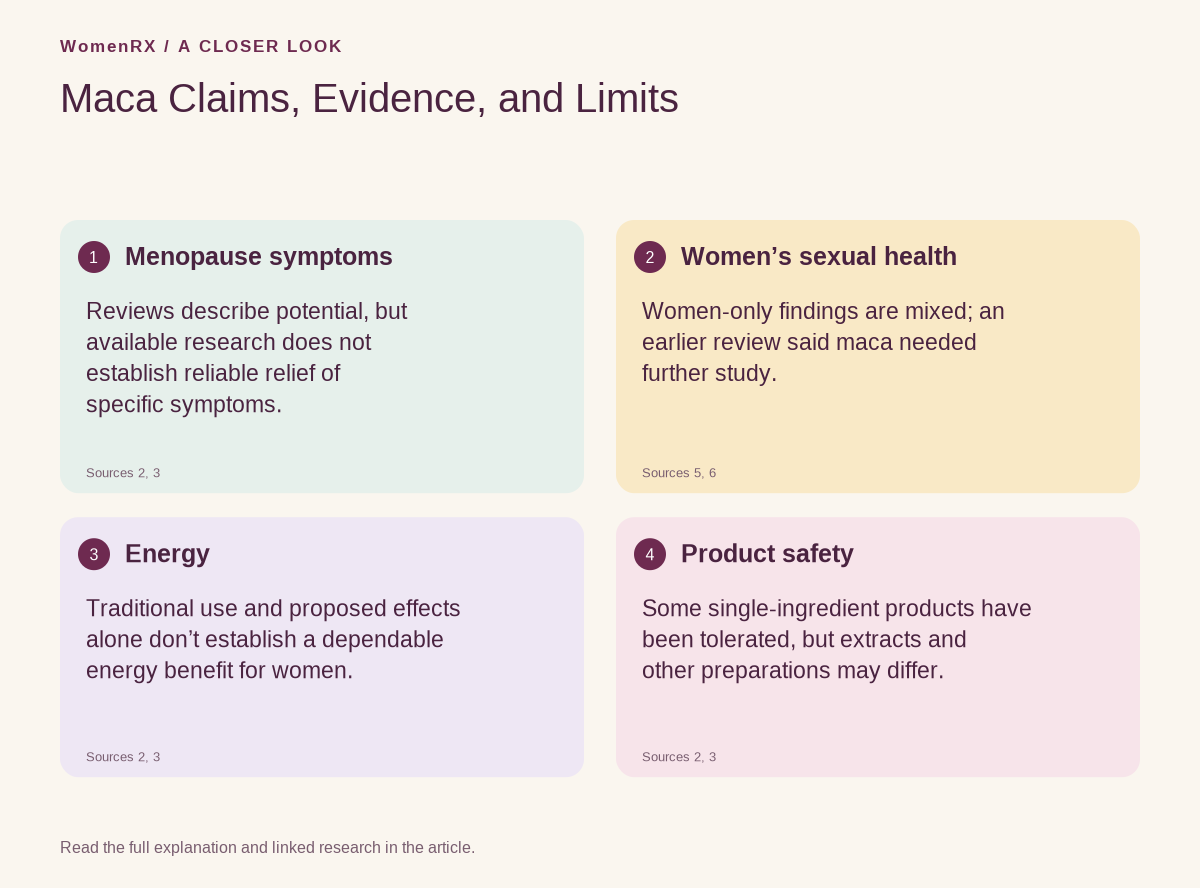
Maca Claims, Evidence, and Limits
Menopause symptoms: Reviews describe potential, but available research does not establish reliable relief of specific symptoms.23
Women’s sexual health: Women-only findings are mixed; an earlier review said maca needed further study.56
Energy: Traditional use and proposed effects alone don’t establish a dependable energy benefit for women.23
Product safety: Some single-ingredient products have been tolerated, but extracts and other preparations may differ.23
Read the figure as text
These claims involve different outcomes, and findings from one preparation or group of women may not transfer to another.- Menopause symptoms: Reviews describe potential, but available research does not establish reliable relief of specific symptoms.23
- Women’s sexual health: Women-only findings are mixed; an earlier review said maca needed further study.56
- Energy: Traditional use and proposed effects alone don’t establish a dependable energy benefit for women.23
- Product safety: Some single-ingredient products have been tolerated, but extracts and other preparations may differ.23
More questions, answered
Is there a known interaction between maca and antidepressants?
A retrospective chart review listed restless legs associated with maca taken alongside mianserin. That finding doesn’t establish a general interaction with antidepressants, but mention maca if you take mianserin or are reviewing your medications. 4
Sources you can check
- Herbal Medicine: MedlinePlusAccessed 2026-09-25Return to first citation
- Exploring the chemical and pharmacological variability of Lepidium meyenii: a comprehensive review of the effects of maca.Ulloa Del Carpio N, Alvarado-Corella D, Quiñones-Laveriano DM, Araya-Sibaja A, Vega-Baudrit J, Monagas-Juan M, Navarro-Hoyos M, Villar-López M. · Frontiers in pharmacology · 2024Return to first citation
- Not All Maca Is Created Equal: A Review of Colors, Nutrition, Phytochemicals, and Clinical Uses.Minich DM, Ross K, Frame J, Fahoum M, Warner W, Meissner HO. · Nutrients · 2024Return to first citation
- Harder, better, faster, stronger? Retrospective chart review of adverse events of interactions between adaptogens and antidepressant drugs.Siwek M, Woroń J, Wrzosek A, Gupało J, Chrobak AA. · Frontiers in pharmacology · 2023Return to first citation
- Medicinal plants as alternative treatments for female sexual dysfunction: utopian vision or possible treatment in climacteric women?Mazaro-Costa R, Andersen ML, Hachul H, Tufik S. · The journal of sexual medicine · 2010Return to first citation
- Effects of Maca (Lepidium Meyenii) on Sexual Health and libido-A Review.Bloomer RJ. · Journal of dietary supplements · 2026Return to first citation