Maca Root: What the Evidence Says About Benefits and Timing
Human studies have explored maca for sexual wellbeing and menopause symptoms, but results vary and study schedules don’t establish a best time to take it.
Maca has been studied for sexual wellbeing and menopause symptoms, but findings in women are mixed. Evidence for a reliable energy boost or improved fertility in women is not established by the clinical findings discussed here. One trial in men took maca before food; because it didn’t compare schedules, it can’t tell you whether morning, evening, or taking it with food is better. 124
Maca is a plant root sold in powders and supplements. If you’re considering it for energy, sexual wellbeing, or menopause symptoms, the evidence depends on which outcome you mean. Studies of one goal don’t automatically support another, and a schedule used in a trial isn’t proof that it’s the best one.
Sexual wellbeing is a separate question from menopause symptoms
Reviews describe human studies of maca for sexual health, but findings in women-only studies are mixed. A 2026 review found more consistent positive results in studies of men than in studies of women, many of whom were postmenopausal. That makes maca a possibility under study, not a dependable way to increase desire or improve sexual wellbeing for every woman. 1
Maca also shouldn’t be treated as a hormone-balancing supplement. A review of maca research says an early hypothesis about hormone effects has not been confirmed. In one study of healthy women taking a maca-containing supplement, researchers found no significant differences in their evaluations of sex hormones compared with placebo. That particular result doesn’t settle what every maca preparation might do, but it doesn’t support a broad claim that maca balances hormones. 2
Menopause symptoms need their own evidence check. A review describes maca as promising for menopausal symptoms, but its summary doesn’t establish whether it helps particular symptoms such as hot flashes or night sweats. The 2023 North American Menopause Society statement does not recommend supplements or herbal remedies as a group for vasomotor symptoms. That guidance is about the category, not a maca-only trial or judgment. 23
Energy and fertility claims need more than a promising label
A review counted 22 clinical maca studies, 18 focused on sexual health and only two on physical performance. That limited performance research doesn’t establish that maca reliably improves everyday energy or fatigue in women. A study of physical performance also wouldn’t, by itself, show that a supplement helps with menopause symptoms or sexual wellbeing. 2
Fertility claims deserve the same distinction. Research findings in men, or preclinical findings, can’t establish that maca improves fertility in women. And an effect on desire or menopause symptoms wouldn’t demonstrate improved fertility. 2
The trial schedule isn’t a timing recommendation
One randomized trial tested gelatinized maca in men with symptoms associated with late-onset hypogonadism. Participants took the study product before food for 12 weeks. The researchers did not compare taking it before versus with food, or morning versus evening, so the trial can’t show that its schedule works better. It also wasn’t a study of women. 4
Across human trials, products and preparations have varied. A review reports that many trials used maca powder or an equivalent preparation, while maca’s composition can vary with the plant type, growing conditions, and processing. A study result from one preparation may not neatly transfer to every powder, capsule, or extract on a store shelf. 12
If you’re comparing products, check which preparation the research actually studied and whether the label clearly identifies the ingredients. Treat a study’s schedule as a description of its protocol, not a proven best time for you. The useful takeaway is that current findings don’t provide a timing comparison for women’s goals. 145
Keep the outcomes distinct
Maca research offers some signals worth studying, especially in sexual health, but it doesn’t support treating libido, hot flashes, energy, hormone levels, and fertility as one shared benefit. The menopause and sexual-wellbeing findings also don’t answer questions about maca use during pregnancy or breastfeeding. Those are different settings and outcomes, not conclusions that can be drawn from studies of libido or menopause symptoms. 12
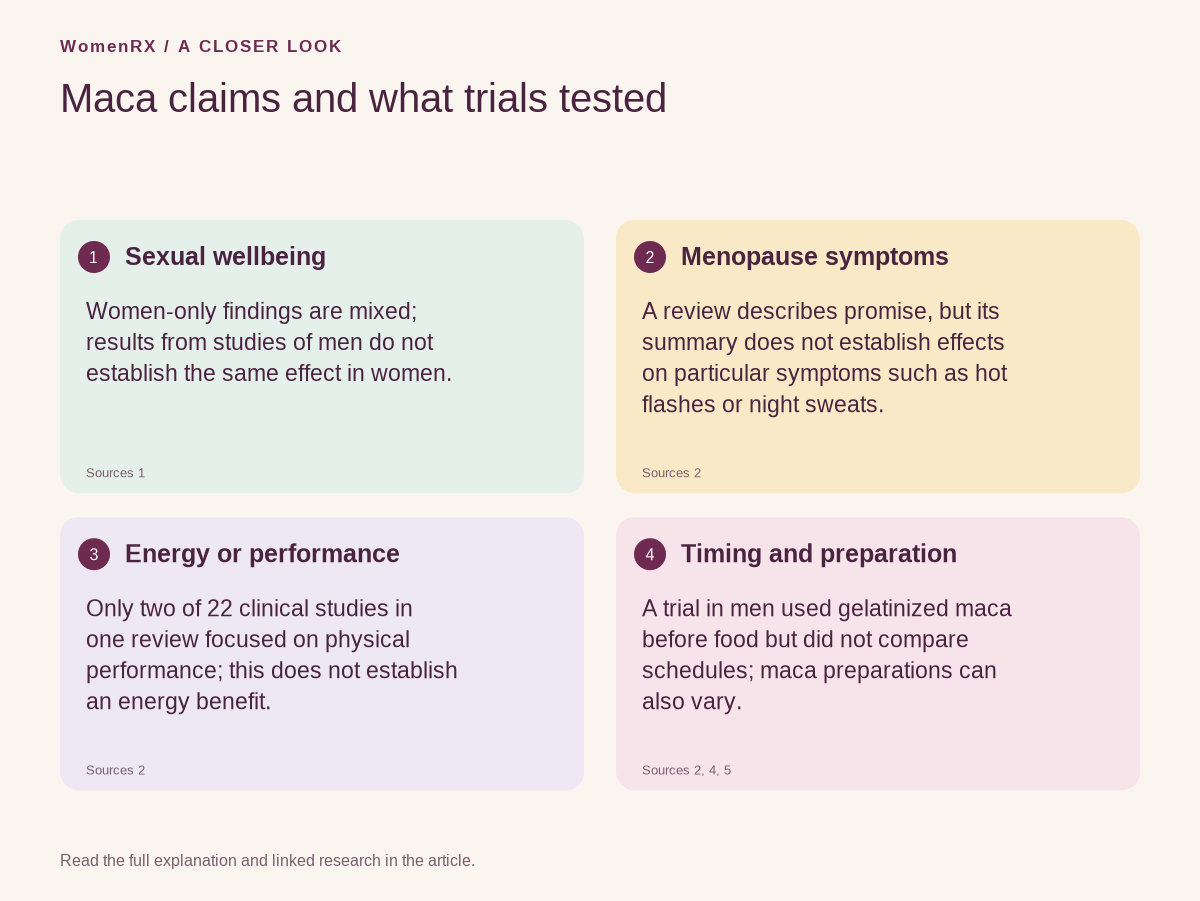
Maca claims and what trials tested
Sexual wellbeing: Women-only findings are mixed; results from studies of men do not establish the same effect in women.1
Menopause symptoms: A review describes promise, but its summary does not establish effects on particular symptoms such as hot flashes or night sweats.2
Energy or performance: Only two of 22 clinical studies in one review focused on physical performance; this does not establish an energy benefit.2
Timing and preparation: A trial in men used gelatinized maca before food but did not compare schedules; maca preparations can also vary.245
Read the figure as text
Compare the claimed goal with the human evidence described and what the study designs can actually answer.- Sexual wellbeing: Women-only findings are mixed; results from studies of men do not establish the same effect in women.1
- Menopause symptoms: A review describes promise, but its summary does not establish effects on particular symptoms such as hot flashes or night sweats.2
- Energy or performance: Only two of 22 clinical studies in one review focused on physical performance; this does not establish an energy benefit.2
- Timing and preparation: A trial in men used gelatinized maca before food but did not compare schedules; maca preparations can also vary.245
More questions, answered
Does maca have to be taken before food?
One trial in men used maca before food, but it didn’t compare that schedule with taking it alongside food. That study can’t establish which is better. 4
Does maca improve fertility in women?
The findings discussed here don’t establish improved fertility in women. Findings about sexual desire or studies in men are not proof of a fertility benefit for women. 12
Sources you can check
- Effects of Maca (Lepidium Meyenii) on Sexual Health and libido-A Review.Bloomer RJ. · Journal of dietary supplements · 2026Return to first citation
- Exploring the chemical and pharmacological variability of Lepidium meyenii: a comprehensive review of the effects of maca.Ulloa Del Carpio N, Alvarado-Corella D, Quiñones-Laveriano DM, Araya-Sibaja A, Vega-Baudrit J, Monagas-Juan M, Navarro-Hoyos M, Villar-López M. · Frontiers in pharmacology · 2024Return to first citation
- The 2023 nonhormone therapy position statement of The North American Menopause Society.Menopause (New York, N.Y.) · 2023Return to first citation
- Efficacy and Safety of Maca (Lepidium meyenii) in Patients with Symptoms of Late-Onset Hypogonadism: A Randomized, Double-Blind, Placebo-Controlled Clinical Trial.Shin D, Jeon SH, Piao J, Park HJ, Tian WJ, Moon DG, Ahn ST, Jeon KH, Zhu GQ, Park I, Park HJ, Bae WJ, Cho HJ, Hong SH, Kim SW. · The world journal of men's health · 2023Return to first citation
- Maca (Lepidium meyenii) as a Functional Food and Dietary Supplement: A Review on Analytical Studies.Wasilewicz A, Grienke U. · Foods (Basel, Switzerland) · 2026Return to first citation