Maca Root: Trial Amounts Versus Menopause Evidence
Human trials commonly used about 3 grams a day, but that figure isn’t a proven dose for every maca product or symptom.
A 2026 review reports that most human maca trials used about 3 grams per day of maca powder or an equivalent preparation. That’s a description of what researchers commonly studied, not a proven dose for libido, energy, or every menopause symptom. Women-only sexual-health findings were mixed, and the review doesn’t establish that different extracts are interchangeable by weight. 2
The short answer: about 3 grams, with an important caveat
If you’re comparing a maca product with amounts used in human research, about 3 grams per day of maca powder is a useful reference point. A 2026 review reports that most human trials used roughly that amount of powder or an equivalent preparation. It does not establish 3 grams as the right dose for every goal, or as a dose that’s been shown to work for every woman. 2
That distinction matters on a product label. Three grams of root powder and three grams of a concentrated extract aren’t automatically equivalent. The review’s summary doesn’t provide a conversion that would let you match an extract to powder by weight. If the label says “extract,” look for the amount and preparation details, but don’t assume that matching a number means matching a studied product.
Libido evidence is not the same as menopause-symptom evidence
Maca has been studied for sexual health, but sexual desire and hot flashes aren’t the same outcome. A change in sexual desire would not, by itself, show that maca helps hot flashes, night sweats, fatigue, or other menopause concerns. 2
The 2026 review describes mixed findings in studies involving women only, often postmenopausal women. It also reports more consistently positive findings in studies involving men, which shouldn’t be treated as proof of benefit for women. The review authors say maca appears not to negatively alter hormone levels, but that cautious summary does not establish a consistent trial finding or show that maca “balances” hormones or treats menopause by changing them. 2
An earlier narrative review of medicinal plants and female sexual dysfunction concluded that maca needed further study and that the plant evidence it reviewed wasn’t strong enough to recommend a treatment for sexual dysfunction. Because that review covered several plants, it’s useful context, not a precise estimate of maca’s effects. 1
For hot flashes and night sweats, the North American Menopause Society’s 2023 position statement does not recommend dietary supplements and herbal remedies as a group for vasomotor symptoms. That conclusion reflects the position statement’s evidence review; it isn’t a maca-specific trial result. Maca shouldn’t be presented as an established treatment for these symptoms. 4
A practical way to assess the label
Before buying or using a maca product, check three things:
- What preparation is it? Note whether the product is root powder or an extract. Don’t treat their gram amounts as interchangeable without evidence for that particular preparation.
- What outcome are you hoping to affect? The roughly 3-gram figure describes common use in human trials; it doesn’t identify a proven dose for libido, energy, or hot flashes individually. 2
- Is the claim about hormones or fertility? The review’s cautious comment about hormone levels does not establish hormone balancing, and the research summarized here does not establish a fertility benefit. 2
If your main concern is bothersome hot flashes or night sweats, it may be more useful to compare maca’s uncertain evidence with treatments supported for those symptoms. The menopause position statement identifies hormone therapy as the most effective treatment for vasomotor symptoms, and lists several evidence-supported nonhormonal options as well. Which approaches fit depends on your circumstances and preferences. 3 4
What to take away
Treat about 3 grams of maca powder as a research reference, not a universal daily recommendation. The women-only sexual-health findings are mixed, and the 2026 review doesn’t establish that powder and extracts can be swapped dose for dose. For hot flashes and night sweats, maca is not an evidence-supported substitute for treatments recommended in menopause guidance. The trial-dose summary also doesn’t establish a dose for pregnancy or breastfeeding, so don’t carry that figure over to either life stage. 2
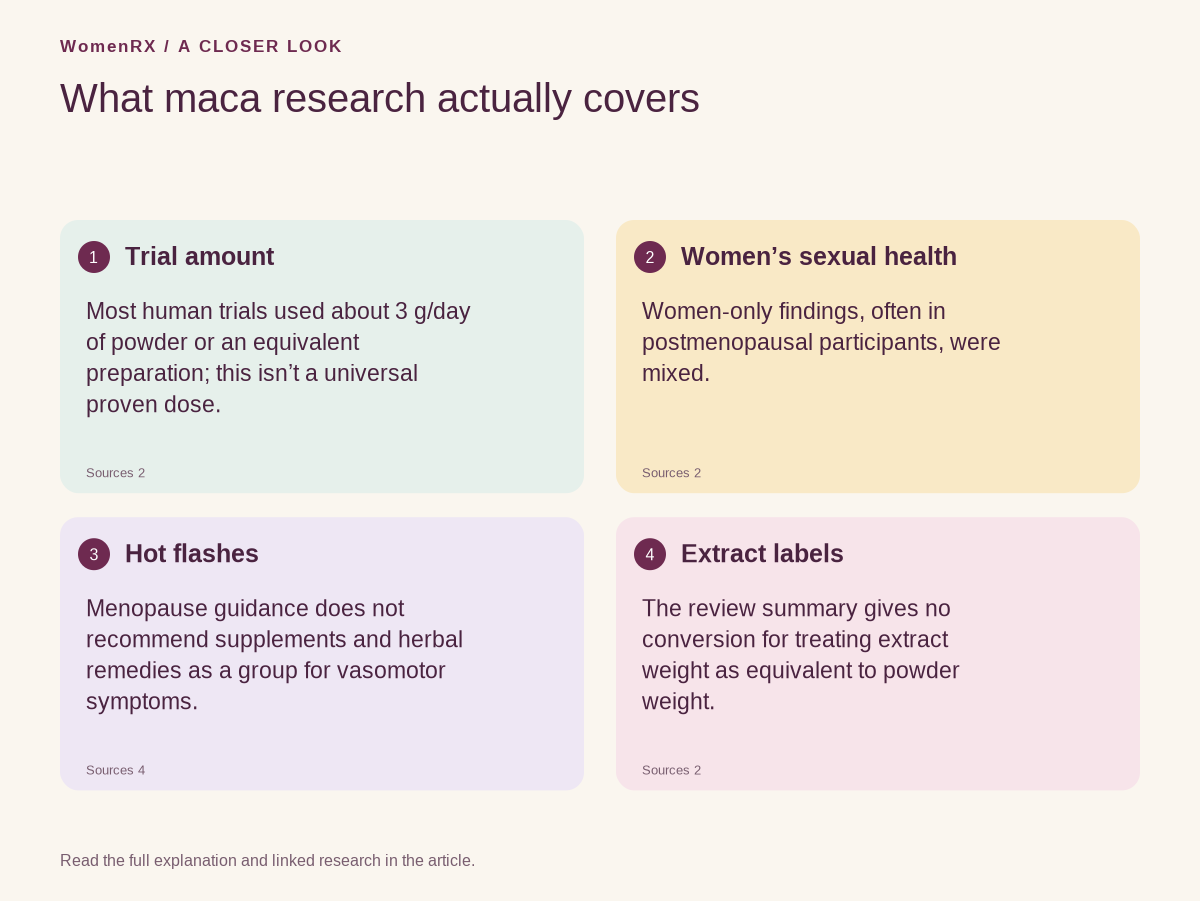
What maca research actually covers
Trial amount: Most human trials used about 3 g/day of powder or an equivalent preparation; this isn’t a universal proven dose.2
Women’s sexual health: Women-only findings, often in postmenopausal participants, were mixed.2
Hot flashes: Menopause guidance does not recommend supplements and herbal remedies as a group for vasomotor symptoms.4
Extract labels: The review summary gives no conversion for treating extract weight as equivalent to powder weight.2
Read the figure as text
Separate the commonly reported trial amount from the outcomes and preparations the evidence does not settle.- Trial amount: Most human trials used about 3 g/day of powder or an equivalent preparation; this isn’t a universal proven dose.2
- Women’s sexual health: Women-only findings, often in postmenopausal participants, were mixed.2
- Hot flashes: Menopause guidance does not recommend supplements and herbal remedies as a group for vasomotor symptoms.4
- Extract labels: The review summary gives no conversion for treating extract weight as equivalent to powder weight.2
More questions, answered
Does maca have a proven dose for menopause symptoms?
No single proven dose for menopause symptoms is established here. The roughly 3-gram figure describes what most human trials used, not a dose shown to treat each symptom. Women-only sexual-health findings were mixed, and menopause guidance does not recommend supplements and herbal remedies as a group for vasomotor symptoms. 2 4
Does maca balance hormones?
The 2026 review authors say maca appears not to negatively alter hormone levels. That cautious summary does not establish a consistent finding across trials, and it isn’t evidence that maca balances hormones or treats menopause by changing them. 2
Sources you can check
- Medicinal plants as alternative treatments for female sexual dysfunction: utopian vision or possible treatment in climacteric women?Mazaro-Costa R, Andersen ML, Hachul H, Tufik S. · The journal of sexual medicine · 2010Return to first citation
- Effects of Maca (Lepidium Meyenii) on Sexual Health and libido-A Review.Bloomer RJ. · Journal of dietary supplements · 2026Return to first citation
- The 2022 hormone therapy position statement of The North American Menopause Society.“The 2022 Hormone Therapy Position Statement of The North American Menopause Society” Advisory Panel. · Menopause (New York, N.Y.) · 2022Return to first citation
- The 2023 nonhormone therapy position statement of The North American Menopause Society.Menopause (New York, N.Y.) · 2023Return to first citation