Maca Root: What Women’s Studies Actually Tested
Maca has been studied most directly for menopausal symptoms, but the limited trials tested a specific processed root preparation, not every product sold as maca.
Researchers have studied maca for menopausal symptoms and measured hormone levels in perimenopausal and early-postmenopausal women. The trials used pre-gelatinized maca powder, so their findings can’t establish that raw maca or other commercial products work the same way. The studies summarized here do not establish menstrual or fertility benefits, and long-term safety remains unclear. 1 2 3
Maca is a root traditionally eaten in the Andes and sold as a supplement. If you’re weighing a product because of claims about hormones, menopause, energy, or fertility, the key distinction is between traditional use and what human studies have actually tested. The clearest direct human tests concern menopausal symptoms, and they involve one particular processed maca preparation. 3 5
The most direct human research is about menopause
A limited set of studies with different sample sizes tested pre-gelatinized maca powder, referred to in the papers as Maca-GO, in women with menopausal symptoms. One small pilot enrolled 20 perimenopausal women and used a randomized crossover design: participants received maca and placebo during separate periods. The researchers reported improvements in symptom scores after maca, alongside changes in some measured hormone levels. Because the pilot was small and a placebo effect was also observed, its results are a preliminary signal, not proof that maca reliably relieves symptoms. 3
A larger study enrolled 168 early-postmenopausal women and compared the same named preparation with placebo over three or four months; 124 women completed the study. The authors reported improvement in symptom scores, particularly for hot flushes and night sweats. A related four-month crossover study also reported symptom improvement, but it was small, and it came from the same research group and preparation. These reports shouldn’t be treated as independent confirmation from a broad range of researchers or products. Both early-postmenopause studies reported enrolling Caucasian women, so it’s uncertain how well their findings apply to more diverse groups. 1 2
The studies also measured hormones, but that does not establish that maca “balances” hormones in a predictable or beneficial way. Reported changes varied across studies and hormones. These studies did not directly assess menstrual symptoms or cycle regulation, and they don’t establish fertility benefits. 1 2 3
What the research did not establish
These trials don’t establish that maca improves fertility, regulates periods, or treats low sexual desire in women. Traditional use and a proposed effect on the body’s hormone systems aren’t substitutes for trials that directly measure those outcomes. A review of marketed sexual-enhancement products describes maca evidence as limited and emerging, and says stronger randomized trials are needed before most such products can be recommended. 4 6
That distinction matters if a product promises a particular reproductive or sexual benefit. A result in postmenopausal women can’t simply be carried over to a different outcome or life stage. 1 2 Nor do proposed mechanisms or animal findings demonstrate a clinical benefit in women. 4
The preparation matters when comparing products
The menopause trials didn’t test every form of maca. They used pre-gelatinized maca powder in capsules. The studies therefore can’t tell you whether raw powder, an extract, a blend, or a product with a different preparation would have the same effects. They also don’t establish that a commercial product matches the preparation used in those trials. 1 2 3
When comparing labels, look for the maca name or species stated, the form of the root, the amount per serving, and whether the product includes other ingredients. These details help you see what you’re actually comparing; they don’t guarantee a product’s effectiveness or quality. The trial amounts describe research protocols, not a dose recommendation. 1 2
Safety questions are still open
The women’s trials were short, and the reported study details don’t provide enough information to establish long-term safety or to identify a complete list of side effects. The cited review notes general concerns about interactions, purity, reliability, and safety, but does not name a specific maca-medicine interaction. 1 2 3 6
If you take medicines, are pregnant or breastfeeding, or are considering maca for a health condition, these studies don’t answer whether a particular product is suitable for you. Check the full ingredient list and bring the label to a clinician or pharmacist who can review your specific medicines and circumstances. Don’t treat maca as a replacement for care or a treatment with established benefits.
A practical bottom line: the most relevant human evidence is a small, short-term body of research on one processed maca preparation for menopausal symptoms. For other commonly promoted uses, and for safety beyond the short study periods, these studies leave meaningful questions unanswered.
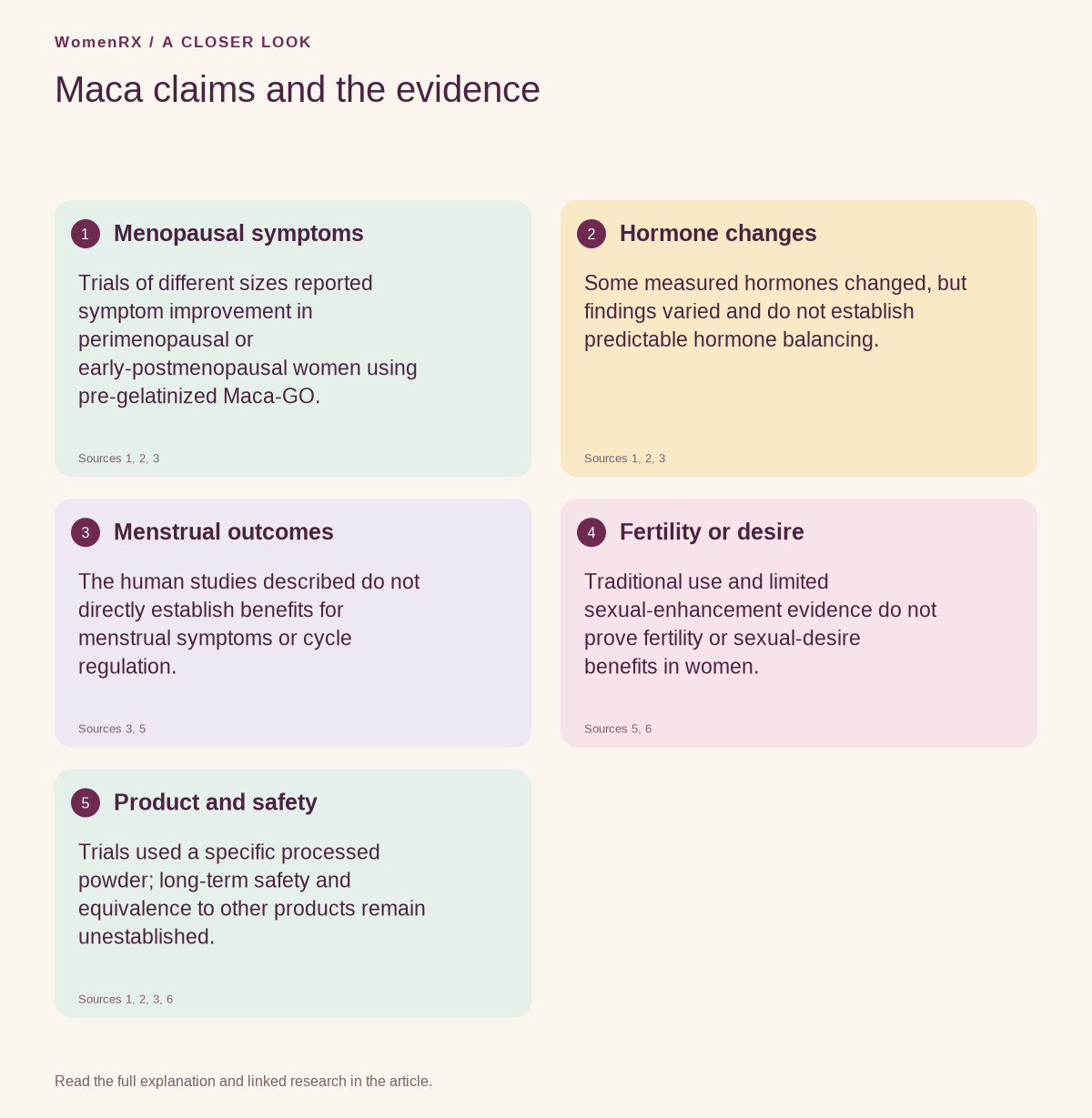
Maca claims and the evidence
Menopausal symptoms: Trials of different sizes reported symptom improvement in perimenopausal or early-postmenopausal women using pre-gelatinized Maca-GO.123
Hormone changes: Some measured hormones changed, but findings varied and do not establish predictable hormone balancing.123
Menstrual outcomes: The human studies described do not directly establish benefits for menstrual symptoms or cycle regulation.35
Fertility or desire: Traditional use and limited sexual-enhancement evidence do not prove fertility or sexual-desire benefits in women.56
Product and safety: Trials used a specific processed powder; long-term safety and equivalence to other products remain unestablished.1236
Read the figure as text
Compare the outcomes studied in women with the preparation used and what the findings can reasonably support.- Menopausal symptoms: Trials of different sizes reported symptom improvement in perimenopausal or early-postmenopausal women using pre-gelatinized Maca-GO.123
- Hormone changes: Some measured hormones changed, but findings varied and do not establish predictable hormone balancing.123
- Menstrual outcomes: The human studies described do not directly establish benefits for menstrual symptoms or cycle regulation.35
- Fertility or desire: Traditional use and limited sexual-enhancement evidence do not prove fertility or sexual-desire benefits in women.56
- Product and safety: Trials used a specific processed powder; long-term safety and equivalence to other products remain unestablished.1236
More questions, answered
Does maca raise estrogen?
Some maca trials in menopausal women reported changes in measured hormone levels, including estrogen, but the studies were small and results varied. That doesn’t establish a predictable estrogen-raising effect or show that maca is a reliable hormone treatment. 1 2 3
Is maca proven to help with periods or fertility?
The human trials discussed above don’t provide direct clinical evidence that maca regulates menstrual cycles or improves fertility in women. Traditional use and animal research can’t establish those benefits in people. 3 4 5
Sources you can check
- Hormone-Balancing Effect of Pre-Gelatinized Organic Maca (Lepidium peruvianum Chacon): (II) Physiological and Symptomatic Responses of Early-Postmenopausal Women to Standardized doses of Maca in Double Blind, Randomized, Placebo-Controlled, Multi-Centre Clinical Study.Meissner HO, Mscisz A, Reich-Bilinska H, Kapczynski W, Mrozikiewicz P, Bobkiewicz-Kozlowska T, Kedzia B, Lowicka A, Barchia I. · International journal of biomedical science : IJBS · 2006Return to first citation
- Hormone-Balancing Effect of Pre-Gelatinized Organic Maca (Lepidium peruvianum Chacon): (III) Clinical responses of early-postmenopausal women to Maca in double blind, randomized, Placebo-controlled, crossover configuration, outpatient study.Meissner HO, Mscisz A, Reich-Bilinska H, Mrozikiewicz P, Bobkiewicz-Kozlowska T, Kedzia B, Lowicka A, Barchia I. · International journal of biomedical science : IJBS · 2006Return to first citation
- Therapeutic Effects of Pre-Gelatinized Maca (Lepidium Peruvianum Chacon) used as a Non-Hormonal Alternative to HRT in Perimenopausal Women - Clinical Pilot Study.Meissner HO, Reich-Bilinska H, Mscisz A, Kedzia B. · International journal of biomedical science : IJBS · 2006Return to first citation
- Hormone-Balancing Effect of Pre-Gelatinized Organic Maca (Lepidium peruvianum Chacon): (I) Biochemical and Pharmacodynamic Study on Maca using Clinical Laboratory Model on Ovariectomized Rats.Meissner HO, Mrozikiewicz P, Bobkiewicz-Kozlowska T, Mscisz A, Kedzia B, Lowicka A, Reich-Bilinska H, Kapczynski W, Barchia I. · International journal of biomedical science : IJBS · 2006Return to first citation
- Use of gelatinized maca (lepidium peruvianum) in early postmenopausal women.Meissner HO, Kapczynski W, Mscisz A, Lutomski J. · International journal of biomedical science : IJBS · 2005Return to first citation
- Natural Aphrodisiacs-A Review of Selected Sexual Enhancers.West E, Krychman M. · Sexual medicine reviews · 2015Return to first citation