Maca Supplements: Match the Claim to the Research
Small trials found promising menopause symptom-score results, but they don’t identify a maca product you can confidently match to those findings.
Maca has been studied in women for menopause symptoms, with four small randomized trials reporting favorable changes on symptom scales. The evidence isn’t strong enough for firm conclusions or for choosing a particular supplement. Libido research is limited, and fertility claims remain unproven. If hot flashes are your main concern, menopause guidance does not recommend supplements or herbal remedies for them. 1 2 3 4
Start with the outcome you want
A maca label might promise support for menopause, desire and fertility in the same breath. Those aren’t interchangeable claims. The research looks different for each goal.
Menopause symptoms: A systematic review found four randomized, placebo-controlled trials involving healthy perimenopausal, early postmenopausal and late postmenopausal women. All four reported favorable results on the Kupperman Menopausal Index or Greene Climacteric Score, which assess a range of menopause symptoms. But the reviewers found too few participants and too many study-quality limitations to reach a firm conclusion about effectiveness. A change in a combined symptom score also doesn’t tell you that maca will reliably relieve the one symptom bothering you most. 2
Hot flashes and night sweats: These are a more specific question than overall menopause symptom scores. The North American Menopause Society’s 2023 guidance does not recommend supplements or herbal remedies for menopause-related hot flashes and night sweats. It does identify evidence-supported nonhormonal options, including cognitive behavioral therapy, clinical hypnosis and several prescription treatments. That gives you a more useful comparison if relief from these symptoms is your main goal. 1
Sexual desire: Don’t read a menopause symptom result as a libido result. A review of sexual-enhancement products described maca’s evidence as limited but emerging and called for more randomized trials before most such products could be recommended. It does not establish a dependable benefit for women from a particular maca supplement. 4
Fertility: Traditional use and current marketing are not evidence that maca improves the chance of pregnancy. A critical review found reproductive-health studies inconclusive and concluded that maca’s health claims could not yet be fully supported. 3
What “maca preparation” tells you, and what it doesn’t
Maca has traditionally been eaten cooked or baked, made into porridge, and fermented as a drink. Those are documented ways of preparing the plant, not the preparations established as effective in the menopause trials. The menopause review included maca-based interventions but does not establish which retail preparation matches the studied ones. It therefore can’t justify treating a capsule, powder or extract as equivalent to a trial intervention. 2 3
Composition is another reason not to assume products are interchangeable. A review of maca’s reproductive-health claims notes that growing and production practices may affect the plant’s chemical composition. It discusses compounds found in maca but says their proposed medicinal effects have not been confirmed. Neither an origin story nor a claim about a particular compound proves that a product works. 3
If you’re comparing labels, first pin down the specific claim you’re buying for. Then look for a clearly identified maca ingredient and preparation, rather than assuming that products with the same plant name have the same evidence behind them. A multi-ingredient product makes the comparison harder still: a study of maca alone wouldn’t establish what the combination does. No brand ranking follows from these clinical findings. 2 3
Keep the promise in proportion
The menopause trials offer a reason to keep studying maca, not proof that it “balances hormones.” Their reported favorable findings concern symptom scales; the broader review of reproductive-health claims also found the evidence inconclusive. The menopause review said safety had not yet been established in larger studies, so its promising results shouldn’t be read as a broad safety finding either. 2 3
The practical distinction is simple: a product can contain maca without being the preparation studied, and a claim can sound related to menopause without measuring the outcome you care about. For hot flashes in particular, there are better-supported options to compare against a supplement claim. 1 2
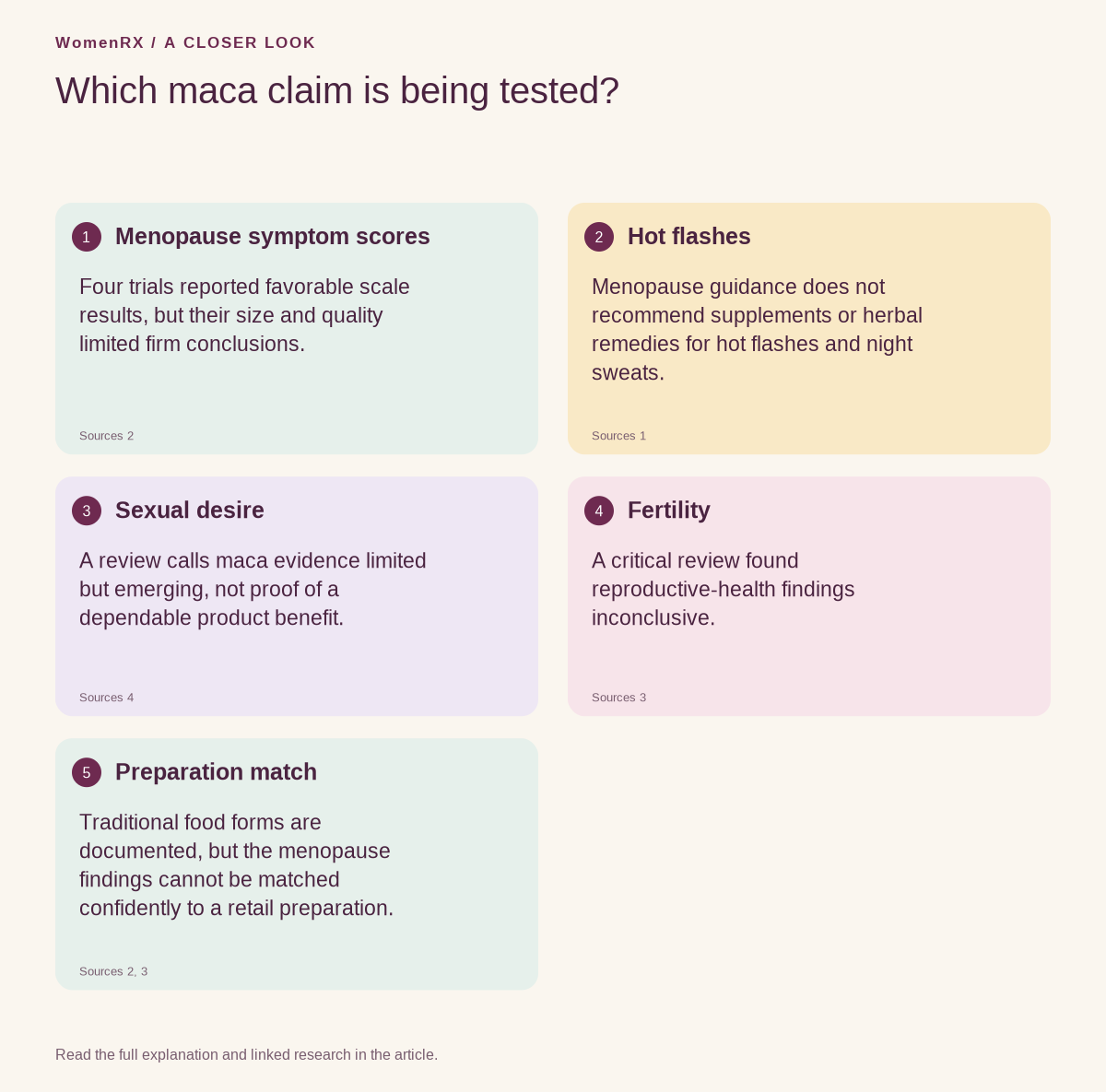
Which maca claim is being tested?
Menopause symptom scores: Four trials reported favorable scale results, but their size and quality limited firm conclusions.2
Hot flashes: Menopause guidance does not recommend supplements or herbal remedies for hot flashes and night sweats.1
Sexual desire: A review calls maca evidence limited but emerging, not proof of a dependable product benefit.4
Fertility: A critical review found reproductive-health findings inconclusive.3
Preparation match: Traditional food forms are documented, but the menopause findings cannot be matched confidently to a retail preparation.23
Read the figure as text
Read the outcome separately from the preparation: a result for one goal does not establish a benefit for another.- Menopause symptom scores: Four trials reported favorable scale results, but their size and quality limited firm conclusions.2
- Hot flashes: Menopause guidance does not recommend supplements or herbal remedies for hot flashes and night sweats.1
- Sexual desire: A review calls maca evidence limited but emerging, not proof of a dependable product benefit.4
- Fertility: A critical review found reproductive-health findings inconclusive.3
- Preparation match: Traditional food forms are documented, but the menopause findings cannot be matched confidently to a retail preparation.23
Sources you can check
- The 2023 nonhormone therapy position statement of The North American Menopause Society.Menopause (New York, N.Y.) · 2023Return to first citation
- Maca (Lepidium meyenii) for treatment of menopausal symptoms: A systematic review.Lee MS, Shin BC, Yang EJ, Lim HJ, Ernst E. · Maturitas · 2011Return to first citation
- Is the hype around the reproductive health claims of maca (Lepidium meyenii Walp.) justified?Beharry S, Heinrich M. · Journal of ethnopharmacology · 2018Return to first citation
- Natural Aphrodisiacs-A Review of Selected Sexual Enhancers.West E, Krychman M. · Sexual medicine reviews · 2015Return to first citation