Maca for Menopause and Libido: What Has Actually Been Tested?
A small trial found improvements in some postmenopausal women’s symptom scores, but it didn’t establish that maca raises libido, balances hormones, or reliably relieves hot flashes.
Maca has been tested in postmenopausal women, but the results are narrower than many product claims. In one 14-person placebo-controlled trial, scores for psychological symptoms and sexual dysfunction improved, while measured reproductive hormones did not change. An earlier, small pilot reported hormone changes and less overall discomfort. Both studies enrolled postmenopausal women, so they do not establish whether maca helps during perimenopause. Neither finding establishes maca as a reliable treatment for hot flashes or proves that it increases libido.75
Sexual wellbeing was measured, but libido is a narrower claim
If you’re considering maca because sex feels different after menopause, the most directly relevant trial offers a reason for interest, not a firm answer. Fourteen postmenopausal women completed a randomized, double-blind crossover study: each received powdered maca for six weeks and placebo for six weeks, in either order. After maca, their scores on a menopause questionnaire improved in the areas of psychological symptoms and sexual dysfunction compared with both their starting scores and placebo. That’s a finding about questionnaire scores in a very small group of women after menopause. The trial does not tell us whether women in perimenopause would have the same result. It also doesn’t tell us that maca specifically increased sexual desire, or which part of sexual wellbeing changed for any given woman.7
Another placebo-controlled study examined maca for antidepressant-induced sexual dysfunction in women. That’s a distinct question: sexual difficulties associated with an antidepressant may not have the same causes as changes around menopause. Because this study investigated sexual difficulties associated with antidepressants, it cannot establish that maca improves libido after menopause.8
Sexual wellbeing is broader than desire alone. Medicines and chronic health conditions can affect the ability to have or enjoy sex. If your main issue is pain with sex related to vaginal changes after menopause, that calls for a different discussion than a supplement marketed for libido; treatments for menopausal vaginal symptoms are available.162
Hot flashes are a different outcome
A reduction in an overall menopause score does not show that hot flashes improved. One small pilot study in healthy women in early postmenopause reported less menopausal discomfort while taking a gelatinized maca preparation. It also found a noticeable response during a placebo period. The study involved 20 women in its three-month portion and eight in a longer portion, so its findings don’t establish dependable relief for a particular symptom.5
A 2014 review described randomized trials of maca extracts as showing reduced vasomotor symptoms, the category that includes hot flashes. That review does not establish how large or consistent the benefit was across trials. The Menopause Society’s later evidence review does not recommend supplements and herbal remedies for treating vasomotor symptoms. Taken together, these sources support interest in further research, not a promise that maca will stop hot flashes or night sweats.43
If hot flashes are disrupting sleep or daily life, you don’t have to treat maca as the only nonhormonal option. The Menopause Society recommends several evidence-supported approaches for vasomotor symptoms, including cognitive behavioral therapy, clinical hypnosis, and certain prescription medicines. Which option fits depends on what you’re experiencing and your preferences.3
A hormone result doesn’t explain a symptom result
Maca is sometimes sold as a way to “balance hormones.” The human findings don’t support that simple story. In the 14-person crossover trial, measured estradiol, follicle-stimulating hormone, luteinizing hormone, and sex hormone-binding globulin did not differ across baseline, maca, and placebo, despite the improvements in some symptom scores.7
The earlier pilot reported changes in several hormone measurements, including higher estradiol and progesterone after eight months with its gelatinized preparation. But only eight women took part in that longer portion, and the researchers also reported a placebo response. That result cannot establish a predictable hormone effect for someone buying maca today. Nor would a change in a blood test, by itself, prove relief from hot flashes or better sexual wellbeing.57
The preparations matter, too. These studies used specified products: powdered maca in the crossover trial and gelatinized maca in the pilot. Their findings shouldn’t be treated as proof that every maca powder, extract, or blend has the same effects.75
How to use this evidence when choosing
Start with the outcome you actually want to change. For hot flashes, the evidence does not put maca alongside established options. For sexual wellbeing, one small postmenopausal trial found an improvement on a sexual-dysfunction questionnaire, but it cannot tell you whether maca will help with low desire, pain, or another specific concern. The symptom studies discussed here enrolled women after menopause, not during perimenopause, so they cannot establish a benefit during the menopause transition. And hormone-balancing language goes beyond what the better-controlled hormone measurements showed.3752
There’s also limited information on the long-term safety of supplements marketed for menopause. Supplements can cause side effects or interact with medicines, but these sources do not establish a specific maca-medicine interaction or a tested safe regimen. If you take medication or have a health condition, bring the exact product label into a conversation about whether it makes sense for you, rather than relying on a general claim that it’s natural.6
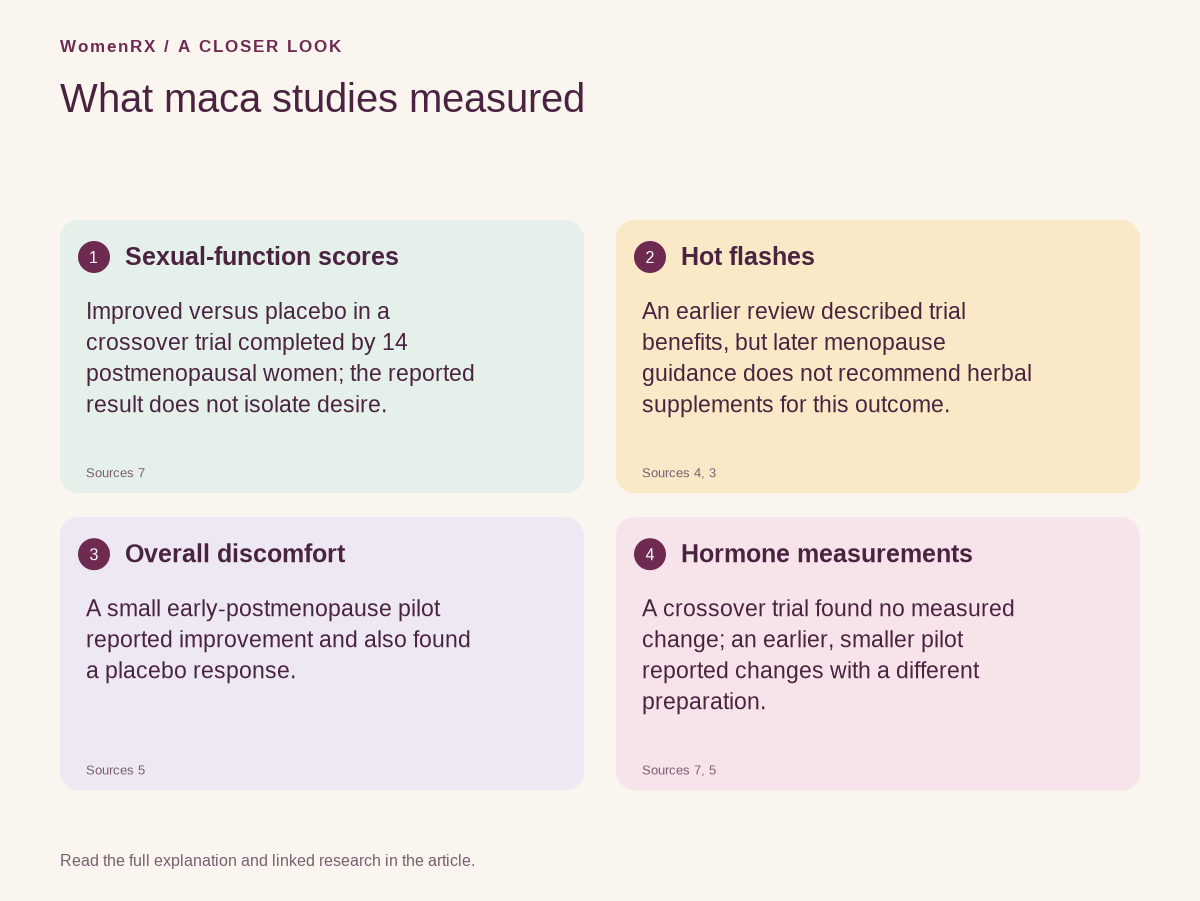
What maca studies measured
Sexual-function scores: Improved versus placebo in a crossover trial completed by 14 postmenopausal women; the reported result does not isolate desire.7
Hot flashes: An earlier review described trial benefits, but later menopause guidance does not recommend herbal supplements for this outcome.43
Overall discomfort: A small early-postmenopause pilot reported improvement and also found a placebo response.5
Hormone measurements: A crossover trial found no measured change; an earlier, smaller pilot reported changes with a different preparation.75
Read the figure as text
These outcomes are related, but a finding in one column does not answer the others.- Sexual-function scores: Improved versus placebo in a crossover trial completed by 14 postmenopausal women; the reported result does not isolate desire.7
- Hot flashes: An earlier review described trial benefits, but later menopause guidance does not recommend herbal supplements for this outcome.43
- Overall discomfort: A small early-postmenopause pilot reported improvement and also found a placebo response.5
- Hormone measurements: A crossover trial found no measured change; an earlier, smaller pilot reported changes with a different preparation.75
More questions, answered
Does maca work by increasing estrogen?
That hasn’t been established. In a small placebo-controlled trial, symptom scores improved without a difference in measured estradiol between maca and placebo. An earlier pilot reported hormone changes with a different preparation, but its longer portion included only eight women.75
Is a study of antidepressant-related sexual problems relevant to menopause?
It shows that maca has been investigated for sexual dysfunction in women, but antidepressant-related difficulties are not the same question as sexual changes after menopause. You can’t assume a result for one group applies to the other.81
Sources you can check
- Sexual Health | MedlinePlusAccessed 2026-09-25Return to first citation
- The 2022 hormone therapy position statement of The North American Menopause Society.“The 2022 Hormone Therapy Position Statement of The North American Menopause Society” Advisory Panel. · Menopause (New York, N.Y.) · 2022Return to first citation
- The 2023 nonhormone therapy position statement of The North American Menopause Society.Menopause (New York, N.Y.) · 2023Return to first citation
- Herbal preparations for the menopause: beyond isoflavones and black cohosh.Depypere HT, Comhaire FH. · Maturitas · 2014Return to first citation
- Use of gelatinized maca (lepidium peruvianum) in early postmenopausal women.Meissner HO, Kapczynski W, Mscisz A, Lutomski J. · International journal of biomedical science : IJBS · 2005Return to first citation
- Menopause | Menopause Symptoms | MedlinePlusAccessed 2026-09-25Return to first citation
- Beneficial effects of Lepidium meyenii (Maca) on psychological symptoms and measures of sexual dysfunction in postmenopausal women are not related to estrogen or androgen content.Brooks NA, Wilcox G, Walker KZ, Ashton JF, Cox MB, Stojanovska L. · Menopause (New York, N.Y.) · 2008Return to first citation
- A double-blind placebo-controlled trial of maca root as treatment for antidepressant-induced sexual dysfunction in women.Dording CM, Schettler PJ, Dalton ED, Parkin SR, Walker RS, Fehling KB, Fava M, Mischoulon D. · Evidence-based complementary and alternative medicine : eCAM · 2015Return to first citation