Can Food Affect Libido? Look Beyond the Menu
A small diet study found an improvement in overall sexual function, but not a significant change in desire itself.
Diet may play a part in sexual health, but a study of women with metabolic syndrome and sexual dysfunction did not find a significant improvement in desire with a Mediterranean-style diet. 3 If your desire has changed, it may be more useful to consider whether medication, discomfort, health concerns, or postpartum changes are part of the picture. 15 You don’t have to treat lower desire as a problem unless it’s a problem for you.
An overall improvement isn’t the same as more desire
The clearest diet study here followed 59 women who had both metabolic syndrome and sexual dysfunction. Thirty-one were assigned to a Mediterranean-style diet and 28 to a control diet. After two years, the diet group’s average overall sexual-function score rose from 19.7 to 26.1, while the control group’s score remained stable. But none of the individual areas measured, including desire, improved significantly on its own. 3
That distinction matters if your question is specifically, “Will eating this make me want sex more?” The study tested an eating pattern, not a particular food, and its participants had a specific combination of health concerns. It offers a reason to consider diet as one part of broader health, not a reliable libido prescription. 3 A separate survey of Turkish women reported an association between diet-related lifestyle factors and sexual dysfunction, but a survey cannot show that diet caused the difference or identify a food that changes desire. 4
What changed besides your meals?
A shift in desire doesn’t automatically need fixing. If it feels unwanted, though, the timing and the kind of concern can tell you more than a list of supposed aphrodisiacs. Consider these possibilities without assuming any one is the cause:
- A medicine was started or changed. Medicines can affect sexual desire or performance. If the timing fits, ask the prescriber whether the medicine could be contributing and what options make sense for you, rather than stopping it on your own. Antidepressants can cause side effects, and a prescriber can discuss options when side effects are difficult to manage. 12
- Sex has become uncomfortable, or something else about it has changed. Desire, pain, lubrication, arousal, and satisfaction are distinct parts of sexual function. Naming what feels different can make the concern clearer than calling every change “low libido.” 3
- You’re postpartum. In a cross-sectional study of 256 postpartum women in Turkey, body-image dissatisfaction was associated with decreased sexual activity and desire. That does not mean body image caused a particular woman’s change. It does show why a conversation about desire after birth might need to include more than food or hormones. 5
- Your health or circumstances have shifted. Chronic disease and concern about an unplanned pregnancy can affect sexual health. 1 You might also consider whether the change coincided with menopause or a change in your relationship, without treating the timing as proof of a cause. A survey found an association between menopause status and sexual dysfunction, but it cannot explain an individual change in desire. 4
Let the concern shape your next step
If the change began around a prescription change, start with the person who prescribes it. If pain or another sexual symptom is what makes sex less appealing, say that directly when seeking care. If you’re postpartum, you can describe the physical or emotional changes that feel relevant without having to choose one explanation first. These are ways to make a conversation more specific, not a checklist that diagnoses the cause. 1235
And if your desire has changed but you’re comfortable with it, you don’t owe anyone a food plan to change it. The diet finding is about an overall score in a small, specific group. It isn’t evidence that a particular food will increase your desire. 3
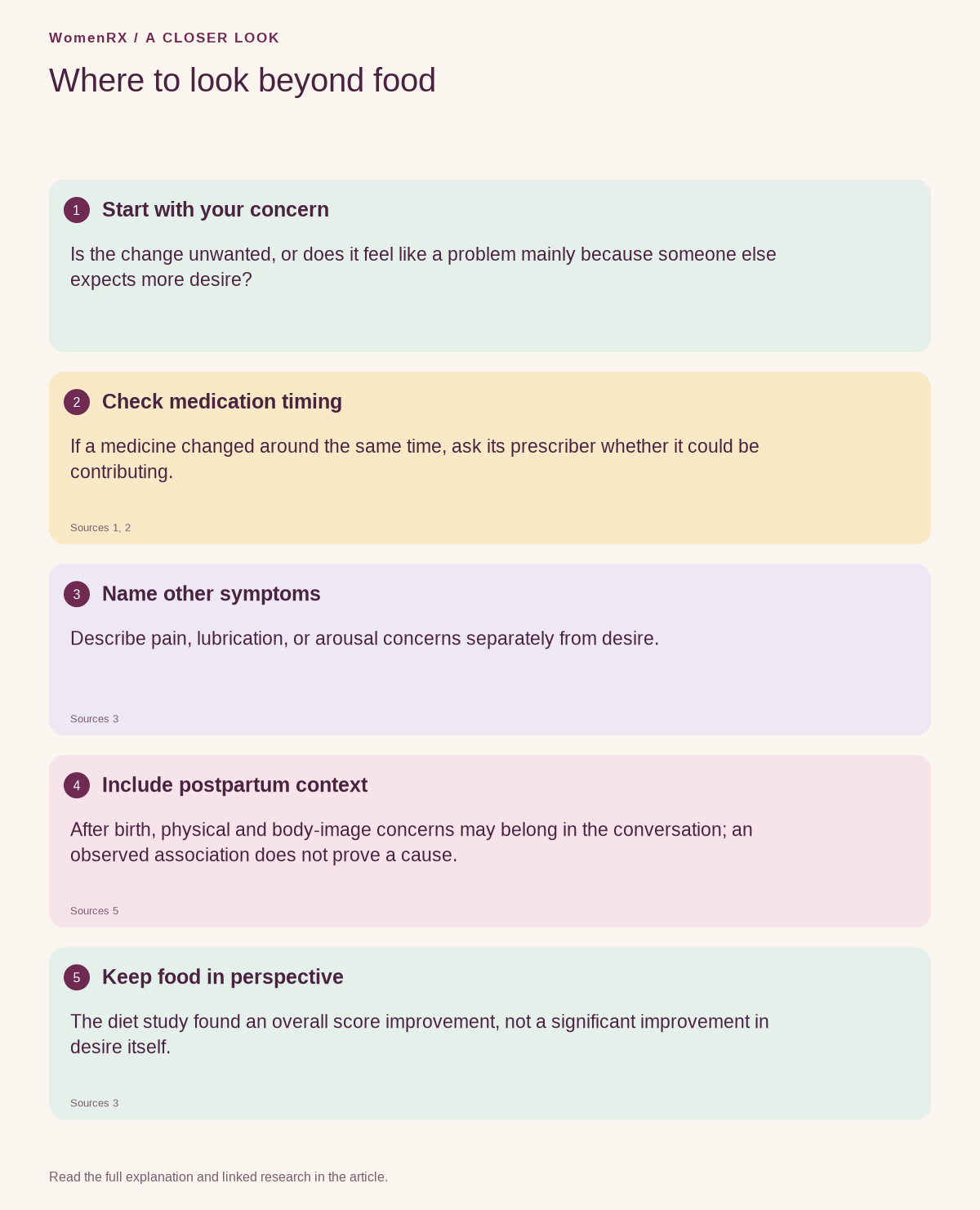
Where to look beyond food
Start with your concern: Is the change unwanted, or does it feel like a problem mainly because someone else expects more desire?
Check medication timing: If a medicine changed around the same time, ask its prescriber whether it could be contributing.12
Name other symptoms: Describe pain, lubrication, or arousal concerns separately from desire.3
Include postpartum context: After birth, physical and body-image concerns may belong in the conversation; an observed association does not prove a cause.5
Keep food in perspective: The diet study found an overall score improvement, not a significant improvement in desire itself.3
Read the figure as text
Use what changed and what feels concerning to find a more focused question. This is not a diagnostic test.- Start with your concern: Is the change unwanted, or does it feel like a problem mainly because someone else expects more desire?
- Check medication timing: If a medicine changed around the same time, ask its prescriber whether it could be contributing.12
- Name other symptoms: Describe pain, lubrication, or arousal concerns separately from desire.3
- Include postpartum context: After birth, physical and body-image concerns may belong in the conversation; an observed association does not prove a cause.5
- Keep food in perspective: The diet study found an overall score improvement, not a significant improvement in desire itself.3
More questions, answered
Did the Mediterranean-style diet study test any individual food as a libido booster?
No. It tested an eating pattern in women with metabolic syndrome and sexual dysfunction. Their overall sexual-function score improved, but desire did not improve significantly as an individual measure. The study cannot tell you whether a particular food increases desire. 3
Sources you can check
- Sexual Health | MedlinePlusAccessed 2026-09-25Return to first citation
- Antidepressants - NHSAccessed 2026-09-25Return to first citation
- Mediterranean diet improves sexual function in women with the metabolic syndrome.Esposito K, Ciotola M, Giugliano F, Schisano B, Autorino R, Iuliano S, Vietri MT, Cioffi M, De Sio M, Giugliano D. · International journal of impotence research · 2007Return to first citation
- Prevalence and risk factors for female sexual dysfunction in Turkish women.Oksuz E, Malhan S. · The Journal of urology · 2006Return to first citation
- Body dissatisfaction of women during postpartum period and copin strategies.Boybay Koyuncu S, Duman M. · Women & health · 2022Return to first citation