Metabolic Health in Your 60s: Look Beyond the Scale
A useful health review connects blood pressure, blood sugar, cholesterol, medications, and the strength you rely on every day.
In your 60s, cardiometabolic care is about more than body weight. Ask whether your blood pressure, blood sugar, and cholesterol need attention, and how your medicines and health history affect those risks. Bring up changes in strength, balance, or everyday mobility too. These details can help shape a plan around both long-term health and what you want to keep doing. 1
Start with risk factors, not a label
Metabolic syndrome describes a cluster of risk factors linked with heart disease and type 2 diabetes. Having several together matters, but the label alone doesn’t tell the whole story about your health or what treatment you need. Many of these risk factors have no obvious symptoms, so a person can feel well and still benefit from reviewing them. 1
At a visit, ask whether your blood pressure, blood sugar, and cholesterol or other blood fats should be checked or discussed. The right review depends on your history and previous results. A clinician may also ask about your health and your family’s health when considering risk. 12
One way to make the conversation specific is to ask: “Which result, if any, changes what we should do next?” That keeps the focus on decisions rather than on collecting numbers without context.
Include strength and mobility in the picture
Weight is only one part of health. It doesn’t show how easily you get out of a chair, climb stairs, carry groceries, or recover after activity. If any of those tasks have become harder, say so. These examples aren’t a diagnostic test; they help explain what matters to you and where function has changed.
Research offers a reason to take muscle function seriously, but not a personal risk calculator. In a prospective study of 3,168 older adults in China, greater muscle power was associated with lower risk of hospital-treated cardiovascular disease among women during follow-up. Measures of adiposity were associated with higher risk in men, but those associations weren’t observed in women in that study. The results are exploratory and don’t show that improving muscle power prevents heart disease, or that body fat is irrelevant to an individual woman’s risk. 3
A separate cross-sectional study of adults aged 50 and older in Mexico found that stronger handgrip was associated with lower pulse pressure among women. Because it measured people at one point in time, it can’t establish which factor came first or show that strength training changes cardiovascular outcomes. Together, these studies support discussing function alongside conventional risk factors, not replacing one assessment with the other. 4
If you have osteoporosis, a prior fracture, or concerns about bone health, mention those alongside muscle and mobility goals. Bone loss, muscle loss, and excess adiposity can overlap in older women, but a review of this topic also describes a need for clearer diagnostic criteria. That’s a reason to discuss your own history and function rather than assume one syndrome or treatment fits everyone. 6
Review medicines for what they may affect
Bring an up-to-date list of prescription medicines, over-the-counter products, and supplements. Some medicines can contribute to weight gain or affect blood pressure, cholesterol, or blood sugar. That doesn’t mean you should stop or change anything on your own. Ask whether any medicine could be influencing a result, what it is treating, and whether there are reasonable alternatives for your situation. 1
If a treatment for blood pressure or cholesterol is being considered, ask what specific risk it targets and how you’ll know whether the plan is working. Lifestyle changes and medicines can both be part of care; the choice depends on your results and individual circumstances. 1
If weight loss is part of the discussion, it’s fair to ask what health or functional benefit is expected, and how the plan accounts for strength and lean mass. A review of weight-loss medicines in older women raises muscle preservation as a consideration, but it doesn’t establish one approach as best for every woman in her 60s. 5
Make the visit about your priorities
Before the visit, choose one or two things you most want to protect or improve. That might be keeping up on walks, managing a health condition, maintaining independence, or feeling steadier on stairs. Then connect each priority to a question:
- “Which risk factor matters most for me right now, and why?”
- “Could any of my medicines be affecting my results or function?”
- “If we recommend a change, how will we account for my strength, mobility, or bone health?”
- “What should we revisit, and when?”
Those questions make room for prevention and treatment without making weight the only measure of progress. The goal is a plan that addresses real risks while respecting the everyday abilities and priorities you want to maintain.
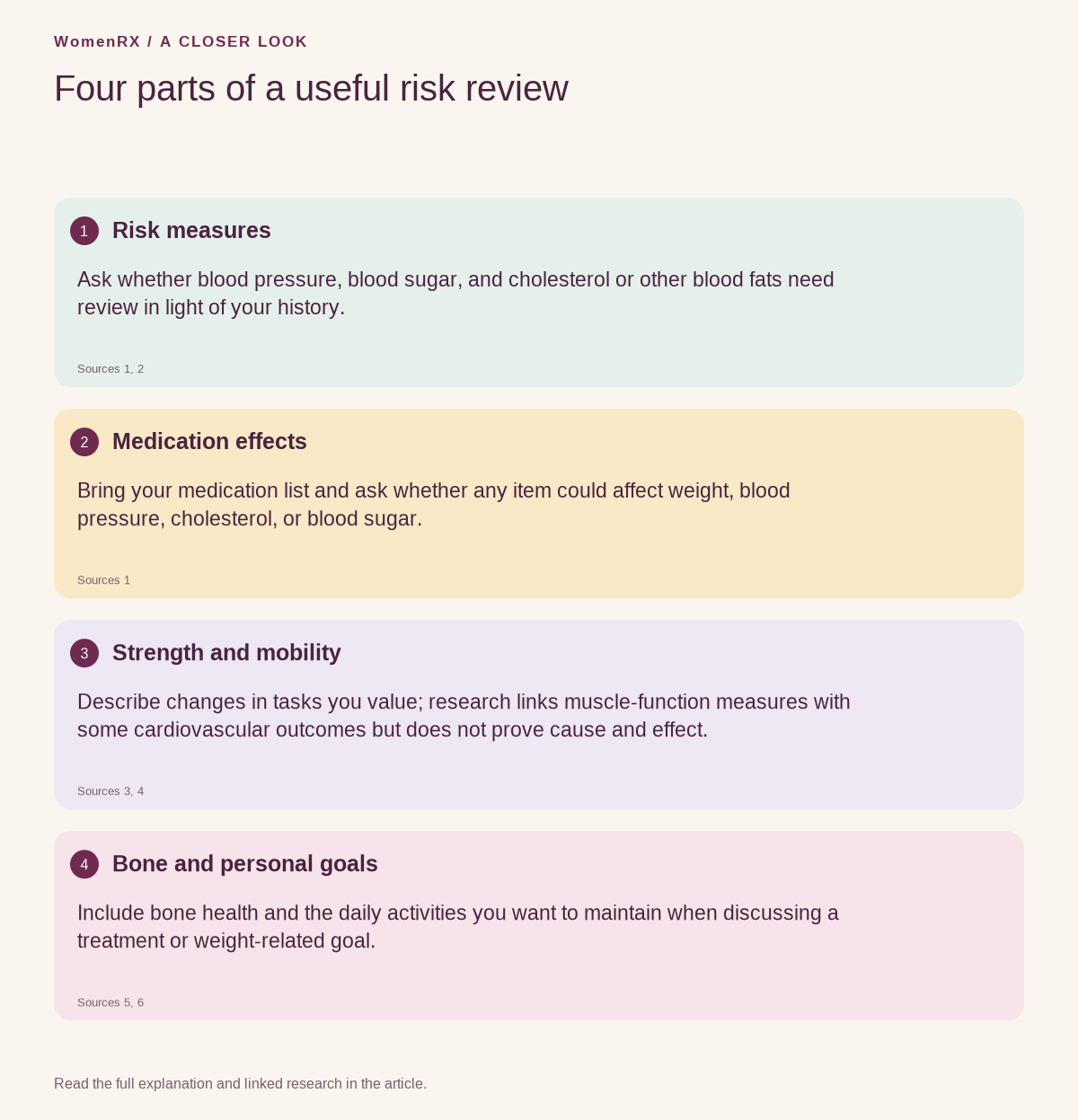
Four parts of a useful risk review
Risk measures: Ask whether blood pressure, blood sugar, and cholesterol or other blood fats need review in light of your history.12
Medication effects: Bring your medication list and ask whether any item could affect weight, blood pressure, cholesterol, or blood sugar.1
Strength and mobility: Describe changes in tasks you value; research links muscle-function measures with some cardiovascular outcomes but does not prove cause and effect.34
Bone and personal goals: Include bone health and the daily activities you want to maintain when discussing a treatment or weight-related goal.56
Read the figure as text
Use these prompts to connect cardiometabolic results with the medicines, physical abilities, and priorities that shape your care.- Risk measures: Ask whether blood pressure, blood sugar, and cholesterol or other blood fats need review in light of your history.12
- Medication effects: Bring your medication list and ask whether any item could affect weight, blood pressure, cholesterol, or blood sugar.1
- Strength and mobility: Describe changes in tasks you value; research links muscle-function measures with some cardiovascular outcomes but does not prove cause and effect.34
- Bone and personal goals: Include bone health and the daily activities you want to maintain when discussing a treatment or weight-related goal.56
More questions, answered
Can metabolic risk be present if I feel fine?
Yes. Many metabolic risk factors have no obvious symptoms, so feeling well doesn’t necessarily tell you whether blood sugar, cholesterol, or other risks need review. 1
Does a stronger grip or better mobility mean my heart risk is low?
No. Studies have found associations between muscle function and some cardiovascular outcomes, but those findings don’t replace reviewing your individual risk factors or prove that strength alone determines risk. 34
Sources you can check
- Metabolic Syndrome | MedlinePlusAccessed 2026-09-25Return to first citation
- Metabolic syndrome - NHSAccessed 2026-09-25Return to first citation
- Sex-Stratified Associations of DXA-Derived Adiposity, Regional Fat Distribution and Muscle Power With Incident Hospitalised Cardiovascular Disease in Older Adults: A Prospective Cohort Study.Zhang T, Gao Y, Wu Y, Leung J, Kwok T. · Diabetes, obesity & metabolism · 2026Return to first citation
- Muscle Strength as a Key Independent Predictor of Arterial Stiffness and Metabolic Syndrome in Aging Mexicans: Unveiling the Sarcopenic Obesity Paradox.Garcia-Carrillo E, Pezoa-Fuentes P, Guzmán-Muñoz E, Concha-Cisternas Y, Montalva-Valenzuela F, Olivares-Arancibia J, González-Aroca J, Cortés-Roco G, Yáñez-Sepúlveda R. · Journal of clinical medicine · 2026Return to first citation
- A Narrative Review on GLP-1 Receptor Agonists for Obesity in Older Women: Maximizing Weight Loss While Preserving Lean Mass.Moscucci F, Baratta F, Pastori D, Menichelli D, Mattioli AV, Gallina S, Lospinuso I, Sciomer S, Piccirillo G, Desideri G. · Nutrients · 2026Return to first citation
- Osteo-sarcopenic obesity in midlife and older women: a current worldwide public health challenge.Chedraui P, Giannini A, Simoncini T. · Climacteric : the journal of the International Menopause Society · 2025Return to first citation