Can Food Choices Affect Stress or Cortisol?
Food can affect how you feel, but evidence doesn’t establish a reliable cortisol-lowering diet for women.
Food choices may affect experiences linked with stress, such as feeling jittery after caffeine, but that’s different from showing that a food lowers cortisol. A review describes links between dietary patterns and mental-health outcomes, while a study in women tested a laboratory stressor, not a diet. Neither establishes that changing foods reliably lowers cortisol in women. 3 4 5
Stress, cortisol, and food are different outcomes
Stress is your body’s response to a challenge. It can bring physical changes, including the release of hormones; cortisol is one hormone measured in some stress studies. But a cortisol result is not the same thing as a person’s reported stress, anxiety, sleep, or eating behavior. 1 2
That distinction matters when you see a claim that a food “balances” or “lowers” cortisol. Ask what the study actually measured. Did people report feeling less stressed? Did researchers measure cortisol? Did they change a food or dietary pattern, or test something else? One result doesn’t automatically answer the others.
What studies of food patterns can tell you
A review describes associations between plant-based dietary patterns and lower risk of depression, anxiety, and cognitive problems. Those are mental-health outcomes, not proof that a particular diet lowers cortisol or treats stress. An association also doesn’t establish that the food pattern caused the difference. 5
A study involving 87 female participants offers a useful example of why outcomes need to be kept separate. Researchers assigned participants to different laboratory stress-test conditions and measured cortisol, anxiety, and food intake. One modified stress test increased cortisol above baseline, but cortisol reactivity didn’t correlate with energy intake. This was a study of responses to a stress test, not a trial of a diet or a cortisol-lowering food. 4
These results don’t establish whether stress or cortisol responses differ by menstrual stage, pregnancy, or menopause. 4
What caffeine can change
Caffeine stimulates the central nervous system. Too much can cause restlessness and shakiness, and MedlinePlus advises people with anxiety or sleep disorders to check whether they should limit or avoid it. If coffee or an energy drink leaves you feeling wired or disrupts your sleep, noticing that personal response may be more useful than assuming the drink has raised or lowered your cortisol. Caffeine’s stimulant effects aren’t evidence of a cortisol-lowering strategy. 3
A supplement claim is not a food claim
Ashwagandha is a supplement, not evidence that ordinary foods lower cortisol. A 2021 review summarized seven randomized trials involving 491 adults in India. Across those trials, ashwagandha was associated with lower self-reported stress or anxiety and lower serum cortisol than placebo. The trials varied in preparations and participants; the results don’t establish that every person felt calmer when cortisol fell, or that the findings apply specifically to women. 1
Later trials summarized by the NIH Office of Dietary Supplements included participants of more than one sex and measured stress ratings and cortisol. One trial found lower perceived stress and serum cortisol compared with placebo; another found lower fatigue but no reduction in perceived stress. These different outcomes are a reminder to check each result separately. The findings don’t establish women-specific effects or whether results differ by menstrual stage, pregnancy, or menopause. 1
Ashwagandha also has safety considerations that a “natural stress remedy” claim can leave out. Short-term studies generally lasted no more than about three months, and longer-term safety isn’t known. It may affect thyroid function, can interact with some medicines, and experts advise against its use during pregnancy or breastfeeding. 1
A quick way to check a claim
Before buying a product or changing your diet for cortisol, look for four details: the exact food or supplement tested, whether it was compared with a control, whether the outcome was perceived stress or a cortisol measurement, and who took part. If the claim is about women, check whether results were actually reported separately for women and whether life stage was considered. A study measuring cortisol during a stress test, or a supplement trial, doesn’t by itself show that a food pattern reliably lowers cortisol in women.
For a practical starting point, pay attention to how caffeine affects your own restlessness and sleep, and treat supplement promises more cautiously than claims about a specific study outcome. If stress is making it hard to manage usual daily activities, that’s a reason to seek support rather than relying on a food or supplement claim alone. 2 3
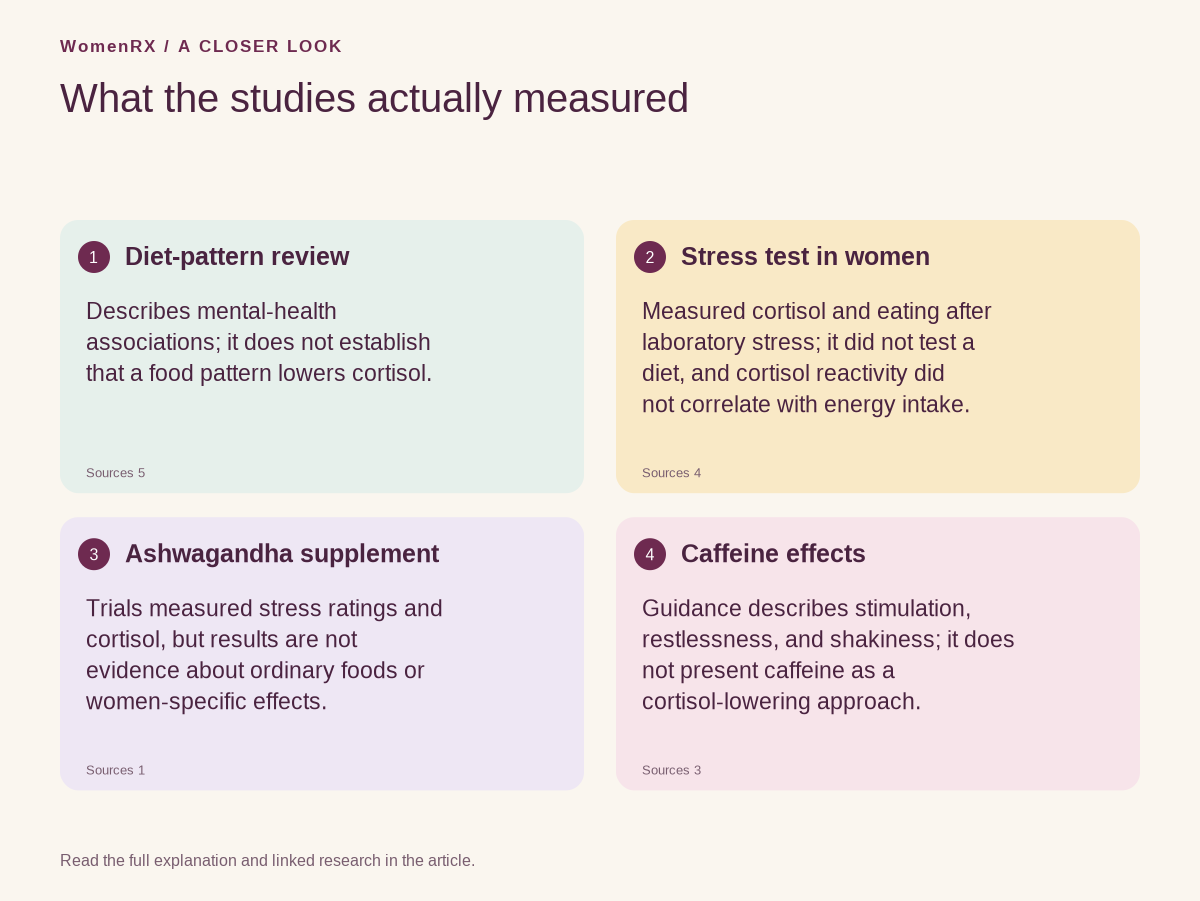
What the studies actually measured
Diet-pattern review: Describes mental-health associations; it does not establish that a food pattern lowers cortisol.5
Stress test in women: Measured cortisol and eating after laboratory stress; it did not test a diet, and cortisol reactivity did not correlate with energy intake.4
Ashwagandha supplement: Trials measured stress ratings and cortisol, but results are not evidence about ordinary foods or women-specific effects.1
Caffeine effects: Guidance describes stimulation, restlessness, and shakiness; it does not present caffeine as a cortisol-lowering approach.3
Read the figure as text
These examples separate food-pattern associations, stress-test responses, supplement trials, and caffeine effects so a result in one category isn’t mistaken for proof in another.- Diet-pattern review: Describes mental-health associations; it does not establish that a food pattern lowers cortisol.5
- Stress test in women: Measured cortisol and eating after laboratory stress; it did not test a diet, and cortisol reactivity did not correlate with energy intake.4
- Ashwagandha supplement: Trials measured stress ratings and cortisol, but results are not evidence about ordinary foods or women-specific effects.1
- Caffeine effects: Guidance describes stimulation, restlessness, and shakiness; it does not present caffeine as a cortisol-lowering approach.3
More questions, answered
Are foods and supplements supported by the same evidence here?
No. The ashwagandha findings are from supplement trials, while the study in women tested laboratory stress conditions rather than changing participants’ diets. Neither is evidence that a particular food reliably lowers cortisol in women. 1 4
Sources you can check
- Ashwagandha: Is it helpful for stress, anxiety, or sleep? - Health Professional Fact SheetAccessed 2026-09-25Return to first citation
- Stress: MedlinePlusAccessed 2026-09-25Return to first citation
- Caffeine: MedlinePlusAccessed 2026-09-25Return to first citation
- A modified Trier Social Stress Test enhances cortisol release, but not energy intake, in females: A randomized trial.Ghadeer TH, Redding CA, Campanella BL, Howes BP, Kingsbury LP, Love TR, McKoy KF, Tomiyama AJ, McKay NJ. · Psychoneuroendocrinology · 2025Return to first citation
- Exploring the role of diet in modulating stress and emotional health: a review on mental nutrition and cognitive resilience.Pandey VK, Tripathi A, Choudhary P, Thapliyal S. · Journal of the science of food and agriculture · 2026Return to first citation