Can Food Choices Support Anxiety Care?
A balanced eating pattern may fit alongside anxiety care, but research in people with IBS or depression doesn’t establish a single food or restrictive diet as an anxiety treatment.
Food can be part of supportive care, but trials in people with IBS or depression don’t establish that a particular food treats anxiety. Some dietary-pattern studies report mental-health improvements in specific groups, such as people with IBS, while a trial in people with treatment-resistant depression found no difference between diets on its secondary anxiety outcomes. Choose sustainable changes for overall eating, not a restrictive diet in place of anxiety treatment. 235
Start with the pattern, not a “calming” food
If you’re looking for something concrete to change, think about your usual eating pattern rather than one supposedly anxiety-fighting ingredient. A Mediterranean-style pattern can include whole grains, vegetables, fruit, legumes, fish, and olive oil. In a small randomized trial involving 59 people with IBS and anxiety or depression symptoms, this pattern was reported as feasible and associated with reduced gastrointestinal and psychological symptom severity compared with participants’ usual diet. That finding is encouraging, but it concerns people with IBS, not anxiety disorders generally. It doesn’t establish that any one food eased anxiety, or that the same result applies to everyone. 5
A later IBS trial compared a personalized diet guided by gut-microbiome testing with a low-FODMAP diet. Both groups’ anxiety scores improved over time, but the reported 12-month between-group comparison did not show a significant difference in anxiety. This is a useful reminder that a diet can help address a particular condition without one diet proving superior for anxiety itself. The participants had IBS, so these findings don’t establish either approach as anxiety treatment for the wider population. 2
What a diet trial can, and can’t, tell you
The details of a study matter. Was it testing a food pattern or a supplement? Were participants being treated for anxiety, or for another condition? Did the researchers test anxiety as a main outcome, or as one of several additional outcomes? And did the intervention combine food changes with something else?
For example, a randomized trial in adults with treatment-resistant depression compared a ketogenic diet with a diet that encouraged extra fruit and vegetables and replacing saturated fats with unsaturated fats. Most participants were women, but the study’s main focus was depression. It found no differences between the diets in secondary outcomes, including anxiety. It therefore doesn’t show that a ketogenic diet treats anxiety, nor does it establish that the comparison diet is an anxiety treatment. 3
In a trial of patients with symptomatic endometriosis, dietary coaching was combined with aerobic-exercise recommendations and ongoing hormonal treatment. The study reported a significant improvement in its anxiety component, but the combined program can’t tell us whether food, exercise, or another part of the intervention was responsible. This finding comes from a particular clinical setting, not evidence that anxiety is generally caused by hormones or can be treated by changing foods. 4
A realistic way to make a change
If you’d like to experiment with food while receiving anxiety care, aim for an addition or substitution you can keep up, not a list of foods you must avoid. For instance, you might try adding a vegetable or legume to a meal, choosing a whole grain more often, or using olive oil in place of a more saturated fat. These examples reflect foods included in the Mediterranean-style pattern studied in IBS and a substitution used in a separate diet trial; they aren’t proven anxiety treatments. 53
Notice whether the change works for your life as well as your plate. A plan that makes eating stressful, limits your choices sharply, or is hard to sustain may not be a useful support. The studies discussed above don’t establish that starting a ketogenic, low-FODMAP, or other restrictive diet solely to manage anxiety is beneficial. If a diet has been suggested for another health condition, its purpose and tradeoffs are a separate question from treating anxiety.
Keep anxiety care in the picture
Anxiety that persists, worsens, or interferes with everyday activities deserves attention in its own right. Anxiety disorders are assessed through symptoms and medical history, and sometimes an exam or tests to check for other causes. Common treatments include psychotherapy, medication, or both; food changes are not a replacement for that care. 1
The practical takeaway: choose a balanced, manageable eating pattern if it suits you, and judge claims by the people studied and what the trial actually measured. These condition-specific findings offer reasons to study dietary patterns further, but they don’t identify a particular food as an anxiety treatment or establish a special anxiety diet for women.
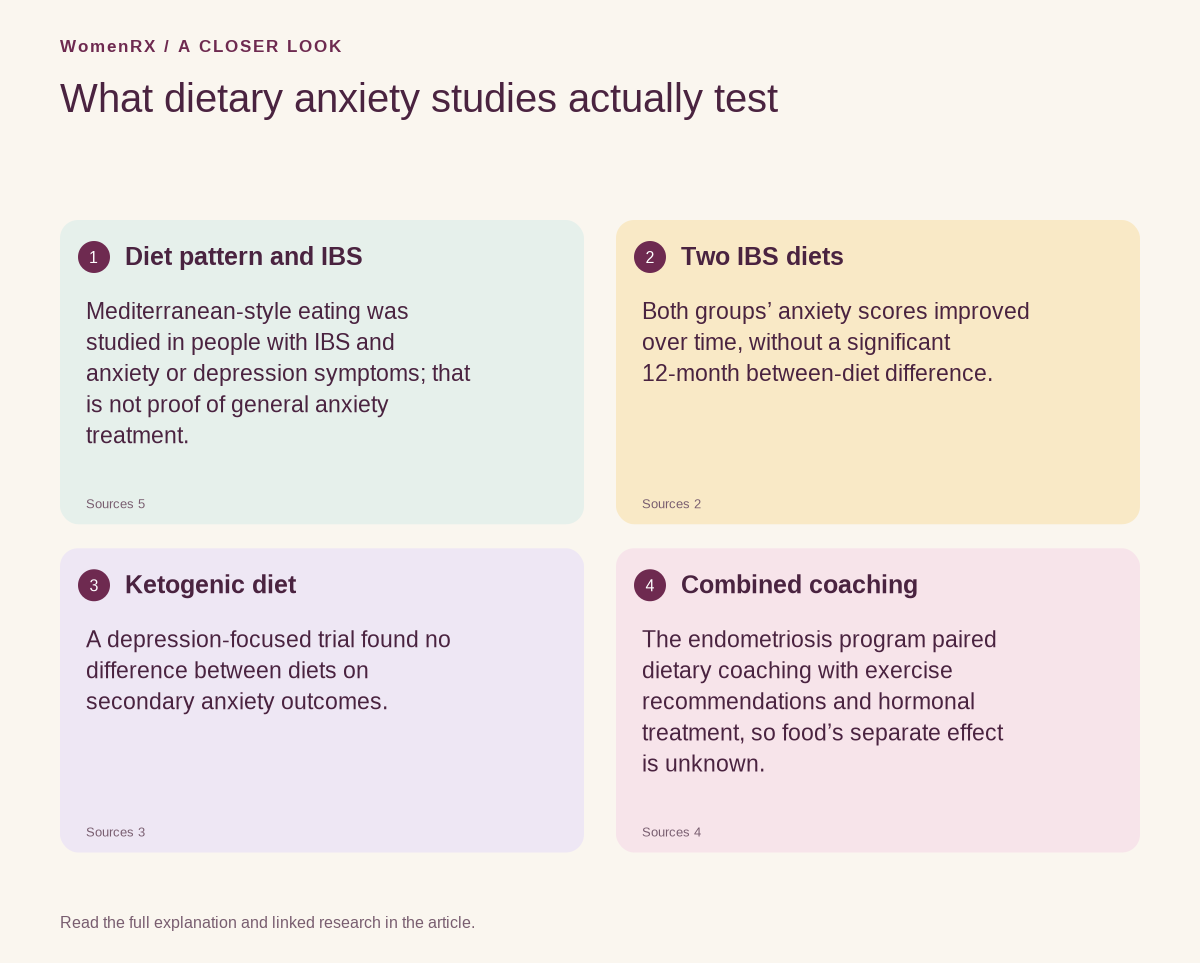
What dietary anxiety studies actually test
Diet pattern and IBS: Mediterranean-style eating was studied in people with IBS and anxiety or depression symptoms; that is not proof of general anxiety treatment.5
Two IBS diets: Both groups’ anxiety scores improved over time, without a significant 12-month between-diet difference.2
Ketogenic diet: A depression-focused trial found no difference between diets on secondary anxiety outcomes.3
Combined coaching: The endometriosis program paired dietary coaching with exercise recommendations and hormonal treatment, so food’s separate effect is unknown.4
Read the figure as text
These examples show why a finding about one group or combined program should not be turned into a universal food prescription.- Diet pattern and IBS: Mediterranean-style eating was studied in people with IBS and anxiety or depression symptoms; that is not proof of general anxiety treatment.5
- Two IBS diets: Both groups’ anxiety scores improved over time, without a significant 12-month between-diet difference.2
- Ketogenic diet: A depression-focused trial found no difference between diets on secondary anxiety outcomes.3
- Combined coaching: The endometriosis program paired dietary coaching with exercise recommendations and hormonal treatment, so food’s separate effect is unknown.4
More questions, answered
Is there one food that has been shown to treat anxiety?
The studies discussed above tested dietary patterns or combined programs, not whether an individual food treats anxiety. They don’t establish a single food as a stand-alone treatment. 245
Does an endometriosis diet study mean anxiety is hormone-related?
No. In the endometriosis trial, diet and exercise coaching were combined with hormonal treatment, so the study can’t identify which part contributed to the reported improvement in the anxiety component. It also doesn’t show that anxiety generally is caused by hormones. 4
Sources you can check
- Anxiety: MedlinePlusAccessed 2026-09-25Return to first citation
- Long-term microbiome and clinical effects of a microbiome-guided personalized diet versus low-FODMAP diet in irritable bowel syndrome: A 12-month follow-up randomized controlled trial.Tunali V, Arslan NÇ, Derviş Haki̇m G, Gündoğdu A, Ermi̇ş BH, Hora M, Nalbantoğlu ÖU. · Gut microbes · 2026Return to first citation
- A Ketogenic Diet for Treatment-Resistant Depression: A Randomized Clinical Trial.Gao M, Kirk M, Knight H, Lash E, Michalopoulou M, Guess N, Stevens R, Browning M, Weich S, Burnet PWJ, Jebb SA, Aveyard P. · JAMA psychiatry · 2026Return to first citation
- Diet and physical activity coaching for well-being and pain reduction in patients with symptomatic endometriosis: a randomized-controlled clinical trial.Donati A, Giola F, Privitera G, Barbara G, Dridi D, Ottolini FL, Buggio L, Biciuffi R, Parazzini F, Chiaffarino F. · European journal of obstetrics, gynecology, and reproductive biology · 2026Return to first citation
- Adherence to a Mediterranean Diet Predicts Gastrointestinal and Anxiety Symptom Response in Irritable Bowel Syndrome.Staudacher HM, So D, Hockey M, Mahoney S, Shanahan E, Loughman A. · Clinical gastroenterology and hepatology : the official clinical practice journal of the American Gastroenterological Association · 2026Return to first citation