Can Diet Help With Perimenopause Symptoms?
Food choices can support digestion and general health, but studies linking diet with menopause symptoms don’t yet show that changing your diet will ease hot flushes or disrupted sleep.
Diet may help with concerns such as constipation, but its effects on perimenopause symptoms are less clear. Studies link some eating patterns with symptom measures without showing that changing foods improves symptoms. A Lagos study also cites earlier Japanese research linking soy-rich diets with fewer hot flushes, but gives too little detail to judge that finding for perimenopause. 1 4 5
Which symptoms have diet studies actually measured?
A useful distinction is whether a study observes what women already eat or tests what happens when they change their diet. The dietary-pattern findings below are associations. They can point to questions worth studying, but they can’t tell you that a particular way of eating will relieve your symptoms.
In a cross-sectional study of 376 postmenopausal women in Lagos, Nigeria, dietary patterns were associated with overall symptom severity. Women who ate less Western-style and processed food were more likely to be asymptomatic. Diet and symptoms were assessed at one point in time, so the study can’t show that changing those foods would change symptoms. Its participants were postmenopausal, not specifically in perimenopause. 4
A study of 702 women in Türkiye included premenopausal, menopausal, and postmenopausal participants. Greater adherence to a Mediterranean-style diet was associated with fewer psychological complaints and lower scores on some symptom measures. The researchers found no significant associations for somatic or urogenital symptoms. The results weren’t reported separately for perimenopause, and the study observed existing diets rather than testing a diet change. 5
That difference between symptom categories matters. An association with an overall score or psychological complaints doesn’t establish that eating differently will stop a hot flush at night or help you stay asleep. These findings don’t demonstrate a sleep benefit.
What about soy for hot flushes?
The Lagos study’s discussion cites earlier Japanese research linking soy- and isoflavone-rich diets with fewer hot flushes and other symptoms. That finding did not come from the Lagos participants. The discussion doesn’t give enough detail about the underlying studies to judge how the diets were assessed, how strong the finding was, or whether it applies specifically to women in perimenopause. Soy is a food you might choose to eat, but this account isn’t a sound basis for promising hot-flush relief. 4
Choose food for benefits you can reasonably expect
Whole grains, fruits, and vegetables provide dietary fiber. Fiber helps digestion and can help you feel full sooner. For example, adding fruit to breakfast or choosing a whole grain you enjoy may be worthwhile for those reasons, without treating either choice as a hot-flush remedy. If you’re eating more fiber than usual, increase it gradually; a rapid increase can cause gas, bloating, or cramps. 1
Weight changes call for equally careful expectations. In the Türkiye study, greater Mediterranean-diet adherence was associated with lower body mass index, but that doesn’t show the diet prevented weight gain. And a scale reading includes muscle, bone, fat, and water. It can’t, by itself, tell you what has changed in your body. 2 5
If hot flushes are disrupting your days or nights, you don’t have to make food carry the whole burden. The North American Menopause Society identifies hormone therapy as the most effective treatment for vasomotor symptoms, with benefits and risks considered individually. Diet can still matter for everyday nutrition and digestion, even when it isn’t a proven treatment for the symptom bothering you most. 3
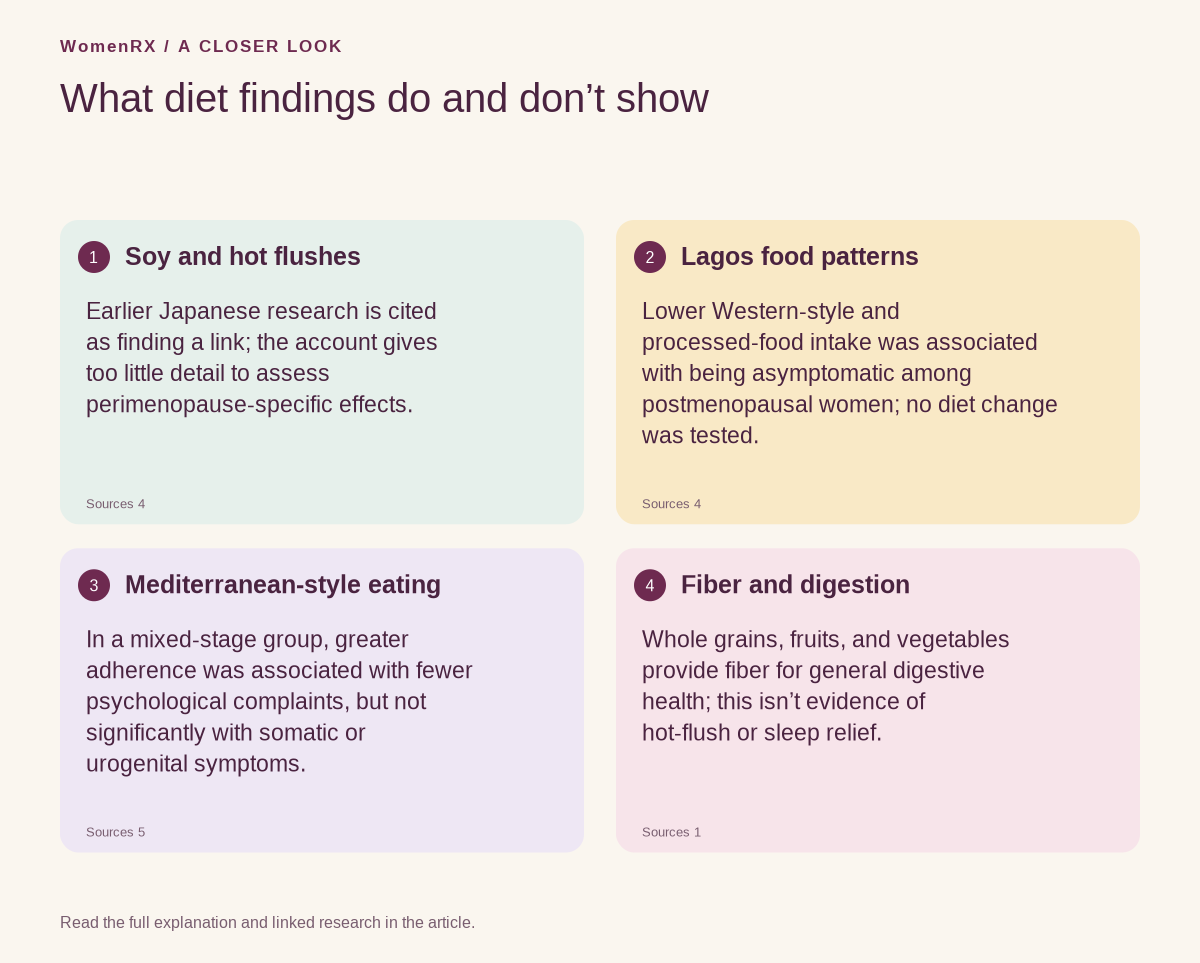
What diet findings do and don’t show
Soy and hot flushes: Earlier Japanese research is cited as finding a link; the account gives too little detail to assess perimenopause-specific effects.4
Lagos food patterns: Lower Western-style and processed-food intake was associated with being asymptomatic among postmenopausal women; no diet change was tested.4
Mediterranean-style eating: In a mixed-stage group, greater adherence was associated with fewer psychological complaints, but not significantly with somatic or urogenital symptoms.5
Fiber and digestion: Whole grains, fruits, and vegetables provide fiber for general digestive health; this isn’t evidence of hot-flush or sleep relief.1
Read the figure as text
Match each food or eating pattern to the outcome studied before treating it as a possible answer to your own symptom.- Soy and hot flushes: Earlier Japanese research is cited as finding a link; the account gives too little detail to assess perimenopause-specific effects.4
- Lagos food patterns: Lower Western-style and processed-food intake was associated with being asymptomatic among postmenopausal women; no diet change was tested.4
- Mediterranean-style eating: In a mixed-stage group, greater adherence was associated with fewer psychological complaints, but not significantly with somatic or urogenital symptoms.5
- Fiber and digestion: Whole grains, fruits, and vegetables provide fiber for general digestive health; this isn’t evidence of hot-flush or sleep relief.1
Sources you can check
- Dietary Fiber: MedlinePlusAccessed 2026-09-25Return to first citation
- Body Weight: MedlinePlusAccessed 2026-09-25Return to first citation
- The 2022 hormone therapy position statement of The North American Menopause Society.“The 2022 Hormone Therapy Position Statement of The North American Menopause Society” Advisory Panel. · Menopause (New York, N.Y.) · 2022Return to first citation
- Association between dietary consumption and menopausal symptoms severity among women in selected local government areas, Lagos state, Nigeria.Ajike SO, Abe MA. · BMJ nutrition, prevention & health · 2026Return to first citation
- From hot flashes to harmony: Mediterranean diet, menopausal symptoms, and cardiovascular risk awareness.Dumlu Bilgin G, Keküllüoğlu Tan M, Usta Ulutaş P, Kaya Cebioğlu İ, Keleş YN, Kural A, Böcek AC. · Nutrition (Burbank, Los Angeles County, Calif.) · 2026Return to first citation