How Much Fiber Do You Need During Perimenopause and Menopause?
For adult women, the commonly cited target is about 25 grams a day, with no separate target given for perimenopause or menopause.
Aim for about 25 grams of fiber a day, the general adult-women target in U.S. nutrition guidance, rather than a menopause-specific amount. Fiber from foods such as beans, whole grains, fruit, vegetables, nuts, and seeds supports digestion; higher intake is also linked with some cardiometabolic benefits, though it isn’t a menopause treatment. Build up gradually and drink plenty of fluids, especially if constipation is a concern. 1 2 3
The target doesn’t change just because menopause does
The commonly cited U.S. target is about 25 grams of fiber a day for adult women, or roughly 14 grams per 1,000 calories. That’s a general adult recommendation, not a target set specifically for perimenopause, menopause, or postmenopause. The amount that suits you can also depend on how much energy you eat overall. 3 4
Fiber intake tends to fall short for many adults: one clinical review reports average U.S. adult intake of about 17 grams a day. If you’re below the target, think of it as a direction to work toward, not a pass-or-fail test. 3
Use foods you already eat to build fiber
Fiber comes from plant foods. Whole grains, beans and other legumes, fruits, vegetables, nuts, and seeds can all contribute. A practical way to spread it across the day is to add a fiber-rich choice to meals you already eat, rather than trying to make one meal do all the work. 1 3
For example, you might include oats and fruit at breakfast, beans or lentils with vegetables at lunch, fruit or nuts as a snack, and a whole grain alongside vegetables at dinner. This is a pattern of food choices, not a menu with a calculated fiber total: portions and the fiber content of specific foods vary. To estimate your own intake, check the total dietary fiber on food labels for the portions you actually eat and add those amounts across the day. 3
You don’t have to eliminate refined grains to get more fiber. Choosing whole grains more often can help, while some refined grain foods also contribute fiber and other nutrients to U.S. diets. The useful goal is to add fiber-rich foods, not to treat every refined grain as fiber-free or nutritionally empty. 5
What fiber may support, and what it doesn’t promise
Insoluble fiber can increase stool bulk. Dietary fiber more broadly helps digestion and can help prevent constipation. Some kinds of soluble fiber form a gel as they absorb water; a clinical review describes effects on glucose absorption and a modest lowering of LDL cholesterol. These are useful potential benefits, but they don’t mean that fiber alone prevents diabetes or heart disease. 3 1
Research also links higher fiber intake with lower risk of conditions such as cardiovascular disease and type 2 diabetes. A link is not proof that fiber by itself caused the difference, and these findings are not evidence of a menopause-specific effect. Menopause is life-stage context, not a reason to assume fiber will change hormones, relieve hot flashes, or produce weight loss. 3 4
Increase at a pace your gut can handle
If you currently eat little fiber, increase it gradually. A fast jump can bring gas, bloating, or cramps. Drink plenty of water and other liquids; fluids are also part of the general self-care advice for constipation. 1 2
If constipation is new or your bowel habits change, don’t assume fiber is the whole explanation. Medicines can contribute to constipation, and a change in bowel habits is a reason to check in with a care provider. 2
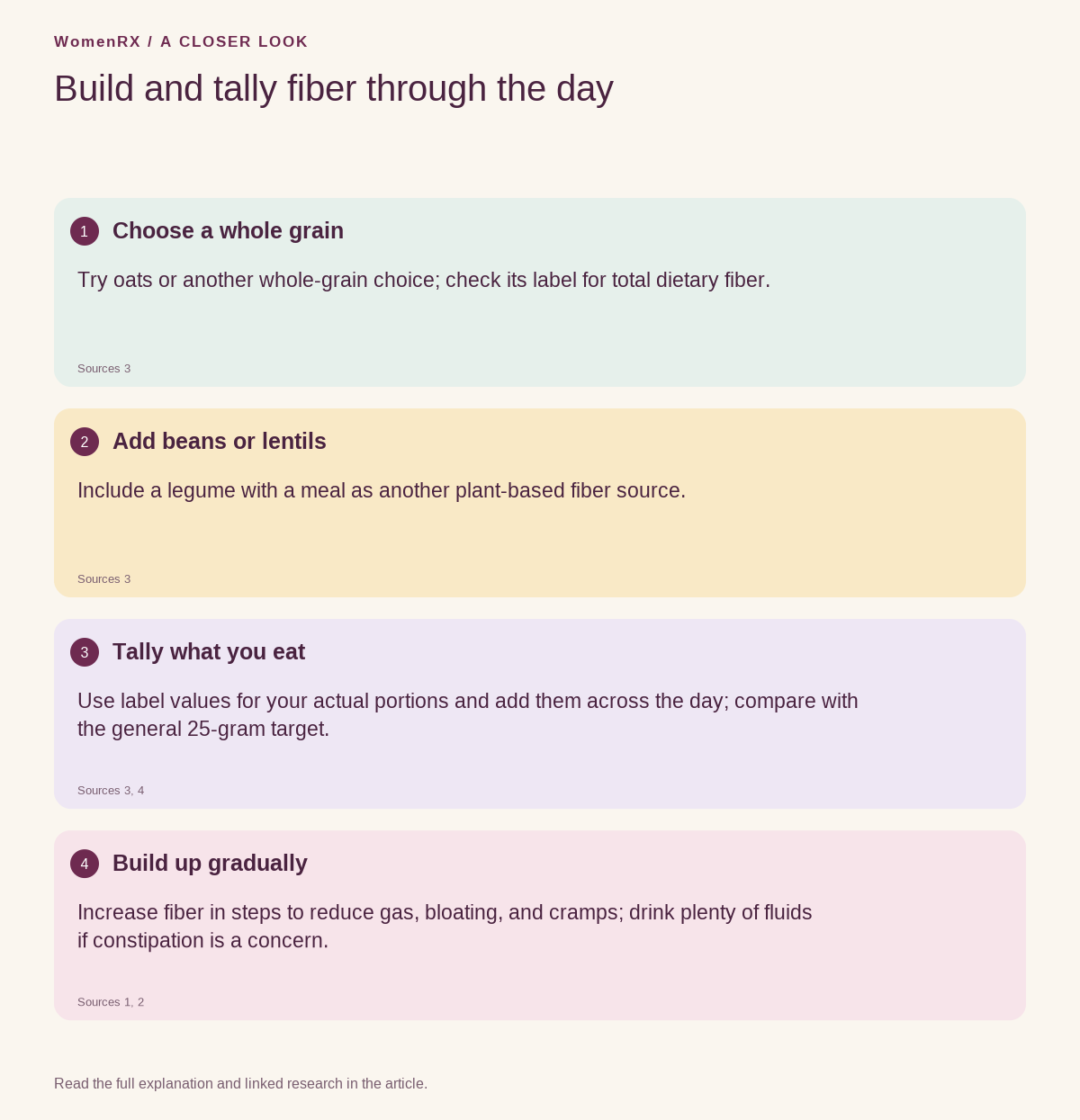
Build and tally fiber through the day
Choose a whole grain: Try oats or another whole-grain choice; check its label for total dietary fiber.3
Add beans or lentils: Include a legume with a meal as another plant-based fiber source.3
Tally what you eat: Use label values for your actual portions and add them across the day; compare with the general 25-gram target.34
Build up gradually: Increase fiber in steps to reduce gas, bloating, and cramps; drink plenty of fluids if constipation is a concern.12
Read the figure as text
Use these prompts to add fiber-rich foods and estimate your own daily intake. The food examples are not a gram-by-gram menu.- Choose a whole grain: Try oats or another whole-grain choice; check its label for total dietary fiber.3
- Add beans or lentils: Include a legume with a meal as another plant-based fiber source.3
- Tally what you eat: Use label values for your actual portions and add them across the day; compare with the general 25-gram target.34
- Build up gradually: Increase fiber in steps to reduce gas, bloating, and cramps; drink plenty of fluids if constipation is a concern.12
More questions, answered
Does the fiber target change after menopause?
The commonly cited target is about 25 grams a day for adult women; it is not presented as a separate perimenopause, menopause, or postmenopause target. 3 4
Should I increase fiber all at once?
No. Add it gradually to reduce the chance of gas, bloating, and cramps, and drink plenty of fluids. 1 2
Sources you can check
- Dietary Fiber: MedlinePlusAccessed 2026-09-25Return to first citation
- Constipation | MedlinePlusAccessed 2026-09-25Return to first citation
- The Role of Dietary Fiber in Health Promotion and Disease Prevention: A Practical Guide for CliniciansDaley SF, Vadakekut ES. · 2026Return to first citation
- Assessing the impact of dietary choices on fiber deficiency: insights from the 2017-2020 Polish national adult nutrition survey.Kucharska A, Sińska BI, Panczyk M, Samel-Kowalik P, Szostak-Węgierek D, Raciborski F, Samoliński B, Traczyk I. · Frontiers in nutrition · 2024Return to first citation
- The Role of Fortified and Enriched Refined Grains in the US Dietary Pattern: A NHANES 2009-2016 Modeling Analysis to Examine Nutrient Adequacy.Papanikolaou Y, Fulgoni VLI. · Frontiers in nutrition · 2021Return to first citation