How Much Fiber Do You Need, and How Should You Add It?
Fiber targets change with age, pregnancy, and breastfeeding, but the most comfortable way to add fiber is usually one food change at a time.
The US adequate intake for fiber is 25 grams a day for women ages 19-50 and 21 grams after age 50. It’s 28 grams during pregnancy and 29 grams while breastfeeding. These are general benchmarks, not amounts you need to reach in one jump. 8 If you’re eating much less, add fiber gradually: a sudden increase can cause gas, bloating, and cramps. 1
Find your benchmark, then look at your usual day
The National Academies’ fiber figures are adequate intakes: general daily benchmarks for healthy people in each life-stage group, not a promise that a particular amount will relieve constipation or suit every bowel condition. The figures are 25 grams for women ages 19-50, 21 grams for women 51 and older, 28 grams during pregnancy, and 29 grams while breastfeeding. 86 If you’re postpartum but not breastfeeding, the table uses your age-group figure; it does not give a separate postpartum target. 8
To estimate your usual intake, write down what you eat on a fairly typical day, including portions. For packaged foods, check the dietary fiber amount and serving size on the Nutrition Facts label. A food labeled 3 grams per serving contributes 6 grams if you eat two servings. 7 For unlabeled foods, look up the fiber amount for the portion you ate. Leave it blank until you find an amount rather than counting it as zero.
Whole grains, nuts, seeds, fruit, and vegetables are places to look when you want to add fiber through food. Legumes are another fiber-containing option. 15 For a food-first day, you might have oatmeal at breakfast, add beans to a lunch you already enjoy, have fruit with a snack, and choose a whole grain at dinner. Note the portion you actually eat of each food, then use this meal-by-meal tally for that example or your own day:
- Breakfast: food and portion ___; fiber ___ g
- Lunch: food and portion ___; fiber ___ g
- Snack: food and portion ___; fiber ___ g
- Dinner and other foods: food and portion ___; fiber ___ g
- Daily total: add the fiber amounts above ___ g
Enter the fiber amount from each label or a nutrition listing matched to your portion. Fill in any blanks before comparing your daily total with your life-stage benchmark; the foods named here do not have a reliable total without portions and their fiber amounts.
Constipation is common during pregnancy and after birth and is more common after age 65. Gradual dietary fiber changes and other simple constipation measures are safe to try during pregnancy. If symptoms persist after birth or later in life, do not assume that increasing fiber again will resolve them. Constipation in an older person can also be easy to miss, particularly when they have dementia. 3
Change one thing at a time if your gut is sensitive
Fiber can help prevent constipation, but adding it quickly can bring on gas, bloating, or cramps. 1 If your usual diet is low in fiber, pick one food you would like to add or increase, such as the oatmeal, beans, or fruit in the example day. Keep the rest of your routine fairly steady while you notice whether that change brings more gas or bloating and whether bowel movements become easier. If it feels comfortable, choose one more food change and check again before making another; if symptoms worsen, do not keep stacking on more fiber. Increase fiber gradually, checking how you feel before making another change. 13
If constipation is the reason you’re making a change, fiber isn’t the only useful lever. Drinking enough liquids, being active, and going when you feel the urge to have a bowel movement are also part of constipation self-care. You don’t have to have a bowel movement every day to be regular. 2
Soluble, insoluble, and supplemental fiber aren’t interchangeable
Soluble and insoluble describe how fibers behave in water. Soluble fibers dissolve; insoluble fibers don’t and mainly add bulk to stool. Plant foods can contribute fiber without requiring you to choose one category at every meal. 15
If you’re comparing a supplement or a food with added fiber, read the ingredient name as well as the total fiber per serving. Psyllium and inulin are examples of added fibers, but added fibers differ in their properties and effects. The number of grams on the label alone won’t tell you how comfortable a product will feel or whether it will help your particular symptoms. 57
That distinction matters especially if bloating comes with recurring bowel trouble. A review of fiber studies in irritable bowel syndrome (IBS) found that fiber generally hadn’t relieved overall IBS symptoms better than placebo in systematic reviews, though results may differ by fiber type and constipation may be a reason to consider it. Abdominal discomfort and bloating can also occur. More fiber isn’t always the better answer. 6
Know when to change the plan
If bloating is frequent, doesn’t go away, or continues despite dietary changes, it’s worth getting it assessed rather than repeatedly increasing fiber. Seek care for a sudden change in bowel habits, ongoing abdominal pain, or unintentional weight loss. Bloating accompanied by blood in your stool also warrants assessment. A suddenly severe stomach ache with a swollen abdomen needs urgent attention. 34
Persistent straining or a feeling that you haven’t fully emptied also deserves a closer look, particularly if gradual diet and routine changes haven’t helped. Those are constipation symptoms, but a fiber target alone can’t explain why they’re happening. 3
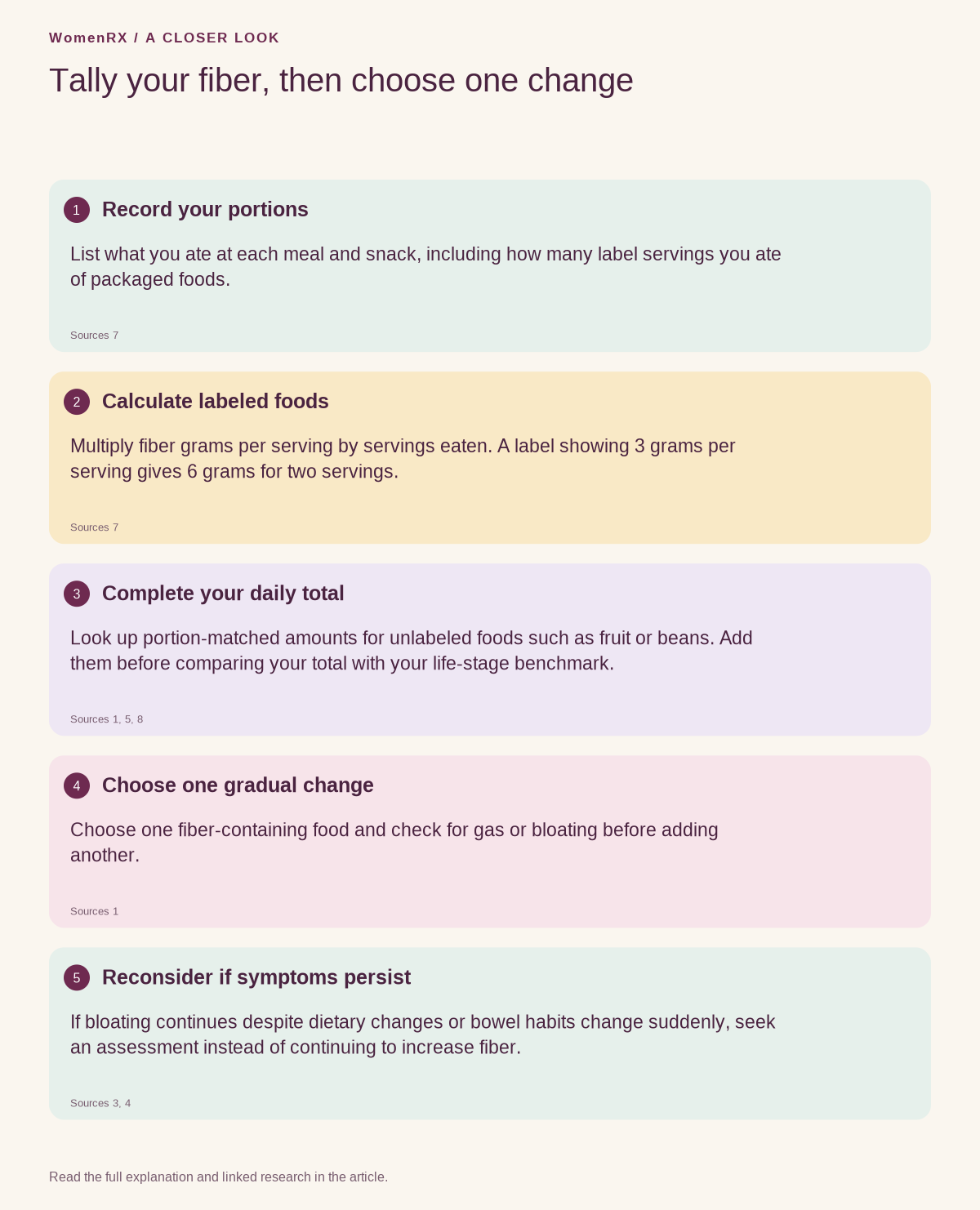
Tally your fiber, then choose one change
Record your portions: List what you ate at each meal and snack, including how many label servings you ate of packaged foods.7
Calculate labeled foods: Multiply fiber grams per serving by servings eaten. A label showing 3 grams per serving gives 6 grams for two servings.7
Complete your daily total: Look up portion-matched amounts for unlabeled foods such as fruit or beans. Add them before comparing your total with your life-stage benchmark.158
Choose one gradual change: Choose one fiber-containing food and check for gas or bloating before adding another.1
Reconsider if symptoms persist: If bloating continues despite dietary changes or bowel habits change suddenly, seek an assessment instead of continuing to increase fiber.34
Read the figure as text
Use this checklist with the meal-by-meal tally to estimate your day before adding more fiber.- Record your portions: List what you ate at each meal and snack, including how many label servings you ate of packaged foods.7
- Calculate labeled foods: Multiply fiber grams per serving by servings eaten. A label showing 3 grams per serving gives 6 grams for two servings.7
- Complete your daily total: Look up portion-matched amounts for unlabeled foods such as fruit or beans. Add them before comparing your total with your life-stage benchmark.158
- Choose one gradual change: Choose one fiber-containing food and check for gas or bloating before adding another.1
- Reconsider if symptoms persist: If bloating continues despite dietary changes or bowel habits change suddenly, seek an assessment instead of continuing to increase fiber.34
More questions, answered
Do I need a fiber supplement to reach my target?
Not necessarily. Fruit, vegetables, whole grains, nuts, seeds, and legumes all provide dietary fiber. Added fibers can contribute to intake, but their effects vary, so a supplement isn’t automatically equivalent to adding a range of fiber-containing foods. 15
Sources you can check
- Dietary Fiber: MedlinePlusAccessed 2026-09-25Return to first citation
- Constipation | MedlinePlusAccessed 2026-09-25Return to first citation
- Constipation - NHSAccessed 2026-09-25Return to first citation
- Bloating - NHSAccessed 2026-09-25Return to first citation
- The Role of Dietary Fiber in Health Promotion and Disease Prevention: A Practical Guide for CliniciansDaley SF, Vadakekut ES. · 2026Return to first citation
- The role of fiber in the treatment of irritable bowel syndrome: therapeutic recommendations.Zuckerman MJ. · Journal of clinical gastroenterology · 2006Return to first citation
- Food Labeling: MedlinePlusAccessed 2026-09-25Return to first citation
- National Academies DRI summary table: total water and macronutrientsAccessed 2026-09-25Return to first citation