Omega-3 From Food or Supplements: What Do You Need?
Plant foods provide ALA, while seafood and some supplements provide EPA and DHA, so a useful intake check looks at both rather than counting all omega-3s as interchangeable.
Check your usual meals in two parts: look for plant foods that provide ALA, then look separately for seafood that provides EPA and DHA. The National Academies’ established omega-3 intake benchmark is for ALA, not EPA or DHA. If you rarely eat seafood, a supplement may be worth discussing, particularly during pregnancy, when lower-mercury seafood choices and DHA intake deserve a separate look. 1 2
Start with the form, not just the word “omega-3”
Omega-3 is a family of fats, not one interchangeable ingredient. ALA (alpha-linolenic acid) is the essential omega-3 found in plant foods. EPA and DHA are long-chain omega-3s found mainly in seafood. Some supplements provide EPA and DHA from fish or algal oil. 1
That difference matters when you look at your meals or a supplement label. A serving of walnuts can contribute plenty of ALA, but it doesn’t count as the same amount of EPA or DHA as salmon. And a product labeled “fish oil” can contain much less EPA and DHA than its total fish-oil amount suggests, so check the label for the amounts of each. 1
A simple check of your usual meals
For women ages 19-50, the Adequate Intake (AI) for ALA is 1.1 grams a day. It’s 1.1 grams for women 51 and older, 1.4 grams during pregnancy, and 1.3 grams during lactation. These AIs are for ALA, not for total omega-3s or EPA and DHA. The National Academies have not established a separate intake benchmark for EPA or DHA. 1
Use those figures as a way to review your usual pattern, not as a verdict based on one meal. First, look for ALA sources you actually use: chia seeds, walnuts, flaxseed, canola oil, or soybean oil. For example, the NIH fact sheet lists about 2.57 grams of ALA in an ounce of English walnuts and 1.28 grams in a tablespoon of canola oil. Amounts vary by food and portion, and you don’t need to eat those particular foods if other ALA sources fit your meals better. 1
Then check seafood separately: do you eat fish or shellfish regularly, and do your choices include fatty fish such as salmon, sardines, herring, or mackerel? Seafood varies widely in EPA and DHA content. For example, the listed amounts for a cooked 3-ounce serving of Atlantic salmon are about 1.24 grams EPA and 0.59 grams DHA when farmed, and 1.22 grams EPA and 0.35 grams DHA when wild. Those examples show why food type matters, but one serving alone doesn’t establish your usual intake or prove you need a supplement. 1
What the comparison can and can’t tell you
ALA foods can help you meet the ALA AI. Seafood is a direct food source of EPA and DHA. These are useful, different contributions, not two ways of measuring the same target. A food tally can show which forms appear in your usual meals, but it cannot by itself establish a deficiency or determine whether you need a supplement. 1
If you avoid seafood, algal-oil products are another source of long-chain omega-3s; some provide DHA and some also provide EPA. Check the product label for the amounts, because formulations vary. 1
Pregnancy calls for a separate seafood check
During pregnancy, U.S. guidance summarized by the NIH recommends 8 to 12 ounces of seafood per week, choosing varieties lower in mercury. Examples include salmon, sardines, oysters, and trout. Seafood can contribute EPA and DHA, while also providing nutrients beyond omega-3s. 2
Expert-group recommendations summarized by the NIH include at least 250 mg a day of DHA plus EPA for women of childbearing age, with an additional 100 to 200 mg a day of DHA during pregnancy. These recommendations don’t mean everyone needs a supplement: seafood is a source, and supplements are an option for people who don’t eat it. If you’re pregnant and considering a supplement, review the product and your usual seafood intake with your prenatal care team. 2 3
Breastfeeding has a different reference point
For women ages 19-50 who are lactating, the ALA AI is 1.3 grams a day. Human milk contains ALA, EPA, and DHA, but the National Academies have not established a separate EPA or DHA intake benchmark for lactation. That distinction does not, on its own, establish a need for an omega-3 supplement. 1
The practical takeaway: look at plant sources when checking ALA, and seafood or a labeled marine- or algal-oil product when considering EPA and DHA. Keep pregnancy’s seafood guidance distinct from general intake benchmarks, and don’t let an ALA-rich food stand in for a direct source of EPA or DHA.
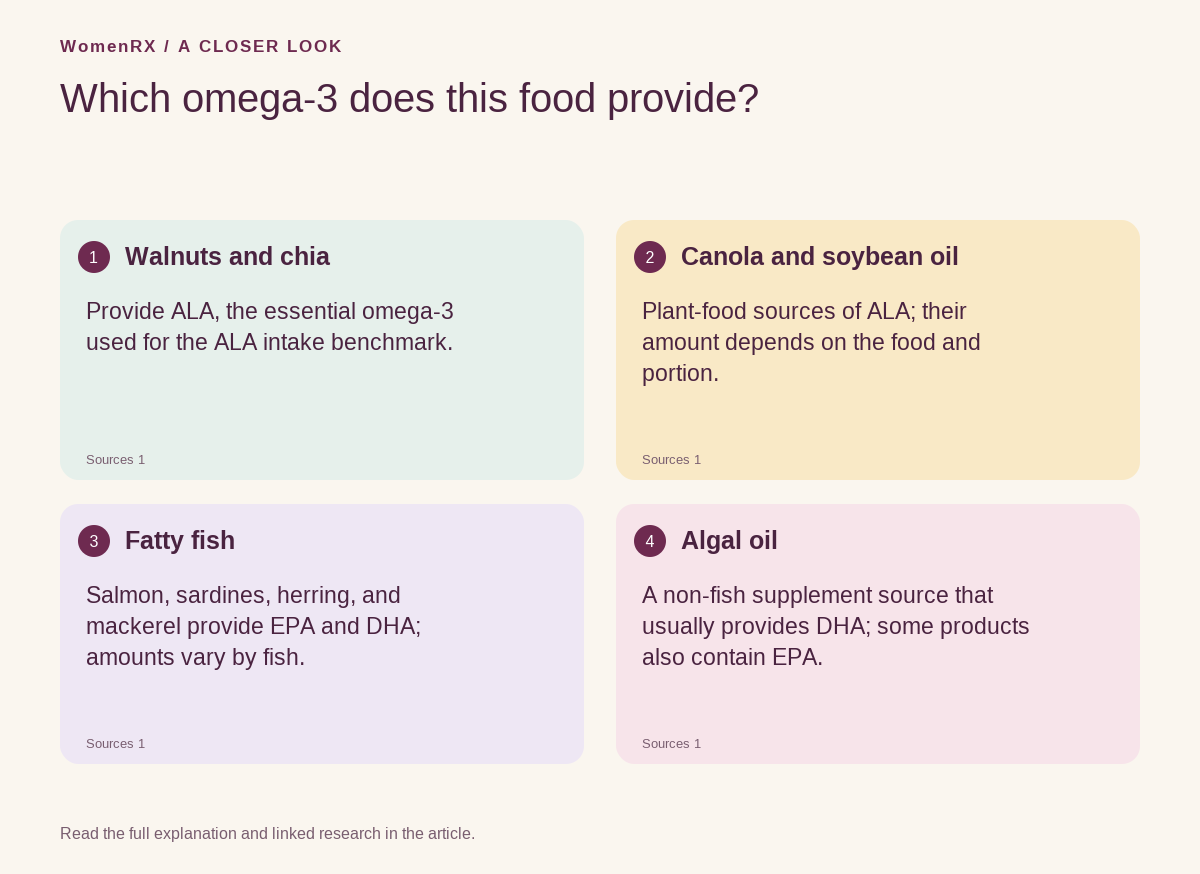
Which omega-3 does this food provide?
Walnuts and chia: Provide ALA, the essential omega-3 used for the ALA intake benchmark.1
Canola and soybean oil: Plant-food sources of ALA; their amount depends on the food and portion.1
Fatty fish: Salmon, sardines, herring, and mackerel provide EPA and DHA; amounts vary by fish.1
Algal oil: A non-fish supplement source that usually provides DHA; some products also contain EPA.1
Read the figure as text
Compare plant-based ALA with seafood and supplement sources of EPA and DHA. The forms contribute differently, so the comparison is not a single adequacy score.- Walnuts and chia: Provide ALA, the essential omega-3 used for the ALA intake benchmark.1
- Canola and soybean oil: Plant-food sources of ALA; their amount depends on the food and portion.1
- Fatty fish: Salmon, sardines, herring, and mackerel provide EPA and DHA; amounts vary by fish.1
- Algal oil: A non-fish supplement source that usually provides DHA; some products also contain EPA.1
More questions, answered
If I eat walnuts or chia, do I still need seafood?
Walnuts and chia provide ALA; seafood provides EPA and DHA. If you don’t eat seafood, that’s the part of your usual intake to consider separately. Algal-oil products can provide DHA, and some also contain EPA. 1
What should I check on an omega-3 supplement label?
Look for the amounts of EPA and DHA themselves, rather than relying only on the total amount of fish oil. Supplement formulations vary, and algal-oil products can provide DHA, sometimes with EPA as well. 1