Can Symptoms Tell You If You Need More Omega-3?
Symptoms alone can’t reliably identify low omega-3 status, and the classic signs of essential-fatty-acid deficiency are uncommon in otherwise healthy people in the United States.
Not reliably. Rough, scaly skin and dermatitis can occur with essential-fatty-acid deficiency, but these findings don’t show that omega-3 is the cause, and deficiency is very uncommon in healthy people in the United States. There are no established EPA or DHA blood-level cutoffs that identify when health functions are impaired. A review of your usual foods and relevant health circumstances is more useful than guessing from symptoms or trying a supplement as a test. 1
What symptoms can, and can’t, tell you
Omega-3 deficiency isn’t something most women can identify from how they feel. The recognized skin findings of essential-fatty-acid deficiency are rough, scaly skin and dermatitis. But those changes aren’t specific to omega-3 deficiency, and a symptom by itself can’t confirm the cause. 1
The NIH Office of Dietary Supplements describes classical essential-fatty-acid deficiency as virtually nonexistent in healthy people in the United States. When dietary-fat restriction or fat malabsorption occurs alongside an energy deficit, the body draws on stored essential fatty acids. The source says clinical signs are usually found in patients receiving parenteral nutrition that lacks PUFAs. 1
That distinction matters if you’re trying to explain dry skin, low mood, trouble concentrating, or another everyday concern. Those symptoms don’t establish low omega-3 status. They can have many possible explanations, and the available guidance doesn’t identify them as a symptom checklist for omega-3 deficiency. 1 A 2025 narrative review discussed associations between omega-3 fatty acids and perinatal depression, but reported variable findings for supplementation. That research doesn’t make low mood a way to diagnose deficiency. 2
A food review is a more useful first step
Omega-3s include different fats. Alpha-linolenic acid (ALA) is the essential omega-3, meaning your body needs to get it from food. The National Academies set adequate intakes for ALA, but not separate intake recommendations for EPA or DHA. An adequate intake is a planning reference, not a blood-test target or proof that an individual is deficient. 1
For a practical review, look at your usual pattern rather than a single meal: do you regularly eat ALA sources such as chia seeds, walnuts, flaxseed, canola oil, or soybean oil? If you eat seafood, do you sometimes choose sources of EPA and DHA, such as salmon, sardines, herring, or trout? Amounts vary by food and serving, and plant sources of ALA are not interchangeable with seafood sources of EPA and DHA. 1
For women ages 19-50, the ALA adequate intake is 1.1 grams a day; it is 1.4 grams during pregnancy and 1.3 grams during lactation. These are population reference values for ALA, not a recommendation for EPA or DHA and not a diagnostic test. A low-intake estimate can help you spot a dietary pattern to discuss or improve, but it can’t diagnose deficiency. 1
What a test can tell you
When omega-3 deficiency is present, plasma and tissue DHA concentrations decrease. But there are no known DHA or EPA concentration cutoffs below which functional effects, such as impaired visual or neural function or immune response, are established. So a number without a validated clinical threshold can’t, by itself, show that symptoms are caused by omega-3 deficiency. 1
The available guidance gives no established EPA or DHA threshold for deciding whether a generally healthy woman’s symptoms are caused by low omega-3 status. Relevant context includes very restricted dietary-fat intake or fat malabsorption when accompanied by an energy deficit, as well as specialized nutrition support. If one of these applies, the overall nutritional situation is more useful to assess than trying to infer deficiency from a symptom or using a supplement as a diagnostic trial. 1
Pregnancy and breastfeeding: intake reference, not a symptom difference
The reference intake for ALA is higher during pregnancy and lactation than for nonpregnant women ages 19-50. That is a difference in the intake benchmark, not evidence that pregnancy or breastfeeding brings a distinct set of omega-3-deficiency symptoms. The available guidance does not establish unique symptoms or EPA/DHA deficiency thresholds for these life stages. 1
If you’re concerned, start with the foods you usually eat and any condition that could limit intake or absorption. That gives you a more grounded next step than trying to diagnose omega-3 deficiency from nonspecific symptoms.
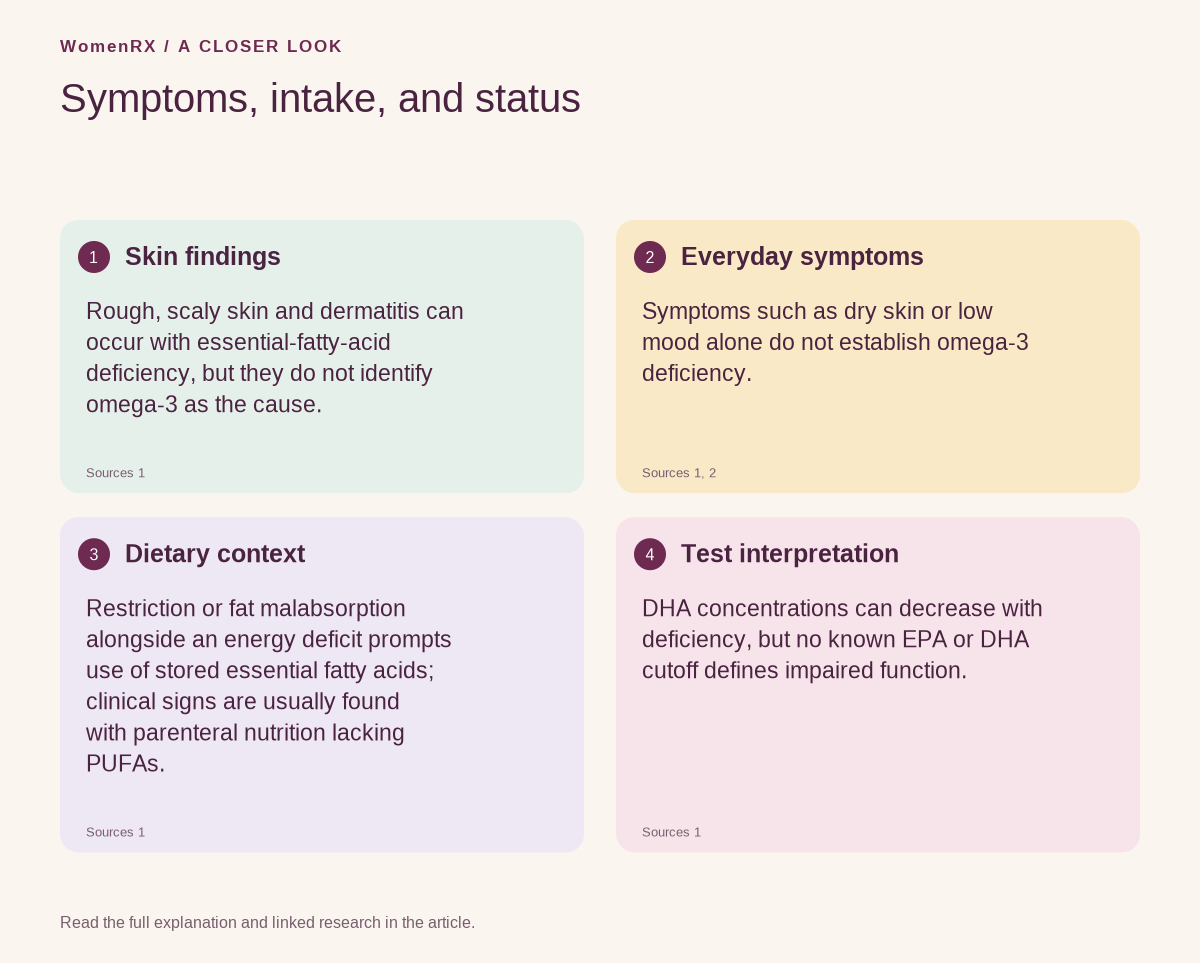
Symptoms, intake, and status
Skin findings: Rough, scaly skin and dermatitis can occur with essential-fatty-acid deficiency, but they do not identify omega-3 as the cause.1
Everyday symptoms: Symptoms such as dry skin or low mood alone do not establish omega-3 deficiency.12
Dietary context: Restriction or fat malabsorption alongside an energy deficit prompts use of stored essential fatty acids; clinical signs are usually found with parenteral nutrition lacking PUFAs.1
Test interpretation: DHA concentrations can decrease with deficiency, but no known EPA or DHA cutoff defines impaired function.1
Read the figure as text
These distinctions show why a symptom is a weak clue, while dietary context and the limits of available thresholds help frame a more useful assessment.- Skin findings: Rough, scaly skin and dermatitis can occur with essential-fatty-acid deficiency, but they do not identify omega-3 as the cause.1
- Everyday symptoms: Symptoms such as dry skin or low mood alone do not establish omega-3 deficiency.12
- Dietary context: Restriction or fat malabsorption alongside an energy deficit prompts use of stored essential fatty acids; clinical signs are usually found with parenteral nutrition lacking PUFAs.1
- Test interpretation: DHA concentrations can decrease with deficiency, but no known EPA or DHA cutoff defines impaired function.1
More questions, answered
Does a low fish intake prove I have an omega-3 deficiency?
No. Fish can provide EPA and DHA, but intake history alone doesn’t diagnose deficiency. ALA, found in foods such as chia, walnuts, and flaxseed, is the essential omega-3 with established adequate-intake values; specific intake recommendations for EPA and DHA have not been set by the National Academies. 1
Can taking an omega-3 supplement confirm that symptoms are caused by deficiency?
No. A supplement trial can’t identify the cause of a symptom, and there is no established EPA or DHA threshold for impaired function. Supplements also differ in the types and amounts of omega-3 they contain. 1
Sources you can check
- Omega-3 Fatty Acids - Health Professional Fact SheetAccessed 2026-09-25Return to first citation
- Selected Lipidome Components and Their Association with Perinatal Depression.Ładno D, Nowak B, Palka A, Strzelecki D, Gawlik-Kotelnicka O. · Nutrients · 2025Return to first citation