What Specific Omega-3 Trials Tell Women
Pregnancy, fertility, muscle and bone trials offer useful answers, but each applies to a particular supplement and outcome.
The omega-3 trials discussed here don’t establish a general fish-oil benefit for women. Two pregnancy trials found no clear improvement in the outcomes they measured, while an IVF trial’s encouraging embryo results came from a combined diet-and-supplement program, not omega-3 alone. Other trials address narrower questions about muscle, fractures and risk markers. The form studied and the outcome measured matter. 234567
Fish oil is often discussed as if it produces one predictable benefit. These trials answer more specific questions: which omega-3 was studied, who took it, and what researchers measured. A change in a blood marker or embryo grade, for example, isn’t the same as preventing illness or improving a pregnancy outcome. The findings below are not a verdict on every proposed omega-3 benefit.
First, separate ALA from EPA and DHA
ALA is the omega-3 found in foods such as walnuts, chia seeds, flaxseed and some vegetable oils. EPA and DHA are long-chain omega-3s found in seafood and in fish-oil or algal-oil supplements. ALA, EPA and DHA are distinct forms; studies of one source don’t automatically apply to another. 1
For adults, the established adequate intake listed by the National Academies is for ALA. There isn’t a specific recommended intake for EPA or DHA in the reference summarized by the NIH Office of Dietary Supplements. That distinction is useful: it means there isn’t one general EPA/DHA target in this guidance that defines what every woman should take. 1
The same distinction applies while breastfeeding. The adequate intake listed for lactation concerns ALA; it isn’t evidence that taking an omega-3 supplement improves a breastfeeding outcome. 1
Pregnancy: distinguish DHA alone from a high-DHA blend
Pregnancy is a life stage where DHA has been studied directly, but individual trials don’t support a simple promise that a supplement prevents complications. In a randomized trial, 809 women with singleton pregnancies before 16 weeks were assigned DHA alone or placebo through delivery. The combined outcome of very early preterm birth, early-onset preeclampsia or severe fetal growth restriction occurred in 3.47% of the DHA group and 2.96% of the placebo group. The difference was not statistically significant, and the trial was underpowered, so it didn’t establish a benefit or rule one out. 5
A separate, smaller trial enrolled low-risk pregnant women in Brazil at 22-24 weeks. Its supplement was predominantly DHA but also contained EPA. Of 60 randomized participants, 45 completed the study. The supplement did not produce significant differences in the maternal and newborn outcomes measured, including gestational age and birth size. The result applies to those measured outcomes in this small, low-risk group; it doesn’t settle what might happen in women with low omega-3 intake or different pregnancy risks. 4
Together, these trials show why pregnancy claims need the exact supplement, outcome and population attached. They do not establish that omega-3 supplements improve every maternal or infant outcome.
IVF: a combined program can’t tell us which part helped
A randomized trial in 180 women undergoing IVF found better fertilization and embryo measures in the group assigned a pro-fertility diet plus several supplements, including omega-3, compared with general dietary advice and folic acid. But omega-3 wasn’t tested on its own: the intervention also included vitamin D, folate and vitamin B12, as well as a structured diet. The study therefore can’t show that omega-3 caused the difference. Embryo measures also aren’t the same as a confirmed pregnancy or live birth. 2
Menopause and cancer risk: biomarkers aren’t prevention
A small pilot study included 34 peri- and postmenopausal women with higher body weight who took part in a weight-loss intervention. Among participants who lost at least 10% of their weight, those assigned EPA/DHA omega-3 showed shifts in gut bacteria and associated changes in some breast-cancer risk-factor biomarkers. These are early, indirect findings. They do not show that omega-3 prevents breast cancer, and the findings are specific to this subgroup and the weight-loss-intervention context. 6
Muscle and bones: don’t generalize beyond the study group
In a randomized trial around bariatric surgery, 58 participants were studied, 81% of them women. The supplement contained EPA, DHA and ALA; it did not prevent muscle-mass loss or improve strength or physical performance over the study period. Because the results weren’t reported separately for women, they don’t tell us whether women had a different response. They do show that a muscle-preserving benefit wasn’t demonstrated in this particular surgical setting. 3
A much larger trial of generally healthy older adults included both men and women and found no reduction in fractures with a marine EPA/DHA supplement compared with placebo. The reported fracture results were for the overall group, not a women-only analysis. So this trial doesn’t establish a separate effect in women, but it also doesn’t support taking that supplement specifically to prevent fractures in the overall population studied. 7
A practical way to read the next omega-3 claim
Before treating a headline as a reason to buy a supplement, check four things: Was it ALA, EPA, DHA or a combination? Were participants similar to you in life stage and health? Was omega-3 tested alone or bundled with diet, exercise or other supplements? And did researchers measure an outcome that matters to you, or a marker that may not translate into a health benefit?
The evidence is not a single yes-or-no verdict on fish oil. Some questions, including whether certain women with low omega-3 intake benefit during pregnancy, need more study. The clearest takeaway from these trials is narrower: a finding for one omega-3, one group or one measured outcome shouldn’t be treated as a benefit for all women.
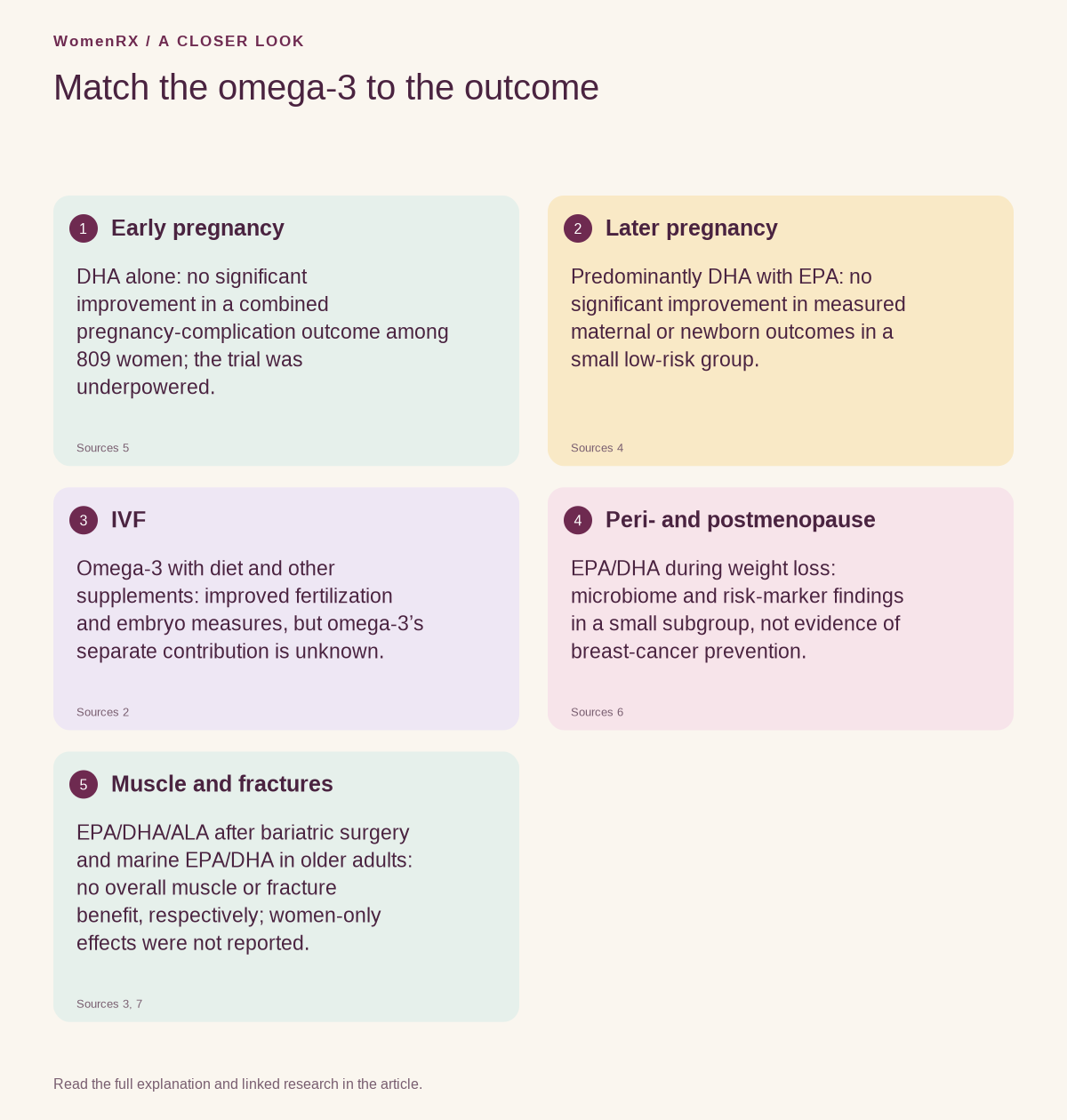
Match the omega-3 to the outcome
Early pregnancy: DHA alone: no significant improvement in a combined pregnancy-complication outcome among 809 women; the trial was underpowered.5
Later pregnancy: Predominantly DHA with EPA: no significant improvement in measured maternal or newborn outcomes in a small low-risk group.4
IVF: Omega-3 with diet and other supplements: improved fertilization and embryo measures, but omega-3’s separate contribution is unknown.2
Peri- and postmenopause: EPA/DHA during weight loss: microbiome and risk-marker findings in a small subgroup, not evidence of breast-cancer prevention.6
Muscle and fractures: EPA/DHA/ALA after bariatric surgery and marine EPA/DHA in older adults: no overall muscle or fracture benefit, respectively; women-only effects were not reported.37
Read the figure as text
Each row shows what was tested, in whom, and what the result can establish.- Early pregnancy: DHA alone: no significant improvement in a combined pregnancy-complication outcome among 809 women; the trial was underpowered.5
- Later pregnancy: Predominantly DHA with EPA: no significant improvement in measured maternal or newborn outcomes in a small low-risk group.4
- IVF: Omega-3 with diet and other supplements: improved fertilization and embryo measures, but omega-3’s separate contribution is unknown.2
- Peri- and postmenopause: EPA/DHA during weight loss: microbiome and risk-marker findings in a small subgroup, not evidence of breast-cancer prevention.6
- Muscle and fractures: EPA/DHA/ALA after bariatric surgery and marine EPA/DHA in older adults: no overall muscle or fracture benefit, respectively; women-only effects were not reported.37
More questions, answered
Does a study of fish oil apply to algal DHA?
Not automatically. Fish oil and algal oil can provide different amounts and combinations of EPA and DHA. Check which fatty acids were studied before applying a result to a different product. 1
Does a better embryo measure mean omega-3 improves IVF success?
Not on its own. The IVF trial tested a diet-and-supplement program, not omega-3 by itself, and reported embryo outcomes rather than establishing a live-birth benefit from omega-3. 2
Sources you can check
- Omega-3 Fatty Acids - Health Professional Fact SheetAccessed 2026-09-25Return to first citation
- Effect of a pro-fertility diet combined with omega-3 supplementation on embryo quality in infertile women undergoing IVF: a randomized controlled trial.Ghadimi Yari M, Ghasemi-Tehrani H, Feizi A, Ziaei R, Derakhshan M, Rouhani MH. · Reproductive biomedicine online · 2026Return to first citation
- Effects of Omega-3 Supplementation in Sarcopenia After Bariatric Surgery: A Triple-Blind Randomized Controlled Clinical Trial.Bigolin AV, Iaroseski J, Carteri RB, Rodrigues GS, de Andrade R, De Carli LA, Razzera EL, Vian I, de Almeida da Silva R, Kalil AN, Ferreira LF. · Journal of cachexia, sarcopenia and muscle · 2026Return to first citation
- Effect of high-docosahexaenoic acid omega-3 supplementation in low-risk pregnant women on maternal and neonatal health outcomes in Southeast Brazil: a randomized clinical trial.de Sousa TM, Cotting CSO, Ferreira LA, Osanan GC, Dos Santos LC. · Journal of tropical pediatrics · 2026Return to first citation
- Early maternal DHA supplementation fails to modify clinical phenotypes associated with impaired placentation: A randomized, double-blind, placebo-controlled trial (DEEPER trial).Carvajal JA, Carvajal SA, Araujo K, Rojas MP, Casanello PC, Vera CM. · Placenta · 2026Return to first citation
- Weight Loss and Omega-3 Supplementation Modulate the Microbiome in Women with Increased Breast Cancer Risk.Cook KL, Giles ED, Sekela JJ, Simpson JB, Redinbo MR, Wilson AS, Umar S, Befort CA, Kimler BF, Hursting SD, Fabian CJ. · Cancer prevention research (Philadelphia, Pa.) · 2026Return to first citation
- The effects of marine fatty acid omega-3 supplements on incident fractures and bone mineral density in generally healthy adults.LeBoff MS, Chou SH, Ratnarajah DM, Cook NR, Khurana B, Kim E, Kotler G, Cawthon PM, Bauer DC, Black D, Gallagher JC, Lee IM, Buring JE, Manson JE. · Journal of bone and mineral research : the official journal of the American Society for Bone and Mineral Research · 2026Return to first citation