When to Take Fish Oil: Morning, Night, or With Food?
Start with your bottle’s directions and any clinician-advised schedule, then choose a time that fits your day.
If you’re choosing between morning and night, start with the serving and food directions on your bottle and any schedule a clinician gave you. Don’t use claims about a “best” hour as a substitute for those instructions. Check the label for EPA and DHA amounts, too: fish oil products vary, and the amount of oil isn’t the same as the amount of those omega-3s. 1
Choose a time that fits your instructions
If a clinician gave you a schedule for fish oil, use that as your starting point. Otherwise, read the directions on your product and choose a time you can remember. Information about omega-3 supplement forms and contents can’t tell you whether breakfast or bedtime is better. 1
Let your bottle answer the food question
Check whether your product gives a food instruction rather than relying on a general tip about taking fish oil with meals. For example, if your bottle says to take a serving with food, you could pair it with a meal you regularly eat. If the wording is unclear, ask a pharmacist to help you interpret that product’s directions. A food instruction tells you how to take that product; it does not establish that breakfast works better than dinner. The NIH fact sheet describes differences in absorption between supplement forms. 1
Check what the serving contains
“Fish oil” on the front of a bottle doesn’t tell you by itself how much EPA and DHA a serving provides. Read the supplement facts panel for those amounts and the serving size. Products differ in their omega-3 content, so the total weight of fish oil isn’t interchangeable with the amount of EPA and DHA. 1
For scale, a typical example in the NIH fact sheet lists 1,000 mg of fish oil with 180 mg EPA and 120 mg DHA. That is 300 mg of EPA and DHA combined, not 1,000 mg; it is an example, not a target dose. Your bottle may differ, so check whether its amounts are listed per capsule or per serving before comparing them with any instructions you received. 1
That distinction matters if a clinician has advised you to take a particular amount: compare their instructions with the EPA and DHA listed on the label, and ask if the numbers or serving size don’t line up. Don’t change a clinician-directed schedule or amount to follow a morning-or-night tip.
Pregnancy changes the product question
If you’re pregnant, don’t assume that a standard fish oil or cod liver oil product is automatically the right choice for you. Pregnancy guidance advises checking before starting supplements, and cod liver oil supplies vitamins A and D as well as omega-3s. Check the product contents and get advice that fits your situation. 13 Pregnancy guidance also discusses DHA and EPA intake, including supplements for people who do not eat seafood, but it does not identify a preferred morning or night schedule. It notes that excessive intake of preformed vitamin A can be harmful during pregnancy, making the contents of a cod liver oil product especially relevant. 2
If you’re breastfeeding, check what your product contains rather than assuming every omega-3 supplement is alike. Cod liver oil, for example, contains vitamins A and D in addition to omega-3s. 1 If you need advice about which product or amount fits your situation, ask your clinician. Don’t assume breastfeeding requires a different morning-or-night schedule.
The practical order is to sort out the product, serving, food directions, and any personal instructions first. Then fit it into your day.
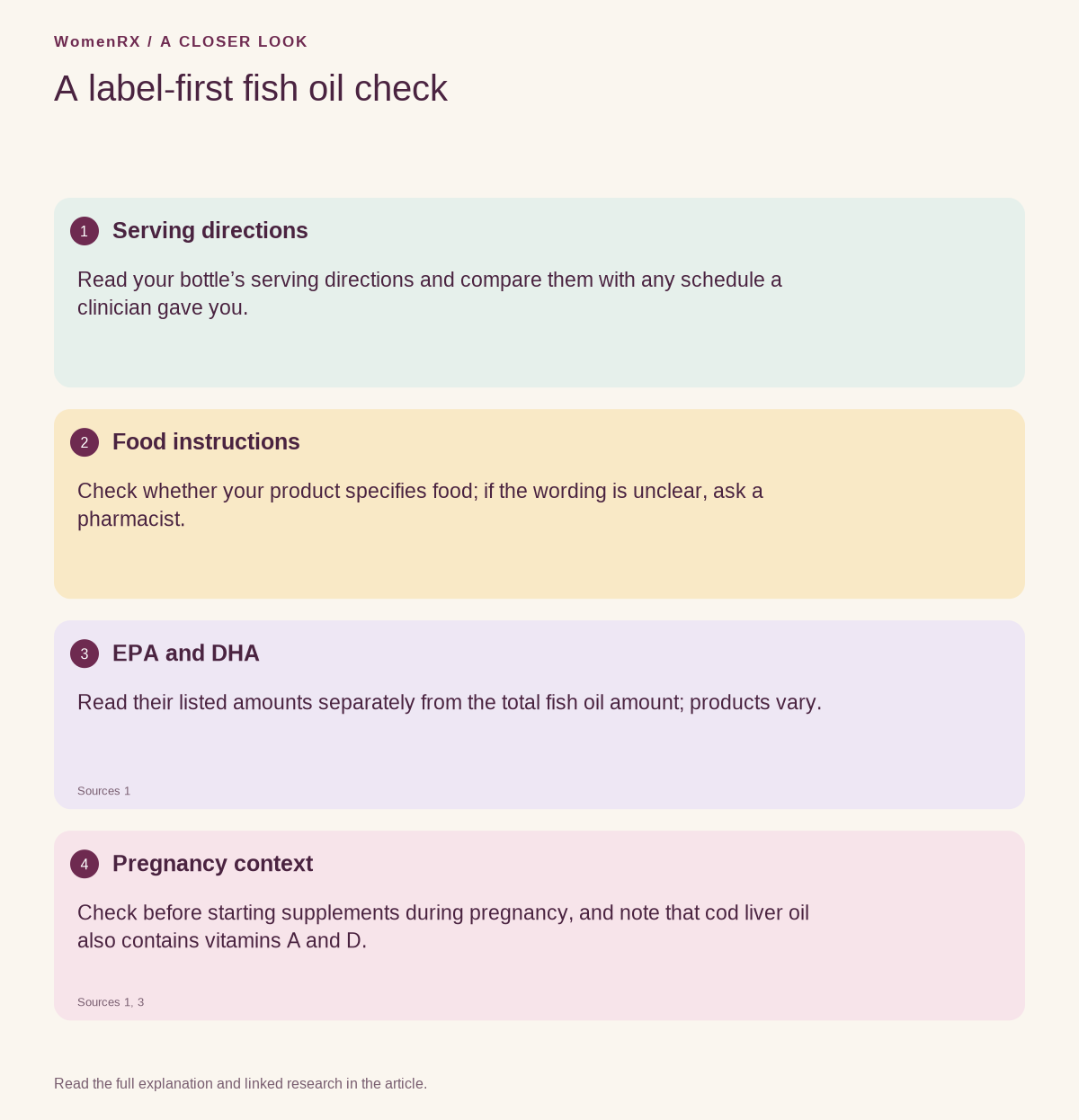
A label-first fish oil check
Serving directions: Read your bottle’s serving directions and compare them with any schedule a clinician gave you.
Food instructions: Check whether your product specifies food; if the wording is unclear, ask a pharmacist.
EPA and DHA: Read their listed amounts separately from the total fish oil amount; products vary.1
Pregnancy context: Check before starting supplements during pregnancy, and note that cod liver oil also contains vitamins A and D.13
Read the figure as text
Use these checks to sort out the product before fitting it into your routine.- Serving directions: Read your bottle’s serving directions and compare them with any schedule a clinician gave you.
- Food instructions: Check whether your product specifies food; if the wording is unclear, ask a pharmacist.
- EPA and DHA: Read their listed amounts separately from the total fish oil amount; products vary.1
- Pregnancy context: Check before starting supplements during pregnancy, and note that cod liver oil also contains vitamins A and D.13
More questions, answered
Should I take fish oil with food?
Check your product’s directions. If they specify food, follow that instruction. If you’re unsure what the wording means, a pharmacist can help you interpret the label.
Is fish oil the same as EPA and DHA?
No. Fish oil is the oil in the supplement; EPA and DHA are omega-3 fatty acids it may contain. Check their amounts on the label because products vary. 1