Is Fish Oil Worth Considering in Midlife?
Being over 40 doesn’t by itself create a need for fish oil, and evidence that it eases menopause symptoms is mixed.
Fish oil may be worth discussing for a specific health goal, but midlife alone isn’t a reason to start it. Trials in perimenopausal and postmenopausal women have not consistently found relief from hot flashes or better menopause-related quality of life. If your goal is simply to get omega-3s, compare a supplement with food: fatty fish provides EPA and DHA, while foods such as walnuts provide ALA. 1 3 4
Start with the goal, not your age
There isn’t a special fish-oil requirement that begins at 40 or at menopause. US dietary reference values set an adequate intake for women for ALA, an omega-3 found in plant foods, but do not set a separate recommended intake for EPA or DHA, the long-chain omega-3s found in fish. The ALA adequate intake is the same for women ages 19-50 and 51 and older. That’s a nutrient-planning reference, not a direction to take fish-oil capsules. 1
So ask what you want the supplement to do. If you’re considering it for hot flashes, night sweats, sleep, or overall menopause-related quality of life, the midlife-specific research doesn’t show a reliable benefit. If you’re considering it to increase omega-3 intake because you rarely eat fish, food and supplements are different ways to get some of the same fatty acids, but they aren’t identical choices.
What menopause trials actually found
The findings on symptoms don’t line up neatly. A systematic review of three randomized trials, involving 483 women ages 51 to 54.7, found no overall difference between omega-3 supplements and placebo for hot-flash frequency or severity, insomnia severity, sleep quality, or quality of life. It did find fewer and less severe night sweats in the omega-3 groups, but the review said the evidence wasn’t enough to conclude the supplements help menopausal vasomotor symptoms overall. 3
A larger randomized trial assigned 355 peri- and postmenopausal women ages 40-62 to omega-3 or placebo as part of a 12-week study. Omega-3 did not improve overall menopause-related quality-of-life scores compared with placebo. 4
There are also positive individual results. In one 8-week trial of women ages 40-55 with moderate to severe psychological distress, an enriched EPA supplement was associated with a bigger reduction in hot-flash frequency than placebo among the participants included in the hot-flash analysis. The average reduction was 1.58 hot flashes per day with EPA and 0.50 per day with placebo. Hot-flash intensity and overall menopause-specific quality-of-life scores did not show a significant between-group difference. The result is a reason the question has been studied, not a settled promise for women in midlife. 2
Taken together, one positive trial doesn’t outweigh the less encouraging findings across other trials. If symptom relief is your main goal, fish oil is not a well-established menopause treatment based on this evidence.
Food and capsules supply different omega-3s
Flaxseed, chia seeds, walnuts, and some plant oils supply ALA. Fatty fish such as salmon, sardines, herring, and mackerel supply EPA and DHA. For a concrete comparison, the NIH reference lists about 1.24 grams of EPA and 0.59 grams of DHA in a 3-ounce serving of cooked farmed Atlantic salmon, while an ounce of English walnuts provides about 2.57 grams of ALA. These are different omega-3 fatty acids, so the numbers aren’t a direct like-for-like comparison. 1
If you do eat fish, a meal can provide omega-3s as part of a whole food. If you prefer a supplement or don’t eat fish, check the label for the amounts of EPA and DHA rather than relying on the number of milligrams of “fish oil.” Products vary, and the total oil listed is not necessarily the amount of EPA plus DHA. Algal-oil supplements are another source of long-chain omega-3s; many provide DHA, and some also contain EPA. 1
Separate menopause symptoms from other reasons for omega-3s
If you’re hoping for fewer hot flashes or better sleep, the trial evidence doesn’t support counting on fish oil for that outcome. If your aim is to include more omega-3-rich foods, consider whether fatty fish or plant sources fit your eating preferences; a supplement is an alternative, not a midlife requirement. If you’re looking at a supplement for a separate medical reason, that’s a different decision from taking it for menopause symptoms, and the symptom trials here don’t answer it.
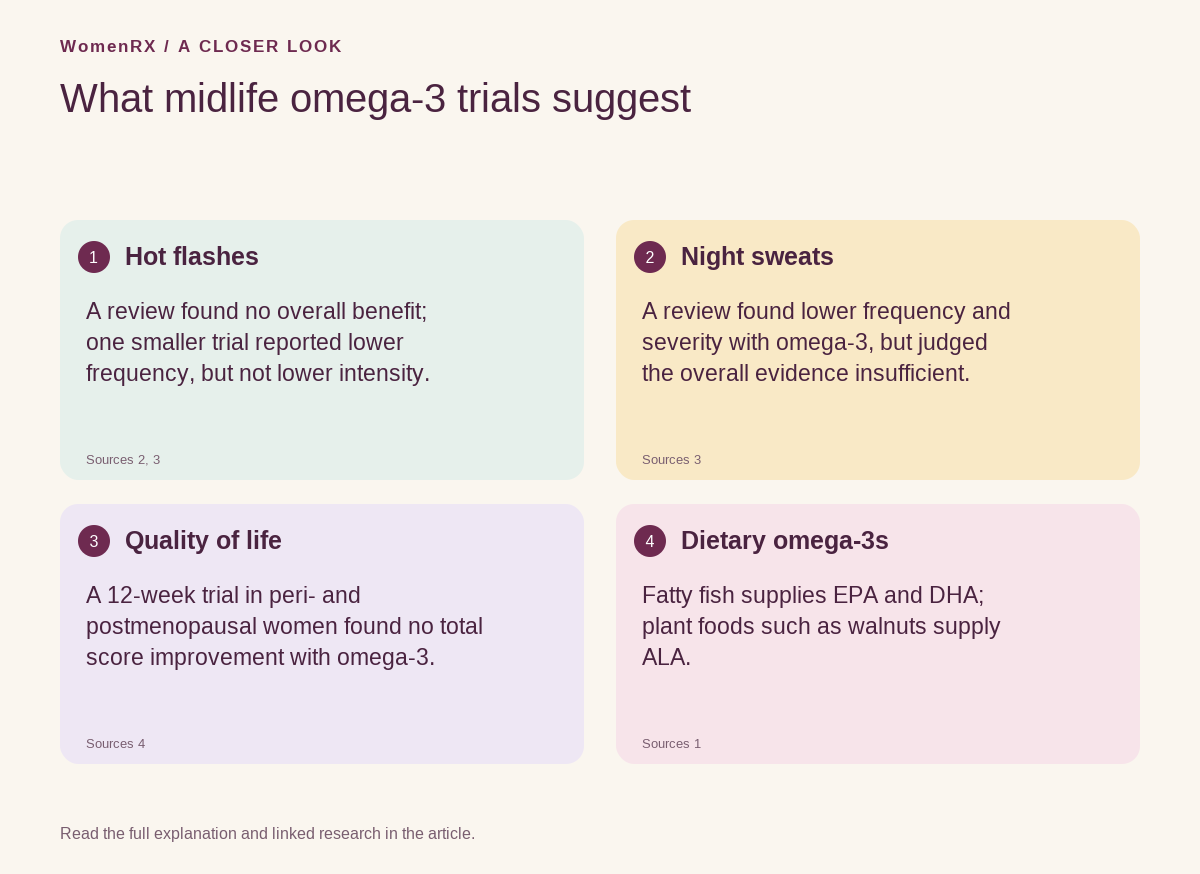
What midlife omega-3 trials suggest
Hot flashes: A review found no overall benefit; one smaller trial reported lower frequency, but not lower intensity.23
Night sweats: A review found lower frequency and severity with omega-3, but judged the overall evidence insufficient.3
Quality of life: A 12-week trial in peri- and postmenopausal women found no total score improvement with omega-3.4
Dietary omega-3s: Fatty fish supplies EPA and DHA; plant foods such as walnuts supply ALA.1
Read the figure as text
The menopause studies test different outcomes and do not point to a consistent symptom benefit.- Hot flashes: A review found no overall benefit; one smaller trial reported lower frequency, but not lower intensity.23
- Night sweats: A review found lower frequency and severity with omega-3, but judged the overall evidence insufficient.3
- Quality of life: A 12-week trial in peri- and postmenopausal women found no total score improvement with omega-3.4
- Dietary omega-3s: Fatty fish supplies EPA and DHA; plant foods such as walnuts supply ALA.1
More questions, answered
Does a fish-oil label tell me how much EPA and DHA I’m getting?
Not from the total fish-oil amount alone. Supplement formulations vary, so check the label for the listed amounts of EPA and DHA specifically. 1
Can I get omega-3s without eating fish?
Yes. Walnuts, chia, flaxseed, and some oils provide ALA. Algal-oil supplements can provide DHA, and some also contain EPA. These are distinct ways to get omega-3 fatty acids, not identical sources. 1
Sources you can check
- Omega-3 Fatty Acids - Health Professional Fact SheetAccessed 2026-09-25Return to first citation
- Effects of ethyl-eicosapentaenoic acid omega-3 fatty acid supplementation on hot flashes and quality of life among middle-aged women: a double-blind, placebo-controlled, randomized clinical trial.Lucas M, Asselin G, Mérette C, Poulin MJ, Dodin S. · Menopause (New York, N.Y.) · 2009Return to first citation
- Effect of omega-3 supplements on vasomotor symptoms in menopausal women: A systematic review and meta-analysis.Mohammady M, Janani L, Jahanfar S, Mousavi MS. · European journal of obstetrics, gynecology, and reproductive biology · 2018Return to first citation
- Menopausal quality of life: RCT of yoga, exercise, and omega-3 supplements.Reed SD, Guthrie KA, Newton KM, Anderson GL, Booth-LaForce C, Caan B, Carpenter JS, Cohen LS, Dunn AL, Ensrud KE, Freeman EW, Hunt JR, Joffe H, Larson JC, Learman LA, Rothenberg R,... · American journal of obstetrics and gynecology · 2014Return to first citation