Fish Oil and Body Weight: What Trials Actually Show
A small trial found no clear effect of fish oil on weight, while the women-focused findings discussed here don’t establish an effect on weight loss or body composition.
In a small trial involving people with gout, weight and BMI did not change significantly differently with fish oil than without it over 24 weeks. That doesn’t prove fish oil has no effect. Studies involving women examined fish oil alongside calorie-restricted diets, but the findings discussed here don’t establish whether fish oil changed how much weight participants lost. 4 2 3
The scale result is not a weight-loss promise
Fish oil isn’t supported by these findings as a reliable way to lose weight. In a 2022 open-label pilot trial, 40 people with gout were assigned to fish oil or no fish oil for 24 weeks. The researchers found no statistically significant difference between the groups in change in body weight or BMI. The trial was small and focused on gout, so it can’t rule out a small effect or tell us what would happen in other groups. 4
A result that is “not statistically significant” is not proof that two options have exactly the same effect. It means this study didn’t establish a difference. That distinction matters when a trial is small, as this one was.
Weight, waist, and body composition answer different questions
The scale measures total body mass, including muscle, bone, fat, and water. BMI relates weight to height but doesn’t separate fat from muscle or bone. Waist circumference offers a different piece of information: it can help indicate whether more body fat is carried around the abdomen. These measures aren’t interchangeable, and a finding for one doesn’t automatically tell you what happened to the others. 1
For fish oil specifically, the direct result above is about weight and BMI. The findings discussed below don’t establish a fish-oil effect on waist circumference or body composition. Weight loss during a diet, on its own, can’t tell you whether fish oil changed abdominal fat, total fat, or lean mass.
What the studies in women can and can’t tell us
A 2024 post-hoc analysis involved 117 middle-aged and older women with obesity and multiple metabolic abnormalities. Participants followed a calorie-restricted diet with or without fish oil for 12 weeks. The published abstract focuses on iron measures and omega-3 levels; it does not give a between-group result for weight change. The findings reported there therefore don’t establish whether adding fish oil altered weight loss. 2
A report on young women with overweight drew on an eight-week energy-restricted diet trial. The broader trial included 324 adults assigned to different diets, including a fish-oil group. The report focuses on DNA methylation and says weight loss occurred with energy restriction. Those findings don’t show whether the women receiving fish oil lost more weight than women receiving the control diet. Weight loss during the diet is not, by itself, evidence that fish oil caused it. 3
Neither report establishes that women respond differently from men. A study focused on women can help answer what happened in that group, but it can’t show a difference by sex without a comparison of treatment effects in women and men.
A practical way to read a weight claim
When a fish-oil claim mentions “weight,” check which outcome it means: body weight, BMI, waist circumference, or a body-composition measure such as fat or lean mass. Then look for the comparison that matters: did people taking fish oil change more than people in a control group, over the same period and under similar conditions?
That comparison is especially useful when everyone is also following a calorie-restricted diet. Weight loss during the study doesn’t by itself show that fish oil contributed to it. The findings discussed here don’t justify choosing fish oil as a weight-loss aid. They also don’t establish that fish oil causes weight gain: the gout pilot found no statistically significant difference in weight or BMI between groups. 2 3 4
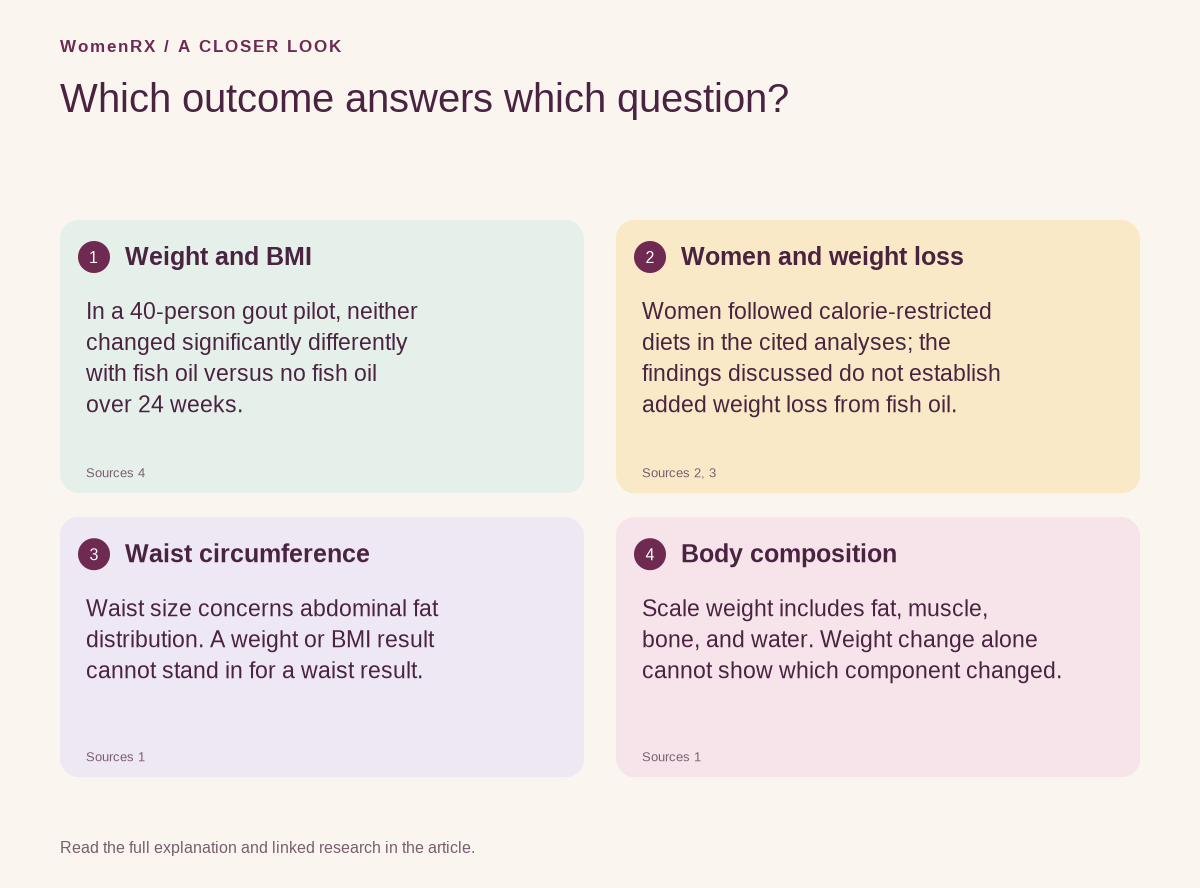
Which outcome answers which question?
Weight and BMI: In a 40-person gout pilot, neither changed significantly differently with fish oil versus no fish oil over 24 weeks.4
Women and weight loss: Women followed calorie-restricted diets in the cited analyses; the findings discussed do not establish added weight loss from fish oil.23
Waist circumference: Waist size concerns abdominal fat distribution. A weight or BMI result cannot stand in for a waist result.1
Body composition: Scale weight includes fat, muscle, bone, and water. Weight change alone cannot show which component changed.1
Read the figure as text
A fish-oil claim can sound broader than the outcome behind it. Match each finding to what was actually established.- Weight and BMI: In a 40-person gout pilot, neither changed significantly differently with fish oil versus no fish oil over 24 weeks.4
- Women and weight loss: Women followed calorie-restricted diets in the cited analyses; the findings discussed do not establish added weight loss from fish oil.23
- Waist circumference: Waist size concerns abdominal fat distribution. A weight or BMI result cannot stand in for a waist result.1
- Body composition: Scale weight includes fat, muscle, bone, and water. Weight change alone cannot show which component changed.1
Sources you can check
- Body Weight: MedlinePlusAccessed 2026-09-25Return to first citation
- Weight loss induced by a hypocaloric diet with or without fish oil supplementation re-established iron and omega-3 fatty acid homeostasis in middle-aged women with obesity: A post-hoc analysis of a randomized controlled trial.Huang SY, Mayasari NR, Tung TH, Lin WL, Tseng SH, Chang CC, Huang HY, Chang JS. · Maturitas · 2024Return to first citation
- DNA methylation pattern in overweight women under an energy-restricted diet supplemented with fish oil.do Amaral CL, Milagro FI, Curi R, Martínez JA. · BioMed research international · 2014Return to first citation
- Effect of omega-three supplementation on serum urate and gout flares in people with gout; a pilot randomized trial.Stamp LK, Grainger R, Frampton C, Drake J, Hill CL. · BMC rheumatology · 2022Return to first citation