Can You Tell If You Get Too Little Omega-3?
Your usual foods offer a better starting point than vague symptoms, while blood tests answer a narrower question about omega-3 levels.
You can get a sense of your omega-3 intake by looking at the foods you regularly eat, but low seafood intake isn’t a diagnosis of deficiency. Blood tests can measure omega-3 fatty acids; a red blood cell measure reflects a longer period than a plasma or serum test. Neither a symptom nor a test result alone shows that you need fish oil or algal oil. 1
Start with what you eat, not a symptom list
Omega-3 isn’t one nutrient. Alpha-linolenic acid (ALA) is found in plant foods such as flaxseed. Eicosapentaenoic acid (EPA) and docosahexaenoic acid (DHA) are long-chain omega-3s found in seafood and some supplements. For people age one and older, established omega-3 intake recommendations apply to ALA; separate recommended intakes for EPA and DHA haven’t been established in the NIH fact sheet. 1
That distinction helps when you look at your usual meals. If you rarely eat seafood, you may get little EPA and DHA from food, even if you eat foods containing ALA. Fatty fish such as salmon, sardines, and herring generally provide more EPA and DHA than leaner fish such as cod or tilapia, though amounts vary. This is a way to understand your dietary pattern, not a way to diagnose a deficiency. 1
There isn’t a reliable shortcut from a vague symptom to an omega-3 conclusion. If something about your health has changed, a list of supposed “low omega-3 signs” can’t tell you whether omega-3 is the cause or whether a supplement would change it. Start with the question you can answer: what kinds of omega-3 are part of your regular diet?
What would a blood test add?
A plasma or serum test can measure individual omega-3 fatty acids, but its result can vary substantially with your most recent meal. Red blood cell fatty-acid measurements reflect a longer period of intake, approximately the preceding 120 days. One such measure, the omega-3 index, reports EPA plus DHA in red blood cell membranes as a percentage of their total fatty acids. 1
A number still needs context. The NIH notes that experts haven’t established normal ranges for the plasma or serum measures it describes, and that most clinicians don’t routinely assess omega-3 status. A red blood cell result may give a longer-term picture of EPA and DHA than a plasma result, but it cannot, on its own, identify the cause of a symptom or settle whether a supplement would help you. 1
There’s also a difference between improving a test result and improving health. In a randomized trial involving 78 adults with active lupus, krill oil increased the omega-3 index, but disease activity did not improve across the study population overall. That condition-specific trial shows why a change in the marker shouldn’t be treated as proof of a benefit for someone choosing an everyday supplement. 2
Food, fish oil, or algal oil?
Food is a useful first comparison because different choices supply different omega-3s. Plant foods such as flaxseed supply ALA. Fatty fish supplies EPA and DHA, along with other components of seafood. Fish oil and vegetarian algal oil are supplement sources of long-chain omega-3s, but formulations vary. If you’re comparing products, check the label for the amounts of EPA and DHA rather than treating the amount of oil as the amount of those fatty acids. 1
The tradeoff changes during pregnancy and breastfeeding. Seafood species vary in both omega-3 content and methylmercury content, so the kind of fish matters when you’re pregnant. During breastfeeding, maternal intake affects the DHA and EPA content of breast milk; that fact alone doesn’t establish that every breastfeeding parent needs a supplement. If you’re weighing a particular fish or product during either period, bring that specific choice to your prenatal or postpartum care team rather than relying on a general claim about “omega-3.” 13
If you eat little or no seafood, fish oil or algal oil may be worth considering as a source of EPA or DHA. If you already eat seafood regularly, a supplement isn’t automatically an upgrade. Either way, a label can tell you what a product contains; it can’t promise relief from a symptom or prove that you were deficient. 12
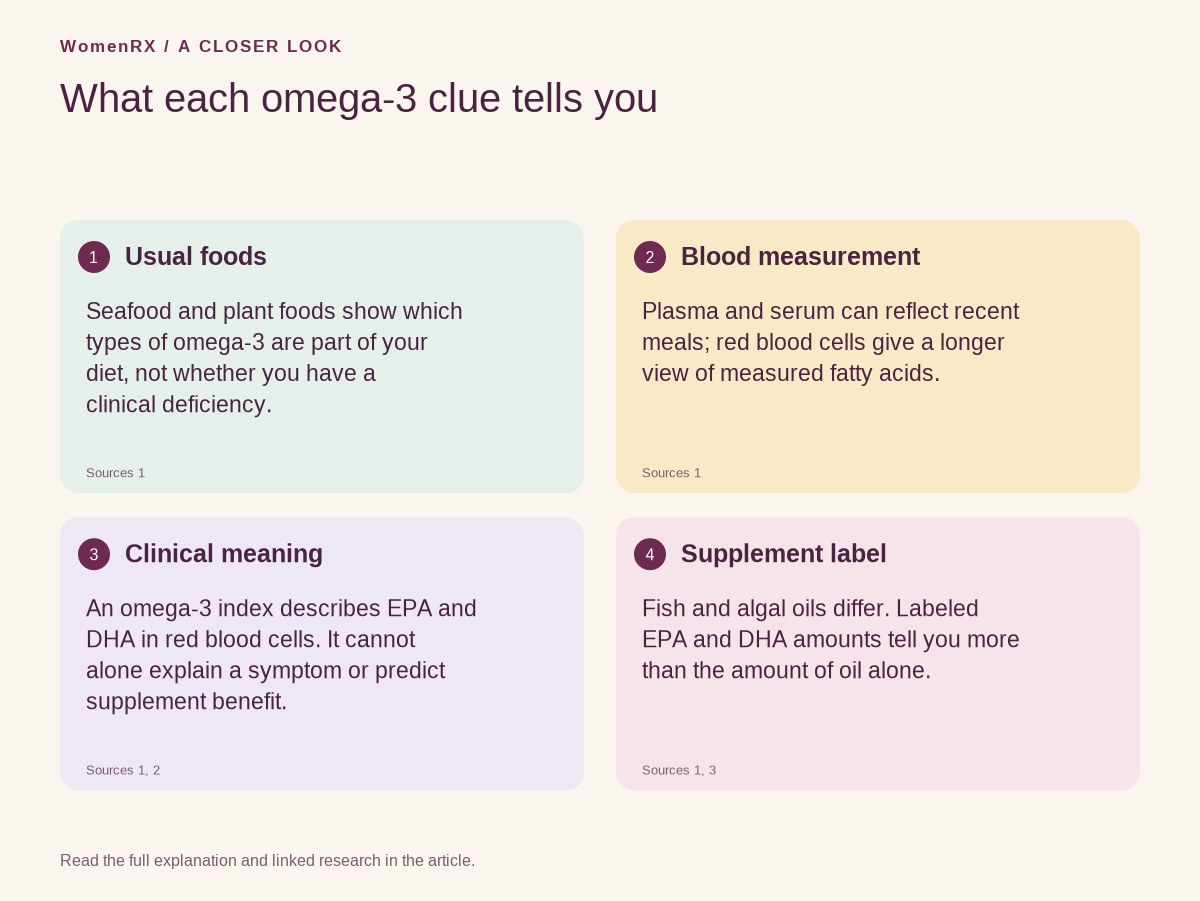
What each omega-3 clue tells you
Usual foods: Seafood and plant foods show which types of omega-3 are part of your diet, not whether you have a clinical deficiency.1
Blood measurement: Plasma and serum can reflect recent meals; red blood cells give a longer view of measured fatty acids.1
Clinical meaning: An omega-3 index describes EPA and DHA in red blood cells. It cannot alone explain a symptom or predict supplement benefit.12
Supplement label: Fish and algal oils differ. Labeled EPA and DHA amounts tell you more than the amount of oil alone.13
Read the figure as text
These four kinds of information answer related but different questions.- Usual foods: Seafood and plant foods show which types of omega-3 are part of your diet, not whether you have a clinical deficiency.1
- Blood measurement: Plasma and serum can reflect recent meals; red blood cells give a longer view of measured fatty acids.1
- Clinical meaning: An omega-3 index describes EPA and DHA in red blood cells. It cannot alone explain a symptom or predict supplement benefit.12
- Supplement label: Fish and algal oils differ. Labeled EPA and DHA amounts tell you more than the amount of oil alone.13
More questions, answered
Does algal oil contain the same omega-3s as fish oil?
Both can supply long-chain omega-3s, but their EPA and DHA amounts can differ. Algal oil is generally higher in DHA and lower in EPA than fish oil; check the particular product’s label rather than assuming all formulas are alike. 13
Sources you can check
- Omega-3 Fatty Acids - Health Professional Fact SheetAccessed 2026-09-25Return to first citation
- Correction of omega-3 fatty acid deficiency and improvement in disease activity in patients with systemic lupus erythematosus treated with krill oil concentrate: a multicentre, randomised, double-blind, placebo-controlled trial.Salmon J, Wallace DJ, Rus V, Cox A, Dykas C, Williams B, Ding Y, Hals PA, Johnsen L, Lipsky PE. · Lupus science & medicine · 2024Return to first citation
- Marine Oils2006Return to first citation