Omega-3 Supplements: Choose by Your Health Goal
Fish oil isn’t a one-size-fits-all wellness supplement: what matters is the goal, the EPA or DHA in the product, and whether its evidence actually fits your situation.
An omega-3 supplement may make sense for a specific reason, but a general fish-oil capsule isn’t interchangeable with a studied treatment. For high triglycerides, evidence about purified EPA doesn’t automatically apply to mixed EPA/DHA products. During pregnancy or breastfeeding, DHA deserves a separate look from ALA intake targets; those targets can’t tell you whether a supplement will improve an outcome. 1 4 8
Start with the reason you’re considering it
Omega-3 is a family of fats, not one ingredient. ALA is found in foods such as walnuts, chia seeds, and canola oil; EPA and DHA are found mainly in fatty fish and some supplements. Algal oil is another supplement source, often providing DHA. These forms and sources aren’t interchangeable just because a label says “omega-3.” 1
A useful first question is: are you trying to address high triglycerides, meet a nutrition need during pregnancy or breastfeeding, or support general wellness? The evidence and the relevant product can differ by goal.
If your goal is lower triglycerides
Some omega-3 products are studied or used for high triglycerides, but that doesn’t mean any over-the-counter fish oil has the same effect. A review describes moderate triglyceride lowering with purified EPA, while noting that trials of mixed EPA/DHA and lower-dose purified EPA did not show the same cardiovascular benefit as the purified-EPA formulation it discusses. 4
A small crossover study offers a reminder that treatments aren’t interchangeable: among 36 analyzed patients with untreated high triglycerides, pemafibrate lowered triglycerides more than EPA plus DHA over the study periods. That study doesn’t establish which treatment is right for you, but it does show why the product and the clinical goal matter. 5
The triglyceride effect and cardiovascular-event benefit are also different questions. In a meta-analysis of 25 trials involving 25,578 people with established cardiovascular disease, combined EPA/DHA at the doses studied did not significantly reduce major cardiovascular events. That finding doesn’t answer every question about omega-3s, but it cautions against assuming that a generic fish-oil supplement prevents heart attacks. 6
If a clinician is treating your triglycerides, ask what the intended formulation and dose are, and whether a supplement is meant to add to your current plan. Don’t substitute a store-bought fish-oil capsule for prescribed lipid treatment. The studied purified-EPA formulation and a mixed EPA/DHA supplement are not the same intervention. 4
If you’re pregnant, breastfeeding, or planning to be
Pregnancy and lactation have their own omega-3 intake reference values. For women ages 19 to 50, the Adequate Intake for ALA is 1.4 grams daily during pregnancy and 1.3 grams during lactation, compared with 1.1 grams for other adults in that age range. These values refer to ALA, not to a recommended amount of EPA or DHA: the Institute of Medicine did not set specific intake recommendations for those fats. 1
Food can provide EPA and DHA: for example, the NIH fact sheet lists cooked salmon, herring, sardines, and mackerel among sources. Some supplements use algal oil, often providing DHA. The amount varies across foods and products, so “fish oil” on the front of a bottle doesn’t tell you how much EPA or DHA it contains. 1
DHA is worth considering separately from ALA, especially while breastfeeding: human milk contains DHA, and research reviewed in breastfeeding women links maternal diet with differences in milk fatty-acid composition. A change in milk composition, though, is not itself proof that taking a DHA supplement improves an infant outcome. 1 8
During pregnancy, NIH nutrition guidance identifies omega-3s among nutrients that may be underconsumed. That makes your usual foods and any prenatal supplement useful starting points for a conversation about DHA; the ALA intake figures above can’t predict whether fish oil will change a pregnancy outcome. If you’re pregnant, check with your prenatal care clinician before starting a supplement. If you’re breastfeeding, you can bring the product label to a postpartum care visit to discuss how it fits your diet. 1 2 3
If your goal is broad wellness
A supplement’s popularity isn’t proof that it prevents heart disease, improves mood, or boosts fertility. In cardiovascular research, results depend on the formulation and the people studied. A review describes positive findings for purified EPA added to a statin in a particular trial, while noting that mixed EPA/DHA and lower-dose purified EPA did not show similar results. Those findings shouldn’t be generalized to all supplements or all women. 4
For fertility, the evidence in the cited systematic review concerns supplements taken by men with infertility, not women. The review found no convincing evidence that supplements improved pregnancy or live-birth rates in that male-infertility research. It also found no improvement in sperm parameters with omega-3s overall, though the individual omega-3 studies had mixed results. This does not answer whether omega-3 supplements affect female fertility. 7
What to check before choosing a product
Look past the large “fish oil” number. Check the label for the separate amounts of EPA and DHA; a typical fish-oil supplement may contain 1,000 mg of fish oil but only 180 mg EPA and 120 mg DHA, and formulations vary widely. Those figures describe an example, not a recommended dose. 1
Then match the label to your reason for taking it. If your goal is a clinician-directed triglyceride treatment, ask whether the product is the exact formulation being discussed. If your goal is pregnancy nutrition, ask how the product fits with your diet and prenatal care. If the goal is general wellness, consider whether the evidence supports that particular outcome before buying a supplement.
The most useful conversation is specific: “What outcome are we treating or trying to meet? Which formulation and amount are appropriate for that purpose? Does this fit with my current medicines and care plan?” In pregnancy, check before starting a supplement or changing a medicine. 3
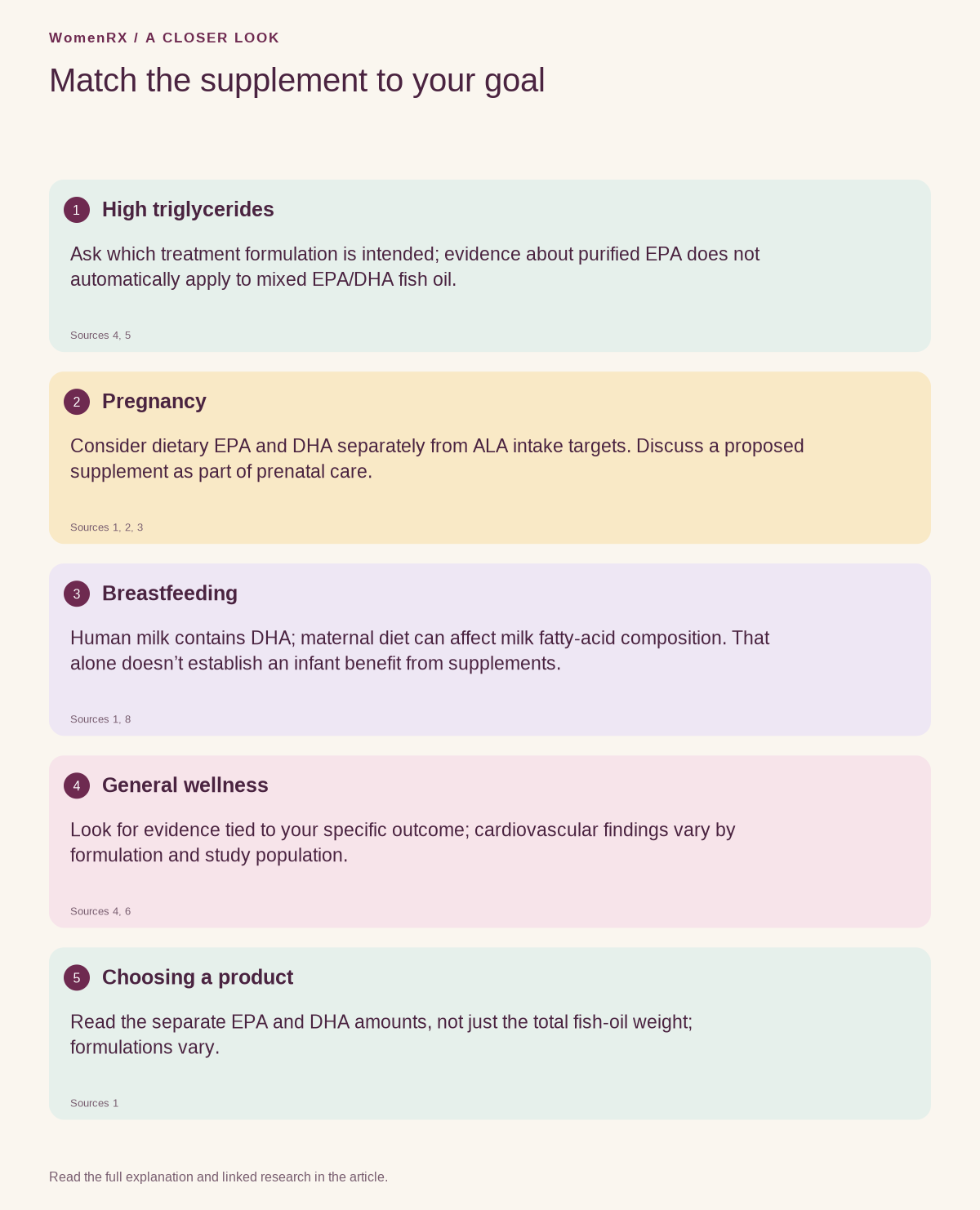
Match the supplement to your goal
High triglycerides: Ask which treatment formulation is intended; evidence about purified EPA does not automatically apply to mixed EPA/DHA fish oil.45
Pregnancy: Consider dietary EPA and DHA separately from ALA intake targets. Discuss a proposed supplement as part of prenatal care.123
Breastfeeding: Human milk contains DHA; maternal diet can affect milk fatty-acid composition. That alone doesn’t establish an infant benefit from supplements.18
General wellness: Look for evidence tied to your specific outcome; cardiovascular findings vary by formulation and study population.46
Choosing a product: Read the separate EPA and DHA amounts, not just the total fish-oil weight; formulations vary.1
Read the figure as text
Start with the reason you’re considering omega-3s, then check which evidence and label details fit that situation.- High triglycerides: Ask which treatment formulation is intended; evidence about purified EPA does not automatically apply to mixed EPA/DHA fish oil.45
- Pregnancy: Consider dietary EPA and DHA separately from ALA intake targets. Discuss a proposed supplement as part of prenatal care.123
- Breastfeeding: Human milk contains DHA; maternal diet can affect milk fatty-acid composition. That alone doesn’t establish an infant benefit from supplements.18
- General wellness: Look for evidence tied to your specific outcome; cardiovascular findings vary by formulation and study population.46
- Choosing a product: Read the separate EPA and DHA amounts, not just the total fish-oil weight; formulations vary.1
More questions, answered
Is a 1,000 mg fish-oil capsule the same as 1,000 mg of omega-3s?
No. The NIH fact sheet gives a typical example of a 1,000 mg fish-oil supplement containing 180 mg EPA and 120 mg DHA. Products vary, so check the separate EPA and DHA amounts on the label. 1
Can I use fish oil instead of my prescribed triglyceride treatment?
Don’t make that switch on your own. Purified EPA, mixed EPA/DHA products, and general fish-oil supplements are not interchangeable evidence-wise. Ask the prescriber what formulation is intended and how it fits your treatment plan. 4
Sources you can check
- Omega-3 Fatty Acids - Health Professional Fact SheetAccessed 2026-09-25Return to first citation
- Dietary Supplements and Life Stages: Pregnancy - Health Professional Fact SheetAccessed 2026-09-25Return to first citation
- Pregnancy and Medicines | MedlinePlusAccessed 2026-09-25Return to first citation
- [Icosapent ethyl for the reduction of residual cardiovascular risk].Giubilato S, De Luca L. · Giornale italiano di cardiologia (2006) · 2025Return to first citation
- Crossover Trial of Pemafibrate and Omega-3-Acid Ethyl Esters for Hypertriglyceridemia in Patients with Cardiovascular Disease.Sezai A, Taoka M, Sekino H, Tanaka M. · JMA journal · 2026Return to first citation
- Meta Analysis of DHA and EPA Supplementation on Cardiovascular Outcomes and Atrial Fibrillation Risk.Shayan SK, Abbood RS, Al-Taie SF, Nataj PG, Khamdamjonovna MM, Aminnezhad S, Boushehri YG, Sindorovich JJ, Sinehsepehr A, Zare F, Pakmehr SA, Abdollahi E, Vahedinezhad M. · Pharmacology research & perspectives · 2026Return to first citation
- The Effect of Dietary Supplements on Male Infertility in Terms of Pregnancy, Live Birth, and Sperm Parameters: A Systematic Review and Meta-Analysis.Michaelsen MP, Poulsen M, Bjerregaard AA, Borgstrøm M, Poulsen LK, Chortsen MB, Henriksen SG, Kesmodel US. · Nutrients · 2025Return to first citation
- Maternal Lifestyle Factors Affecting Breast Milk Composition and Infant Health: A Systematic Review.Favara G, Maugeri A, Barchitta M, Lanza E, Magnano San Lio R, Agodi A. · Nutrients · 2024Return to first citation