Omega-3s and Fish Oil: How to Choose What Fits
Omega-3 is a family of fats, so the right food or supplement depends on which type you’re looking for and what you hope it will do.
ALA, EPA, and DHA are different omega-3 fats. ALA comes mainly from plant foods such as walnuts, chia, and flax; fatty fish provide EPA and DHA, which are also found in fish, krill, and algae-based supplements. Fish oil isn’t a universal wellness fix: evidence differs by outcome, and prescription EPA used in a specific high-risk heart population isn’t interchangeable with an over-the-counter blend. 1
Start with the type, not the bottle
“Omega-3” names a family of fats, not one ingredient. ALA (alpha-linolenic acid) is the essential omega-3: your body needs it from food. EPA and DHA are long-chain omega-3s. That distinction matters when comparing foods or reading a supplement label, because a product may contain one type, two types, or a mix. 1
Plant foods such as chia seeds, walnuts, flaxseed, and canola oil provide ALA. Fatty fish such as salmon, sardines, herring, and mackerel provide EPA and DHA. Supplements may use fish oil, krill oil, cod liver oil, or algal oil; algae-based products are a non-fish source and usually provide DHA, sometimes with EPA too. 1
Match the product to the goal
For a food-first approach, plant foods can add ALA, while fatty fish provide EPA and DHA. The amount of omega-3 in fish varies by species and other factors, so “fish” isn’t one consistent dose. 1
For a supplement, look past the large number on the front of the bottle. Check how much EPA and DHA it provides per serving, and whether it contains ALA or other ingredients. “Fish oil” is the oil’s total amount, not necessarily the amount of EPA plus DHA; formulations vary widely. Cod liver oil also provides vitamins A and D, so it isn’t simply the same product in a different package. 1
A product form can change how much EPA or DHA shows up in the blood without showing that it improves a health outcome. For example, a small 12-week randomized trial in 72 healthy adults found higher blood EPA and DHA levels with krill oil than with fish oil when participants received the same amount of omega-3s. That result measures a biomarker, not fewer heart attacks or better health overall. 2
Heart claims need the most context
The broad claim that fish oil prevents heart disease isn’t supported consistently. In the VITAL trial, a mixed-sex group of adults without previous heart attacks or strokes took an omega-3 supplement or placebo; the supplement did not significantly reduce the combined rate of major cardiovascular events over a median 5.3 years. The study included women aged 55 and older and men aged 50 and older, so its overall result isn’t a women-only estimate. 1
There is a more specific finding for prescription EPA. In REDUCE-IT, people with established cardiovascular disease or diabetes plus another risk factor, elevated triglycerides despite statin treatment, received prescription icosapent ethyl or placebo. Over a median 4.9 years, the prescription EPA group had a 25% lower rate of the trial’s composite cardiovascular outcome. That result applies to the studied high-risk group and prescription product, not to fish oil supplements generally. 1
The contrast matters: a prescription treatment tested for a defined medical purpose isn’t interchangeable with an over-the-counter supplement just because both contain omega-3s. If your goal is treating high triglycerides or reducing cardiovascular risk, don’t substitute a supplement for prescribed treatment based on a label claim. 1
Pregnancy and breastfeeding are a separate question
For women ages 19-50, the U.S. adequate intake for ALA is 1.1 grams daily; it is 1.4 grams during pregnancy and 1.3 grams during lactation. These are ALA intake values, not recommended EPA or DHA supplement doses. The National Academies framework cited by NIH does not set a separate EPA or DHA intake recommendation. 1
That distinction can help you read pregnancy or breastfeeding claims more carefully: a number for ALA does not tell you how much DHA to take. Cod liver oil also contains vitamins A and D, unlike a product that provides only omega-3s, so check the full label rather than treating the products as interchangeable. 1
A practical label check
Before choosing a product, ask yourself: Am I looking for ALA from plant foods, EPA and DHA from seafood or a supplement, or a prescribed treatment for a specific medical goal? Then check the actual amount of each omega-3 per serving, the source, and whether the product adds vitamins. If the goal is a medical one, the evidence for a particular prescription treatment should not be used to justify a different supplement.
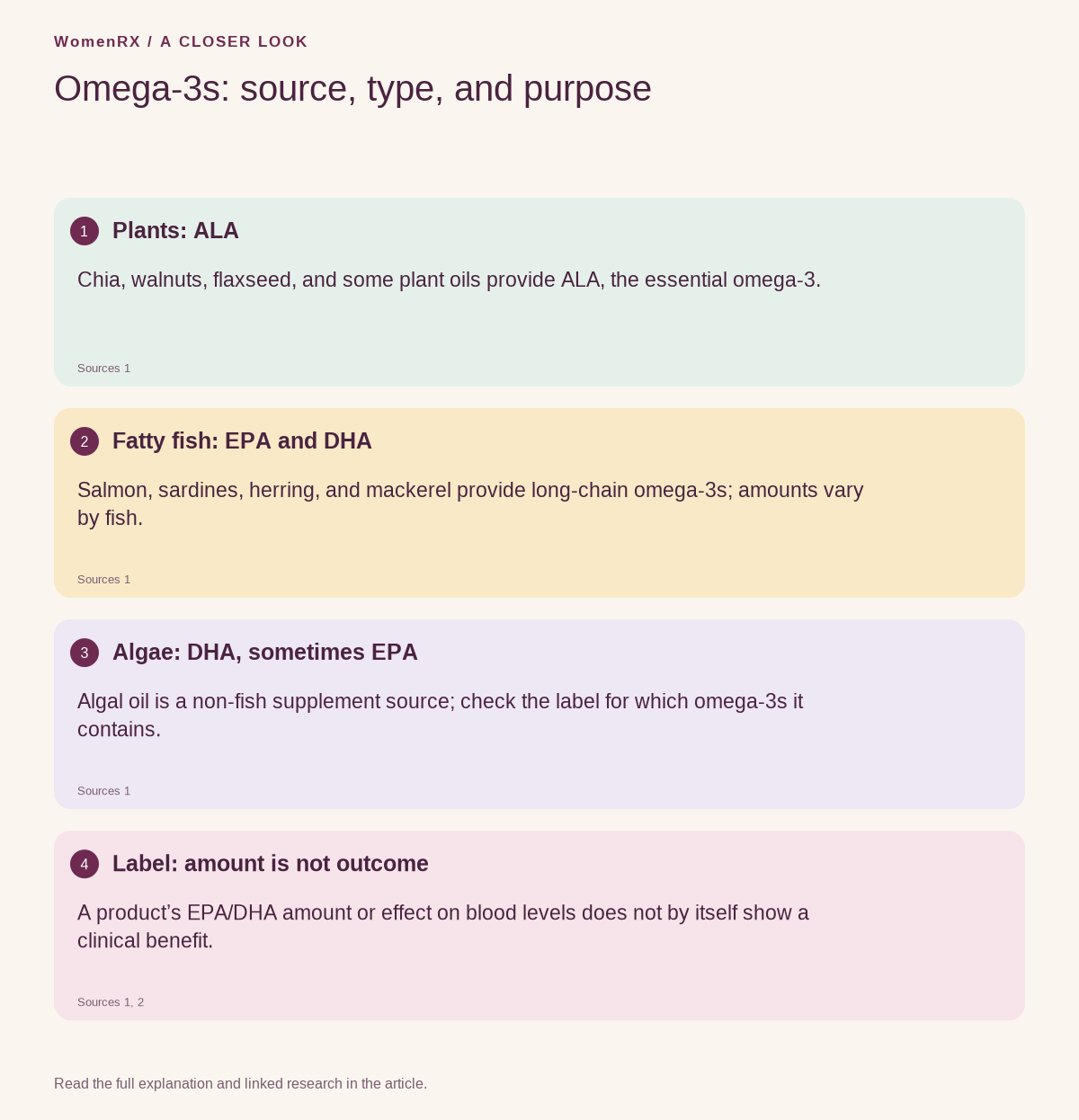
Omega-3s: source, type, and purpose
Plants: ALA: Chia, walnuts, flaxseed, and some plant oils provide ALA, the essential omega-3.1
Fatty fish: EPA and DHA: Salmon, sardines, herring, and mackerel provide long-chain omega-3s; amounts vary by fish.1
Algae: DHA, sometimes EPA: Algal oil is a non-fish supplement source; check the label for which omega-3s it contains.1
Label: amount is not outcome: A product’s EPA/DHA amount or effect on blood levels does not by itself show a clinical benefit.12
Read the figure as text
Follow the source to the omega-3 type, then separate what a label tells you from what clinical trials have tested.- Plants: ALA: Chia, walnuts, flaxseed, and some plant oils provide ALA, the essential omega-3.1
- Fatty fish: EPA and DHA: Salmon, sardines, herring, and mackerel provide long-chain omega-3s; amounts vary by fish.1
- Algae: DHA, sometimes EPA: Algal oil is a non-fish supplement source; check the label for which omega-3s it contains.1
- Label: amount is not outcome: A product’s EPA/DHA amount or effect on blood levels does not by itself show a clinical benefit.12
More questions, answered
Can I get omega-3s without eating fish?
Yes. Walnuts, chia, flaxseed, and some plant oils provide ALA. Algal oil supplements are another non-fish option and usually provide DHA; some include EPA as well. Those sources provide different omega-3 types, so check the product label for the specific fats it contains. 1
Does a higher blood omega-3 level mean a supplement works better?
Not by itself. Blood EPA and DHA are biomarkers, not proof of a health benefit. A small trial found higher blood levels with krill oil than fish oil, but it did not test whether krill oil prevented disease or improved clinical outcomes. 2
Sources you can check
- Omega-3 Fatty Acids - Health Professional Fact SheetAccessed 2026-09-25Return to first citation
- Krill oil increases plasma omega-3 fatty acids more than fish oil in healthy adults: a double-blind randomized controlled trial.Loukil I, Vachon A, Çaku A, Plourde M. · The American journal of clinical nutrition · 2026Return to first citation