How to Choose an Omega-3 Supplement for Your Goal
The right choice depends on what you want it to do: evidence for pregnancy and triglycerides doesn’t make every fish-oil product a heart-health treatment.
Start with the outcome, then read the amounts of EPA and DHA on the label, not just the larger “fish oil” number. A review reports that several studied formulations lowered triglycerides comparably, but cardiovascular-event benefit was demonstrated for purified icosapent ethyl added to a statin in patients with residual cardiovascular risk, not for ordinary fish-oil supplements. Pregnancy has separate seafood and omega-3 recommendations, including targets for DHA plus EPA. 1 2 5
First, match the product to the goal
Omega-3 isn’t one ingredient with one proven effect. A product may contain alpha-linolenic acid (ALA), EPA, DHA, or a combination. ALA comes from foods such as walnuts, chia, and flax; EPA and DHA are found mainly in seafood and some supplements. Plant ALA and fish-oil EPA/DHA aren’t interchangeable on a label. 1
For general nutrition, food may be enough. Fatty fish such as salmon, herring, and sardines provide EPA and DHA, along with other nutrients. The amount varies by fish and serving; NIH lists a 3-ounce serving of cooked Atlantic farmed salmon among its omega-3 food examples. If you don’t eat seafood, algal oil can provide DHA, and some products also contain EPA. 1
A supplement can help fill a dietary gap, but it shouldn’t be chosen just because the front label says “omega-3” or “fish oil.” The NIH notes that products vary widely in their omega-3 content. 1
Triglycerides and heart outcomes aren’t the same claim
Triglyceride reduction and fewer cardiovascular events are different outcomes. A review reports that icosapent ethyl, a purified form of EPA, moderately lowered triglycerides, while trials of mixed EPA/DHA formulations and low-dose icosapent ethyl achieved comparable triglyceride reductions. Those other regimens did not show the same cardiovascular-event benefit as icosapent ethyl added to a statin in patients with residual cardiovascular risk. Lower triglycerides alone do not establish heart-attack prevention, and these trial results do not establish an over-the-counter fish-oil product as a triglyceride treatment or a substitute for the studied regimen. 5
A bottle’s EPA/DHA total alone isn’t a treatment plan for high triglycerides. If triglycerides are your reason for looking at supplements, focus on the exact product and treatment plan your clinician recommends rather than trying to match a trial finding by comparing bottle totals. The available findings do not report results separately for women, so they cannot establish whether the cardiovascular effect differs for women. 5
Make the label do some work
Look at the Supplement Facts panel for the amounts of EPA and DHA per serving. “1,000 mg fish oil” means the total oil, not necessarily 1,000 mg of EPA plus DHA. NIH gives a typical example of about 1,000 mg of fish oil containing 180 mg EPA and 120 mg DHA, while emphasizing that amounts vary. Add the EPA and DHA figures only if you’re comparing the amount of those two fatty acids; don’t mistake the fish-oil total for their combined amount. 1
Next, check whether the product’s ingredients match your situation. Algal oil is a non-fish source; some algal products provide DHA alone and some include EPA. Cod liver oil also provides vitamins A and D, so it isn’t simply another name for fish oil. 1
The label can tell you what the product says it contains. It cannot establish that a particular amount prevents heart disease, treats high triglycerides, or improves another health outcome. Those conclusions depend on evidence for the specific product and population, not just the total number of milligrams in a bottle.
Pregnancy has its own comparison
During pregnancy, seafood is a food source of DHA and EPA, and expert groups recommend 8 to 12 ounces per week of seafood varieties lower in mercury. For women who don’t eat seafood, including those following vegetarian or vegan diets, an EPA/DHA supplement may help increase intake. Pregnancy guidance summarized by NIH recommends at least 250 mg per day of DHA plus EPA from food or supplements, with an additional 100 to 200 mg per day of DHA during pregnancy. These are expert recommendations, not established EPA or DHA Dietary Reference Intakes. 2
Pregnancy outcomes also need to be kept distinct. A systematic review included 21 randomized trials, 19 of which were eligible for its meta-analysis, and found no significant benefit of prenatal DHA supplementation for the offspring neurodevelopment outcomes it assessed. It did find an average birth-weight difference of about 73 grams, but no notable differences in gestational age, birth length, or head circumference. 4 Separately, NIH’s pregnancy review reports that trials of long-chain omega-3s reduced preterm-birth risk, while cognitive and visual-development benefits from supplementation have not been consistent. 2
That evidence supports a practical distinction: pregnancy guidance about seafood and omega-3 intake isn’t the same as proof that a supplement improves every outcome for every pregnant person. If you’re pregnant or trying to conceive, check a supplement’s EPA and DHA amounts and ingredients with your prenatal care team before adding it; supplements, including herbal products, can matter during pregnancy. 2 3
Read the label against the goal
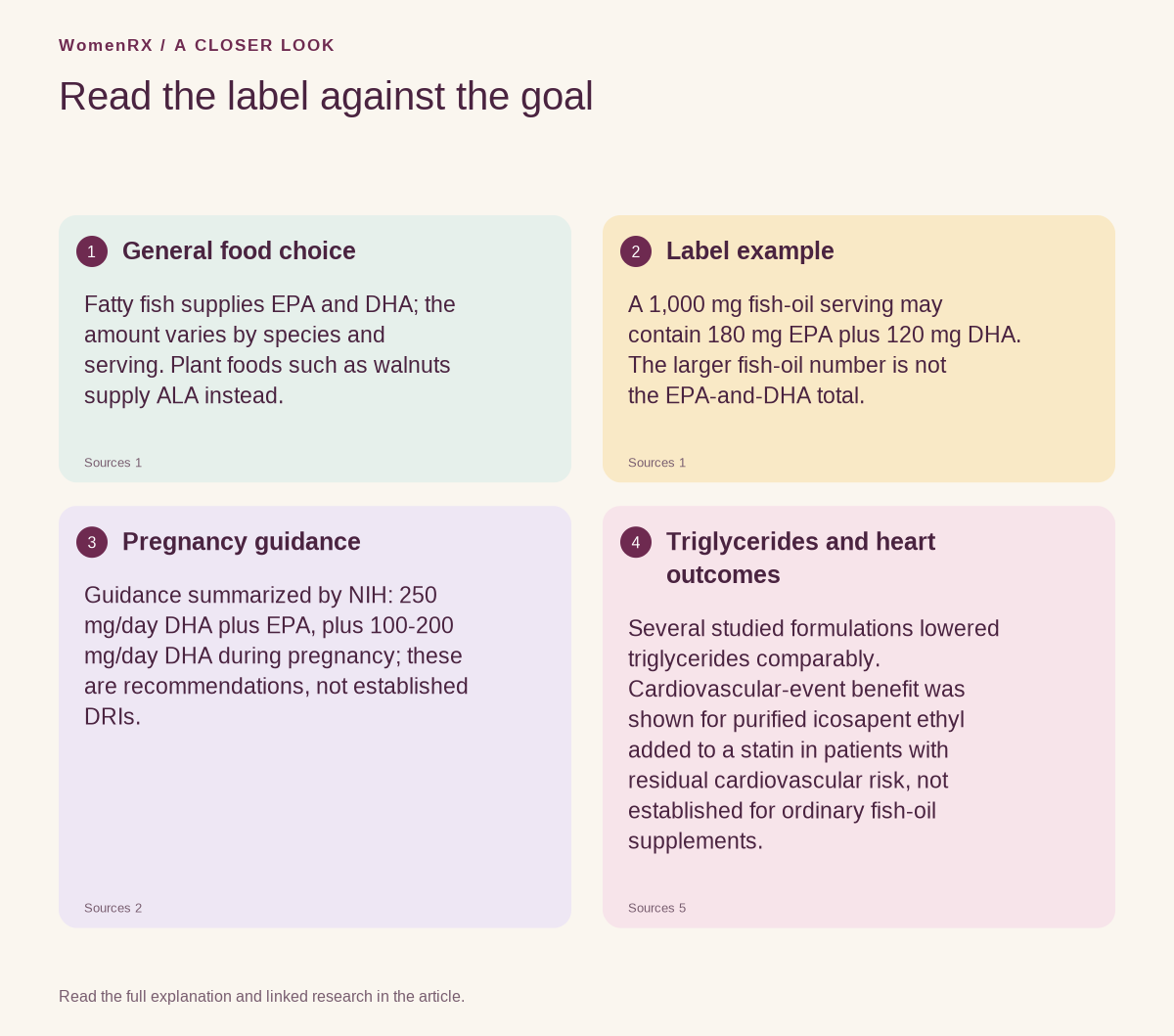
General food choice: Fatty fish supplies EPA and DHA; the amount varies by species and serving. Plant foods such as walnuts supply ALA instead.1
Label example: A 1,000 mg fish-oil serving may contain 180 mg EPA plus 120 mg DHA. The larger fish-oil number is not the EPA-and-DHA total.1
Pregnancy guidance: Guidance summarized by NIH: 250 mg/day DHA plus EPA, plus 100-200 mg/day DHA during pregnancy; these are recommendations, not established DRIs.2
Triglycerides and heart outcomes: Several studied formulations lowered triglycerides comparably. Cardiovascular-event benefit was shown for purified icosapent ethyl added to a statin in patients with residual cardiovascular risk, not established for ordinary fish-oil supplements.5
Read the figure as text
The EPA and DHA amounts help you compare products, but they do not make evidence for one outcome apply to another.- General food choice: Fatty fish supplies EPA and DHA; the amount varies by species and serving. Plant foods such as walnuts supply ALA instead.1
- Label example: A 1,000 mg fish-oil serving may contain 180 mg EPA plus 120 mg DHA. The larger fish-oil number is not the EPA-and-DHA total.1
- Pregnancy guidance: Guidance summarized by NIH: 250 mg/day DHA plus EPA, plus 100-200 mg/day DHA during pregnancy; these are recommendations, not established DRIs.2
- Triglycerides and heart outcomes: Several studied formulations lowered triglycerides comparably. Cardiovascular-event benefit was shown for purified icosapent ethyl added to a statin in patients with residual cardiovascular risk, not established for ordinary fish-oil supplements.5
More questions, answered
Is fish oil the same as omega-3?
No. Fish oil is one supplement source of omega-3s, and its EPA and DHA amounts vary. Read those amounts on the label rather than relying on the total fish-oil weight. 1
Can I use an over-the-counter fish-oil product for high triglycerides?
Don’t choose an over-the-counter fish-oil dose to treat high triglycerides based on the bottle’s total oil content. In trials summarized by a review, several formulations lowered triglycerides comparably, but they did not show the same cardiovascular-event benefit as purified icosapent ethyl added to a statin in patients with residual cardiovascular risk. Those results do not establish an over-the-counter treatment dose. 1 5
Sources you can check
- Omega-3 Fatty Acids - Health Professional Fact SheetAccessed 2026-09-25Return to first citation
- Dietary Supplements and Life Stages: Pregnancy - Health Professional Fact SheetAccessed 2026-09-25Return to first citation
- Pregnancy and Medicines | MedlinePlusAccessed 2026-09-25Return to first citation
- Impact of Omega-3 Fatty Acid Docosahexaenoic Acid Supplementation in Individuals During Pregnancy on Neurodevelopment and Growth of Offspring: Systematic Review and Meta-Analysis.Xie L, Zhou M, Lu L, Ning X, Song Y. · Developmental psychobiology · 2026Return to first citation
- [Icosapent ethyl for the reduction of residual cardiovascular risk].Giubilato S, De Luca L. · Giornale italiano di cardiologia (2006) · 2025Return to first citation