How Much Fiber Do You Need Each Day?
Your daily fiber reference changes with age and during pregnancy or breastfeeding, and a gradual increase is easier on your gut.
For women ages 19-50, the National Academies’ daily fiber Adequate Intake is 25 grams; from age 51, it’s 21 grams. The reference is 28 grams during pregnancy and 29 grams while breastfeeding. These are population guides, not numbers you have to reach overnight. If you’re eating less fiber now, add fiber-rich foods gradually and drink enough fluids, especially if constipation is an issue.912
Find the reference that fits your life stage
The National Academies lists daily fiber Adequate Intakes of 25 grams for women ages 19-50 and 21 grams from age 51 onward. The reference is 26 grams for ages 14-18, 28 grams during pregnancy, and 29 grams while breastfeeding. “Adequate Intake” matters here: it’s a population reference used when the evidence isn’t sufficient to set a Recommended Dietary Allowance. It isn’t a test of whether your own diet is healthy on any particular day.9
The lower reference after age 50 is tied to the age group in the nutrition reference table; it isn’t a rule that menopause suddenly changes your fiber needs. Pregnancy and breastfeeding have their own entries, so the usual adult figure shouldn’t simply be carried over to those stages.9
You may also see fiber expressed as 14 grams per 1,000 calories. That energy-based benchmark helps explain why daily numbers can differ when estimated food intake differs. For choosing a straightforward starting reference, use the age or life-stage figure above rather than treating every number you encounter as a separate goal to add together.69
Make the numbers look like food
Fiber comes from plant foods, including fruit, vegetables, whole grains, legumes, nuts, and seeds.15 You don’t need to get it all from one food. For a sense of scale, USDA reference data put a medium banana at about 3 grams of fiber and a cup of cooked quinoa at about 5 grams. Those are examples, not required portions; the amount you eat and the food you choose will change the total.78
If breakfast is usually low in fiber, you could try fruit with it. If a familiar lunch includes a grain, you could try quinoa in one meal. Beans or lentils, vegetables, nuts, and seeds offer other ways to spread fiber across the day. The useful question is less “Which single food gets me to 25 grams?” and more “Where could one fiber-rich food fit into what I already eat?”15
Increase it at a pace your gut can handle
Adding a lot of fiber at once can bring gas, bloating, or cramps. Start with one manageable food change, see how you feel, then add another rather than changing every meal at once.1 There’s no need to set a fixed weekly increase to make this work.
Pay attention to fluids too, particularly if you’re adding fiber because your stools are hard or difficult to pass. Drinking water and other liquids is one of the measures recommended alongside fiber-rich foods for constipation.23 This isn’t a reason to force a particular volume of water: the National Academies’ total water references include water from food as well as drinks, so they aren’t instructions for how much plain water to drink with fiber.9
If a new food leaves you uncomfortable, pause the increase and consider whether a smaller amount or a different fiber-rich food sits better. Persistent bloating isn’t necessarily a sign that you need still more fiber: constipation, food intolerance, and other causes can contribute to it.14
When more fiber isn’t the whole answer
Fiber and fluids can help with constipation, but low fiber isn’t its only possible cause. Changes in routine, activity, medicines, and other factors can also play a part; constipation is common during pregnancy and after giving birth.3 You don’t need a bowel movement every day to be healthy, but a change in your usual bowel habits is worth attention.2
If constipation isn’t improving with food and lifestyle changes, keeps returning, or comes with blood in your stool, unexplained weight loss, or a sudden change in bowel habits, seek medical advice rather than continuing to raise your fiber intake. Bloating that persists or keeps returning also deserves attention.34
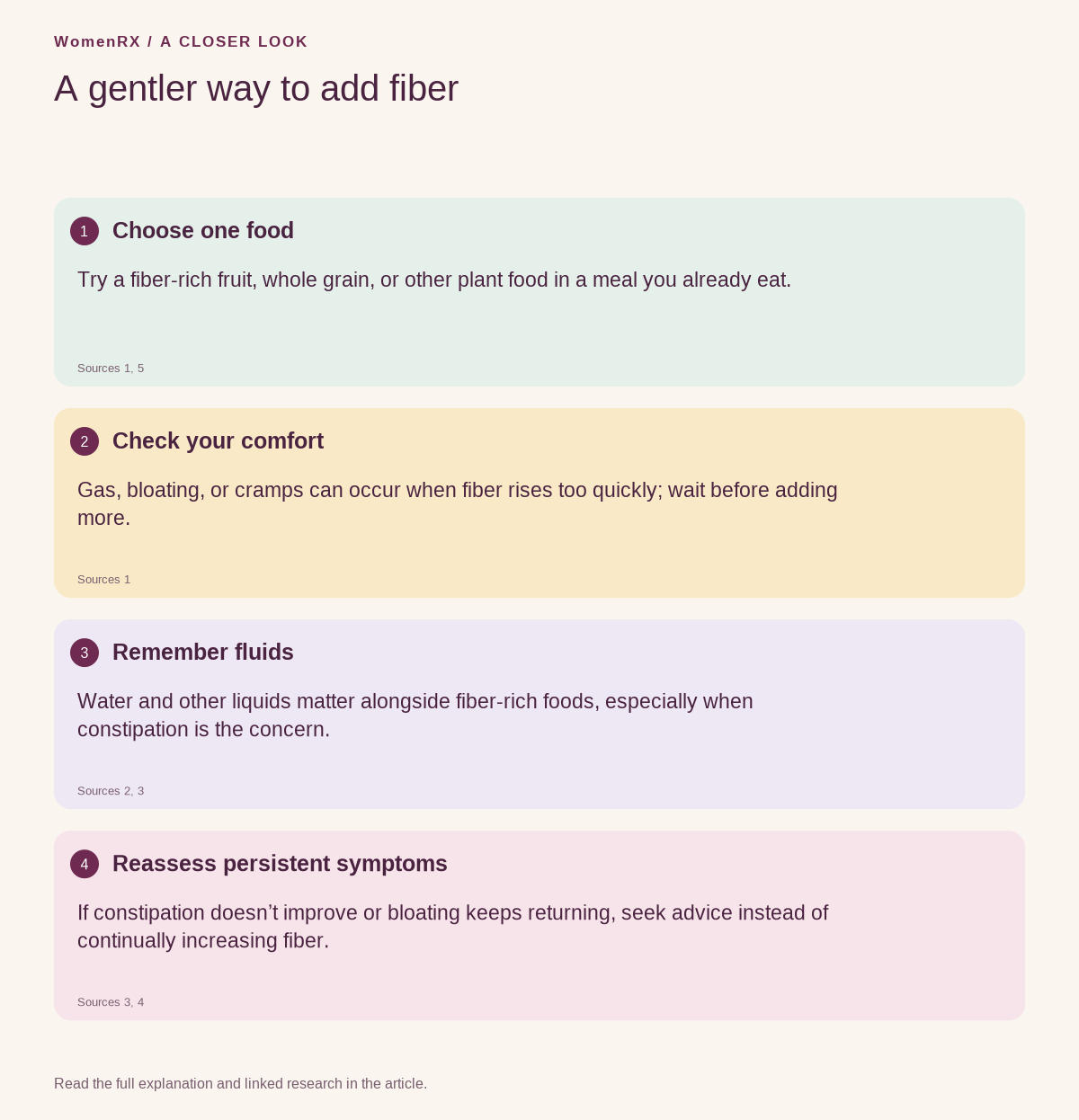
A gentler way to add fiber
Choose one food: Try a fiber-rich fruit, whole grain, or other plant food in a meal you already eat.15
Check your comfort: Gas, bloating, or cramps can occur when fiber rises too quickly; wait before adding more.1
Remember fluids: Water and other liquids matter alongside fiber-rich foods, especially when constipation is the concern.23
Reassess persistent symptoms: If constipation doesn’t improve or bloating keeps returning, seek advice instead of continually increasing fiber.34
Read the figure as text
Use comfort and bowel changes to guide the next food change, rather than following a fixed escalation schedule.- Choose one food: Try a fiber-rich fruit, whole grain, or other plant food in a meal you already eat.15
- Check your comfort: Gas, bloating, or cramps can occur when fiber rises too quickly; wait before adding more.1
- Remember fluids: Water and other liquids matter alongside fiber-rich foods, especially when constipation is the concern.23
- Reassess persistent symptoms: If constipation doesn’t improve or bloating keeps returning, seek advice instead of continually increasing fiber.34
More questions, answered
Does all dietary fiber have to come from whole grains?
No. Fruit, vegetables, legumes, nuts, and seeds provide fiber too. Using a mix of foods gives you more ways to add it without relying on one large serving.15
If I’m constipated, should I just keep adding fiber?
Not if symptoms are persisting or the increase is making you uncomfortable. Fluids, activity, medicines, and changes in routine may also matter. Constipation that isn’t improving, or a notable change in your usual bowel habits, is a reason to seek advice.23
Sources you can check
- Dietary Fiber: MedlinePlusAccessed 2026-09-25Return to first citation
- Constipation | MedlinePlusAccessed 2026-09-25Return to first citation
- Constipation - NHSAccessed 2026-09-25Return to first citation
- Bloating - NHSAccessed 2026-09-25Return to first citation
- The Role of Dietary Fiber in Health Promotion and Disease Prevention: A Practical Guide for CliniciansDaley SF, Vadakekut ES. · 2026Return to first citation
- Adequate Intake of Dietary Fiber May Relieve the Detrimental Impact of Blood Lead on Dyslipidemia among US Adults: A Study of Data from the National Health and Nutrition Examination Survey Database.Li B, Zhang F, Jiang H, Wang C, Zhao Q, Yang W, Hu A. · Nutrients · 2023Return to first citation
- USDA SR Legacy reference composition: bananaAccessed 2026-09-25Return to first citation
- USDA SR Legacy reference composition: quinoaAccessed 2026-09-25Return to first citation
- National Academies DRI summary table: total water and macronutrientsAccessed 2026-09-25Return to first citation