How Much Fluid Do You Need Each Day?
A daily fluid estimate is a starting point, not a water-bottle quota: food and other drinks count, and your needs change with your day.
For adults, the U.S. Adequate Intake for women is 2.7 liters of total water a day, including water in food, plain water and other drinks. The estimates are 3.0 liters during pregnancy and 3.8 liters while breastfeeding. These are reference values, not amounts every person must drink. Heat, activity and health conditions can change what makes sense for you.45
Start with total water, not glasses of plain water
The 2.7-liter estimate for adult women is about 11 cups from everything combined. It doesn't mean drinking 11 cups of plain water on top of your meals and other beverages. Water in food counts, as do drinks such as milk, tea and coffee.45
For perspective, the National Academies estimated that beverages, including plain water, provided about 2.2 liters of the 2.7 liters of total water consumed daily by women ages 19 to 30 in the U.S. survey used for its reference values. Food supplied the rest. That's a description of intake in that survey, not a separate drinking target for you.4
The distinction matters on an ordinary day. For example, if you have coffee with breakfast, water with lunch and foods that contain moisture, you haven't started your water intake from zero just because you haven't emptied a large bottle. Plain water is a useful drink, but you don't need to make every bit of fluid plain water for it to count.4
Use the estimate as a reference, then look at your day
The National Academies set an Adequate Intake rather than a precise requirement for water because needs vary too much with activity and environmental conditions for one number to fit everyone. The adult women's value is based on observed intake in a population, not on a test showing that every woman needs exactly 2.7 liters.4
On a routine day in a temperate setting, thirst and drinks with meals generally help healthy people maintain hydration. A hot day, strenuous exercise or physical work can increase water loss through sweat, so your usual pattern may need to change. Body size and activity also affect how much water a person needs. There's no supported single number of extra ounces to add for every workout or warm day.42
This isn't a reason to force down large amounts. Drinking too much water can upset fluid and electrolyte balance, and excessive fluid intake during prolonged endurance activity can, in unusual circumstances, contribute to dangerously low blood sodium. More water isn't automatically better.34
Pregnancy and breastfeeding have different reference values
The U.S. Adequate Intake rises to 3.0 liters of total water a day during pregnancy and 3.8 liters during lactation. Each figure includes moisture in food and water in all drinks; neither is a plain-water prescription. Like the nonpregnant value, these are planning references, not a test of whether you've had enough on a particular day.45
If you're pregnant and spending the day somewhere hot, or breastfeeding while your usual drinking routine has changed, consider both the life-stage estimate and the circumstances of that day. The reference value doesn't cancel out the effects of heat and activity.45
When a standard target may not fit
A fluid limit given to you for a medical condition takes priority over a general population estimate. Kidney, heart and liver problems can affect fluid balance, and some medicines can affect it too. Don't use the 2.7-, 3.0- or 3.8-liter figures to override an individual fluid plan.35
Severe vomiting or diarrhea and heavy sweating can also disrupt fluid and electrolyte balance. If you have persistent or worrying symptoms such as swelling of your ankles, feet or hands, or shortness of breath, seek medical advice rather than trying to fix the problem by drinking more. Those symptoms can have different causes and need an assessment.31
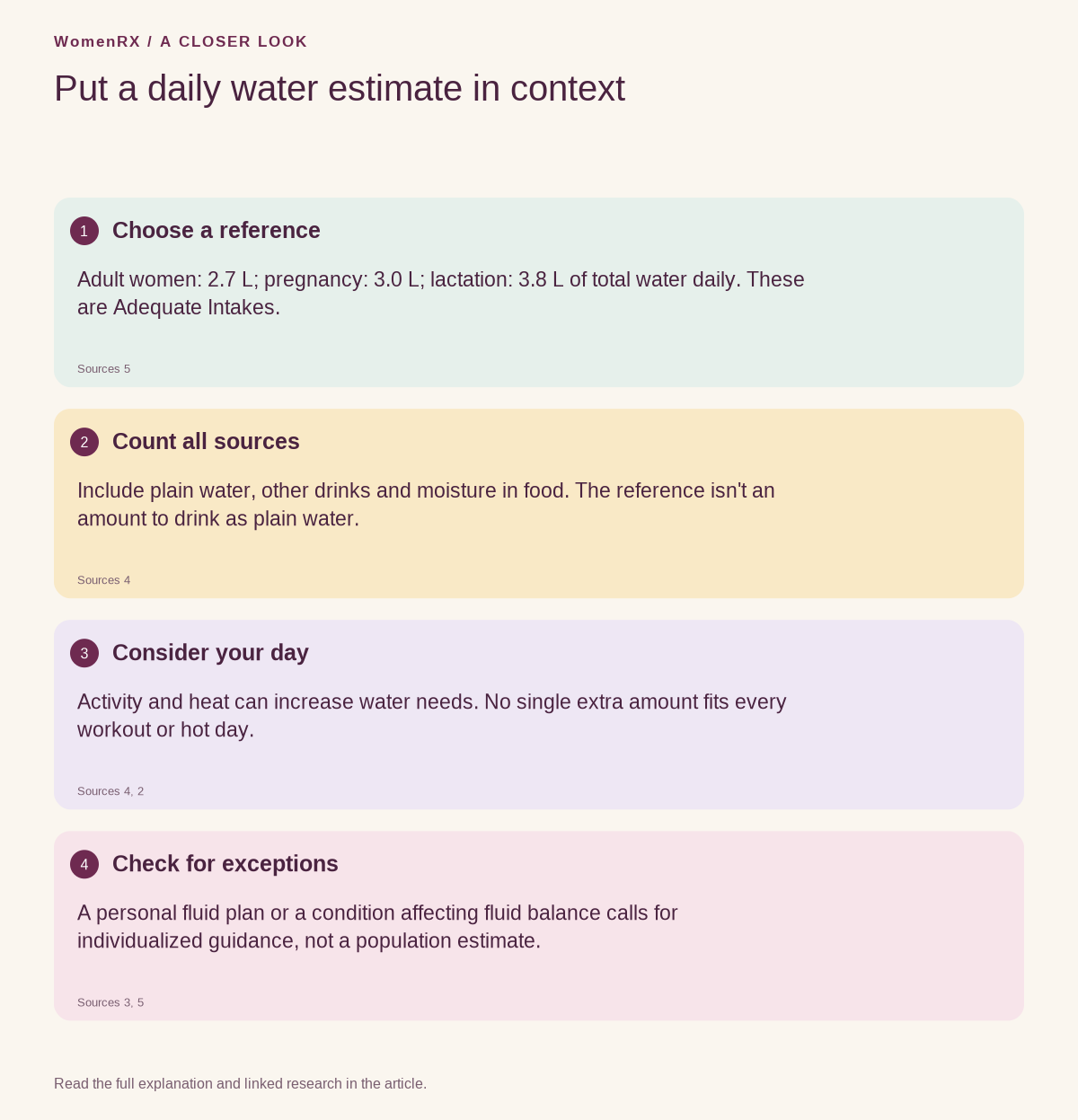
Put a daily water estimate in context
Choose a reference: Adult women: 2.7 L; pregnancy: 3.0 L; lactation: 3.8 L of total water daily. These are Adequate Intakes.5
Count all sources: Include plain water, other drinks and moisture in food. The reference isn't an amount to drink as plain water.4
Consider your day: Activity and heat can increase water needs. No single extra amount fits every workout or hot day.42
Check for exceptions: A personal fluid plan or a condition affecting fluid balance calls for individualized guidance, not a population estimate.35
Read the figure as text
Use the total-water reference for your life stage, then account for what you consume and what might change your needs.- Choose a reference: Adult women: 2.7 L; pregnancy: 3.0 L; lactation: 3.8 L of total water daily. These are Adequate Intakes.5
- Count all sources: Include plain water, other drinks and moisture in food. The reference isn't an amount to drink as plain water.4
- Consider your day: Activity and heat can increase water needs. No single extra amount fits every workout or hot day.42
- Check for exceptions: A personal fluid plan or a condition affecting fluid balance calls for individualized guidance, not a population estimate.35
More questions, answered
Do coffee and tea count toward total water?
Yes. The National Academies counts water from other beverages toward total water intake. It notes that any diuretic effects seen with caffeinated beverages may be transient; they aren't excluded from the total.4
Sources you can check
- Chronic kidney disease - Symptoms - NHSAccessed 2026-09-25Return to first citation
- Drinking Water: MedlinePlusAccessed 2026-09-25Return to first citation
- Fluid and Electrolyte Balance: MedlinePlusAccessed 2026-09-25Return to first citation
- Read "Dietary Reference Intakes for Water, Potassium, Sodium, Chloride, and Sulfate" at NAP.eduAccessed 2026-09-25Return to first citation
- National Academies DRI summary table: total water and macronutrientsAccessed 2026-09-25Return to first citation