Can Diet Ease Menopause Symptoms? What Evidence Shows
A balanced eating pattern can support health, but current guidance doesn’t recommend dietary changes or soy as proven treatments for hot flashes.
For hot flashes and night sweats, the evidence doesn’t support a particular food or eating pattern as a reliable treatment. A 2023 menopause position statement does not recommend dietary modification or soy foods and extracts for these symptoms, although an earlier review reported mixed, modest benefits from soy isoflavones. Diet may still matter for health goals beyond symptom relief, which are separate questions.
Start with the symptom you want to change
If you’re considering a food change because of hot flashes or night sweats, it’s reasonable to ask whether it has a fair chance of helping. Current guidance doesn’t support dietary modification as a treatment for these vasomotor symptoms. It also doesn’t recommend soy foods or soy extracts for that purpose. That’s different from saying you shouldn’t eat soy or make dietary changes for other reasons. 2
An earlier North American Menopause Society review described the soy research as mixed and reported modest symptom relief from soy-based isoflavones. The society’s 2023 position statement later assessed soy foods and extracts as not recommended for vasomotor symptoms. Taken together, these findings don’t establish soy as a dependable way to ease hot flashes, and a supplement claim shouldn’t be treated as proof that ordinary soy foods will have the same effect. 4 2
The evidence also doesn’t establish that a diet works differently in perimenopause, around the final menstrual period, or after menopause. The soy review covered peri- and postmenopausal women, but it described mixed results rather than a clear phase-specific benefit. 4
Keep symptom relief separate from long-term health
A diet can be worth considering for health goals that aren’t hot-flash relief. For example, the Women’s Health Initiative tested a low-fat eating pattern with more fruits, vegetables, and grains in postmenopausal women, but its reported outcomes were cancer outcomes, not menopause symptoms. The pattern didn’t prevent breast or colorectal cancer, and a possible finding for breast-cancer mortality was a secondary result that needs further study. That trial doesn’t tell us whether a particular food will ease hot flashes. 3
Bone health is another distinct question. A review of the Women’s Health Initiative trials says the results don’t support routinely recommending calcium plus vitamin D supplements to all postmenopausal women for fracture prevention; they may be appropriate when someone isn’t meeting national recommended intakes through food. That is not evidence that these nutrients treat menopause symptoms. 3
If you want to try a food change
Make it a small, focused experiment, not a restrictive overhaul. Pick one change and one symptom to pay attention to. For example, you might note how often hot flashes occur and how disruptive they feel before and while trying the change. Changing one thing at a time makes it easier to judge whether you notice a difference; it still can’t prove the food caused that difference, since symptoms can vary on their own.
Don’t feel you have to keep a food that doesn’t suit you or spend money on a supplement because it’s marketed for menopause. The 2023 position statement also does not recommend supplements or herbal remedies for vasomotor symptoms. 2
Diet isn’t your only option
If hot flashes are disrupting sleep or daily life, you have options beyond food. Hormone therapy is the most effective treatment for vasomotor symptoms, and whether it’s appropriate depends on your circumstances and preferences. The 2023 nonhormone position statement recommends several options, including cognitive behavioral therapy and clinical hypnosis, and lists certain prescription treatments as evidence-supported choices. A discussion focused on your symptoms can help compare these with your priorities. 1 2
The useful bottom line: choose food for the health goals it can reasonably support, but don’t rely on a specific food or eating pattern as a proven hot-flash treatment.
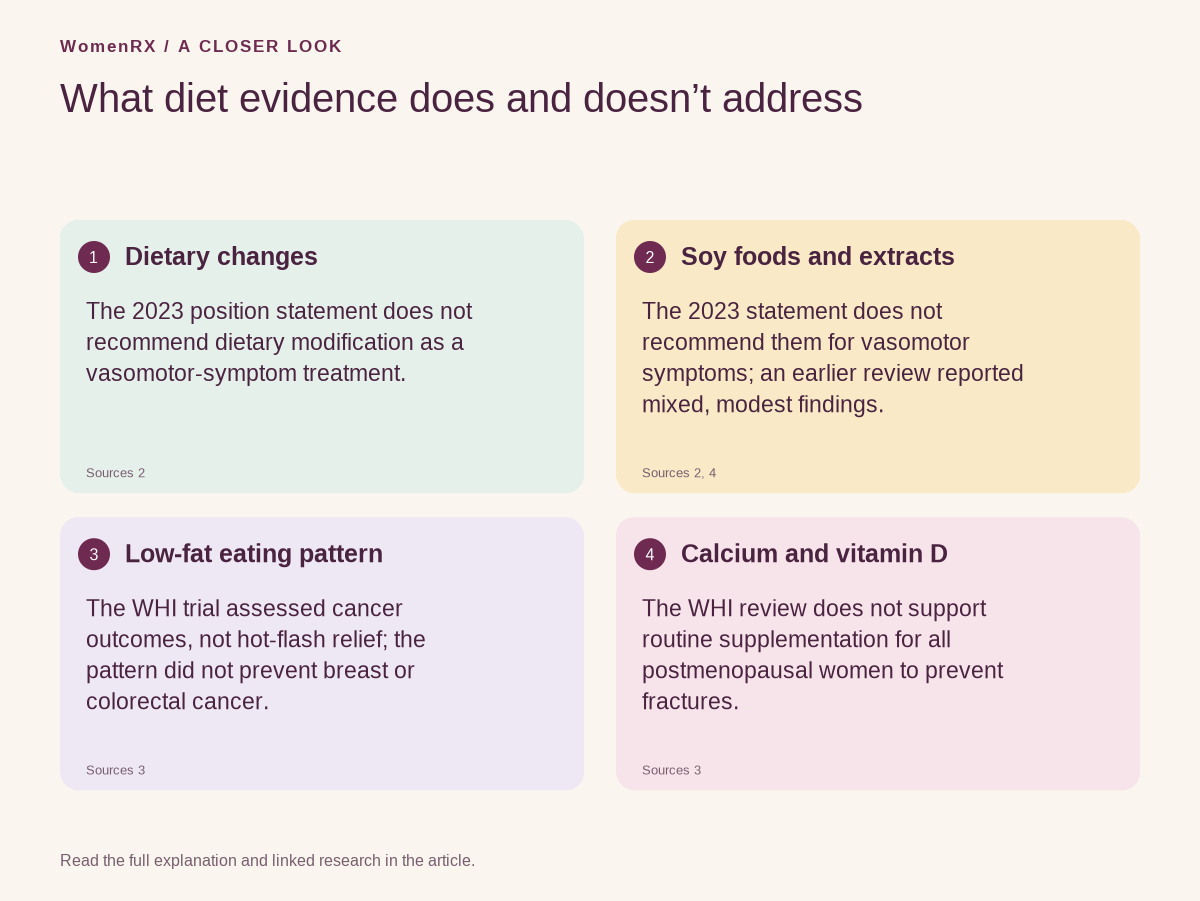
What diet evidence does and doesn’t address
Dietary changes: The 2023 position statement does not recommend dietary modification as a vasomotor-symptom treatment.2
Soy foods and extracts: The 2023 statement does not recommend them for vasomotor symptoms; an earlier review reported mixed, modest findings.24
Low-fat eating pattern: The WHI trial assessed cancer outcomes, not hot-flash relief; the pattern did not prevent breast or colorectal cancer.3
Calcium and vitamin D: The WHI review does not support routine supplementation for all postmenopausal women to prevent fractures.3
Read the figure as text
These findings concern different outcomes. Evidence about cancer or fracture prevention should not be mistaken for proof that a food relieves hot flashes.- Dietary changes: The 2023 position statement does not recommend dietary modification as a vasomotor-symptom treatment.2
- Soy foods and extracts: The 2023 statement does not recommend them for vasomotor symptoms; an earlier review reported mixed, modest findings.24
- Low-fat eating pattern: The WHI trial assessed cancer outcomes, not hot-flash relief; the pattern did not prevent breast or colorectal cancer.3
- Calcium and vitamin D: The WHI review does not support routine supplementation for all postmenopausal women to prevent fractures.3
More questions, answered
Does evidence for soy supplements mean soy foods will ease hot flashes?
No. An earlier review discussed soy-based isoflavones and reported mixed, modest effects, while the 2023 position statement did not recommend soy foods or extracts for vasomotor symptoms. The evidence doesn’t establish soy foods as a reliable treatment. 4 2
Should every postmenopausal woman take calcium and vitamin D?
The Women’s Health Initiative review does not support routinely recommending calcium plus vitamin D supplements to all postmenopausal women for fracture prevention. It says they may be appropriate when recommended intakes aren’t met through diet. This is a bone-health question, not a treatment for hot flashes. 3
Sources you can check
- The 2022 hormone therapy position statement of The North American Menopause Society.“The 2022 Hormone Therapy Position Statement of The North American Menopause Society” Advisory Panel. · Menopause (New York, N.Y.) · 2022Return to first citation
- The 2023 nonhormone therapy position statement of The North American Menopause Society.Menopause (New York, N.Y.) · 2023Return to first citation
- The Women's Health Initiative Randomized Trials and Clinical Practice: A Review.Manson JE, Crandall CJ, Rossouw JE, Chlebowski RT, Anderson GL, Stefanick ML, Aragaki AK, Cauley JA, Wells GL, LaCroix AZ, Thomson CA, Neuhouser ML, Van Horn L, Kooperberg C, Howar... · JAMA · 2024Return to first citation
- The role of soy isoflavones in menopausal health: report of The North American Menopause Society/Wulf H. Utian Translational Science Symposium in Chicago, IL (October 2010).North American Menopause Society. · Menopause (New York, N.Y.) · 2011Return to first citation