Can Food Relieve Vaginal Dryness? What We Know
Phytoestrogen-rich foods were linked with lower odds of dryness in one study, but that doesn’t show they treat it.
Current evidence doesn’t establish a dependable dietary treatment for vaginal dryness. One observational study found an association between higher phytoestrogen intake and lower odds of dryness, but it can’t show that the foods caused the difference. A small soy-supplement trial didn’t find a benefit. For relief, vaginal moisturizers and lubricants are more directly aimed at symptoms and are recommended in guidance. 4 3 1
Food research is suggestive, not a treatment plan
Research on dietary phytoestrogens has looked at both food intake and soy supplementation. Those are different questions from whether eating a particular food relieves vaginal symptoms, and neither kind of finding by itself establishes a reliable dietary treatment.
One study examined phytoestrogen intake and symptoms among 331 Bangladeshi women ages 35 to 59 living in Bangladesh or London. Higher phytoestrogen intake was associated with slightly lower odds of vaginal dryness in the researchers’ statistical analysis. Because this was an observational study, it can show a relationship, not that the foods relieved dryness. The finding also doesn’t establish what would happen if someone deliberately changed her diet. 4
A small randomized trial offers a useful counterpoint. Among 27 postmenopausal women assigned to soy cereal or placebo, 19 completed the six-month study. Vaginal dryness improved from the start of the study in the placebo group, but not in the soy group. That small pilot can’t settle the question, but it doesn’t support relying on soy supplementation for relief. 3
These findings concern different things: an association with food intake and a small trial of a supplement. Neither establishes a food or supplement as a dependable treatment for vaginal dryness.
Why vaginal products are a different kind of evidence
A food is eaten, while a vaginal moisturizer or lubricant is used where symptoms occur. That difference matters when weighing evidence: a study of a vaginal product, even one containing plant compounds, is not proof that eating the same plant will help.
A review of randomized trials in menopausal women included vaginal therapies such as lubricants, moisturizers, and phytoestrogens. It found that dryness or painful sex improved in the studies that assessed those symptoms, but the review also said the evidence wasn’t adequate to guide counseling across all aspects of sexual function. The findings are about vaginal therapies, not phytoestrogen-rich foods. 2
For day-to-day symptom relief, the NHS recommends trying a vaginal moisturizer for ongoing dryness or a water-based lubricant before sex. These address symptoms directly; they don’t identify or treat every possible cause. If dryness seems related to menopause or another hormone change, a clinician may discuss estrogen-containing treatment and whether it’s suitable for you. 1
Consider the cause, not just the diet
Dryness can occur around menopause, during pregnancy or breastfeeding, and after some cancer treatments that affect hormones. It can also relate to not being aroused during sex or to conditions such as diabetes or Sjögren’s syndrome. So a dietary change may not address what’s driving your symptoms. 1
If a food you enjoy is part of your usual diet, there’s no need to treat it as a vaginal remedy or make a major diet change for this purpose. Be especially cautious about assuming a concentrated supplement will work like a food: the small soy trial described above did not demonstrate symptom relief. 3
Consider getting care if dryness continues for a few weeks despite measures you’ve tried, affects daily life, or comes with unusual discharge or bleeding after sex, between periods, or after menopause. Those symptoms are reasons to have the cause assessed rather than trying to solve it through diet alone. 1
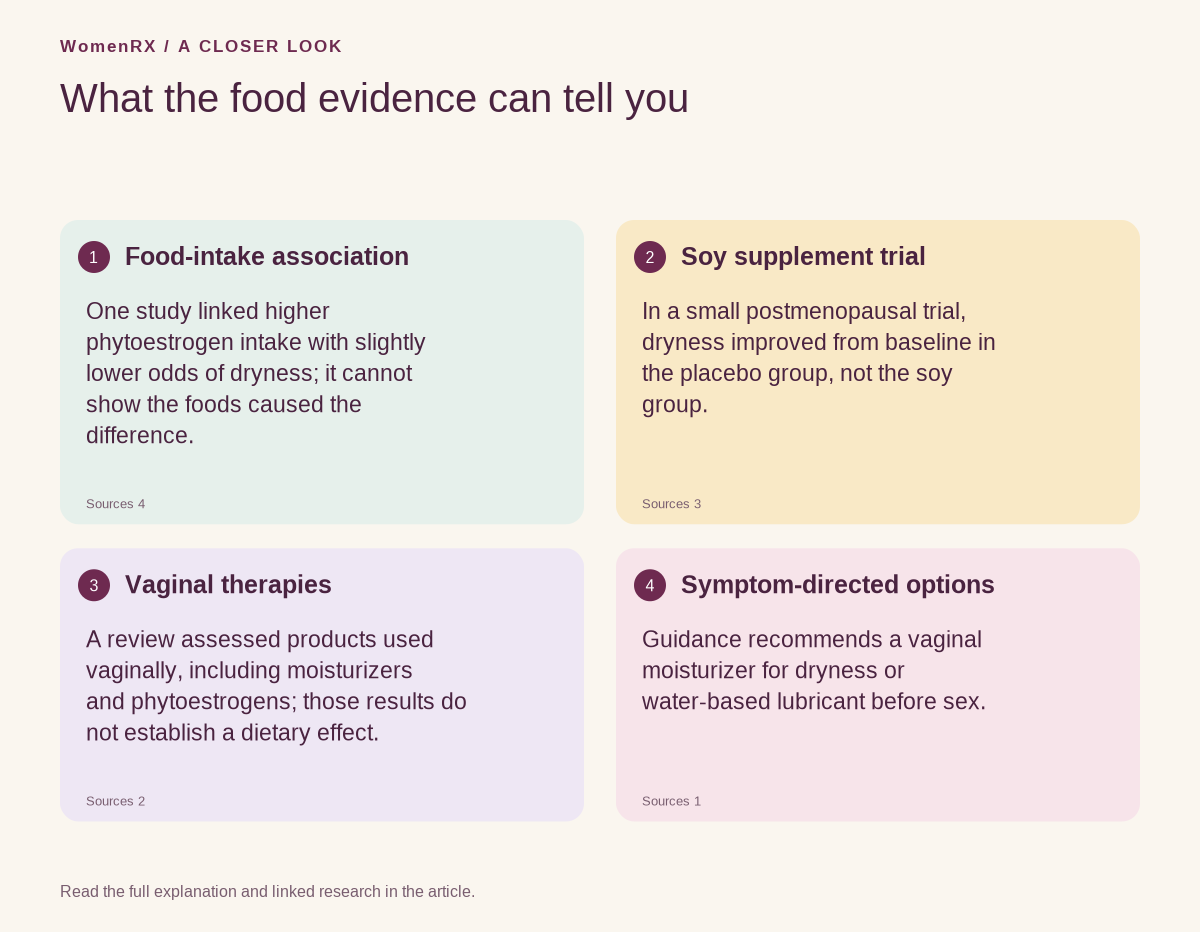
What the food evidence can tell you
Food-intake association: One study linked higher phytoestrogen intake with slightly lower odds of dryness; it cannot show the foods caused the difference.4
Soy supplement trial: In a small postmenopausal trial, dryness improved from baseline in the placebo group, not the soy group.3
Vaginal therapies: A review assessed products used vaginally, including moisturizers and phytoestrogens; those results do not establish a dietary effect.2
Symptom-directed options: Guidance recommends a vaginal moisturizer for dryness or water-based lubricant before sex.1
Read the figure as text
These findings differ by study design and by whether the intervention is eaten or used vaginally.- Food-intake association: One study linked higher phytoestrogen intake with slightly lower odds of dryness; it cannot show the foods caused the difference.4
- Soy supplement trial: In a small postmenopausal trial, dryness improved from baseline in the placebo group, not the soy group.3
- Vaginal therapies: A review assessed products used vaginally, including moisturizers and phytoestrogens; those results do not establish a dietary effect.2
- Symptom-directed options: Guidance recommends a vaginal moisturizer for dryness or water-based lubricant before sex.1
More questions, answered
Does eating soy work like vaginal estrogen?
A small trial of soy cereal supplementation in postmenopausal women did not find that vaginal dryness improved in the soy group. The trial doesn’t establish that eating soy works like estrogen treatment. 3
What can I try for dryness during sex?
A water-based lubricant before sex is one option recommended by the NHS. For dryness that isn’t limited to sex, a vaginal moisturizer may be useful. 1
Sources you can check
- Vaginal dryness - NHSAccessed 2026-09-25Return to first citation
- Efficacy of vaginal therapies alternative to vaginal estrogens on sexual function and orgasm of menopausal women: A systematic review and meta-analysis of randomized controlled trials.Pitsouni E, Grigoriadis T, Douskos A, Kyriakidou M, Falagas ME, Athanasiou S. · European journal of obstetrics, gynecology, and reproductive biology · 2018Return to first citation
- A pilot study of the effects of phytoestrogen supplementation on postmenopausal endometrium.Balk JL, Whiteside DA, Naus G, DeFerrari E, Roberts JM. · Journal of the Society for Gynecologic Investigation · 2002Return to first citation
- Frequency of Phytoestrogen Consumption and Symptoms at Midlife among Bangladeshis in Bangladesh and London.Sievert LL, Sharmeen T, Begum K, Muttukrishna S, Chowdhury O, Bentley GR. · Nutrients · 2023Return to first citation