Hot Flashes and Food: What Has Been Tested?
Soy foods and supplements have been studied, but results are mixed and no particular menu has been shown to reliably control hot flashes.
Soy foods and soy-isoflavone supplements have been studied, but menopause guidance does not recommend either as a dependable hot-flash treatment, and trial reviews disagree about whether supplements reduce symptoms. Equol, a substance studied in some soy-related trials, has shown a possible benefit in a small evidence base. Dietary changes and avoiding triggers have weaker support than treatments recommended in menopause guidance. 2 4 5
If you’re hoping a food change will quiet hot flashes, the evidence doesn’t point to a proven list of foods or a reliable menopause diet. Soy foods and soy extracts have been studied, but results vary. A few trials have explored equol, and broad dietary changes or avoiding suspected triggers have not emerged as dependable treatments. 2 4 5
Soy has been studied, but it isn’t a sure fix
Soy foods and soy extracts both appear in research, but they aren’t identical interventions. The North American Menopause Society’s 2023 position statement does not recommend soy foods or soy extracts for vasomotor symptoms, citing Level II evidence. That means the evidence is limited or inconsistent, rather than proof that soy never helps anyone. 2
Reviews of soy-isoflavone supplements illustrate the uncertainty. A 2022 review of 11 randomized trials found no significant overall effect on hot flashes. A 2015 model-based analysis, using data from 16 studies and about 1,710 participants, estimated a modest, slow reduction after accounting for placebo effects. These are different ways of analyzing the evidence, and their conclusions don’t establish that a supplement will ease hot flashes for an individual. 3 5
It’s also worth separating the outcome being measured. Some research reports hot-flash frequency, some severity or a combined symptom score, and a change in a broader menopause-symptom score isn’t the same as showing fewer hot flashes. For example, the 2022 review found changes in some other outcomes but no significant effect on hot flashes specifically. 5
Equol findings are promising, but narrow
Some research asks whether producing equol changes how soy-related interventions affect symptoms. In a systematic review, six studies with 779 participants met the criteria; five studies with 728 participants were included in the meta-analysis. Three of those five studies reported significant benefits, while two did not. The pooled analysis found a benefit for hot-flash scores, but the small set of trials and mixed individual results leave uncertainty about how broadly that finding applies. 4
That result is not the same as evidence that eating soy will reliably reduce hot flashes. The review focused on equol and on soy isoflavones in people identified as equol producers, so its findings shouldn’t be treated as a promise for everyone who eats soy or takes an isoflavone supplement. 4
No proven menu or universal trigger list
The same position statement does not recommend dietary modification as a treatment for vasomotor symptoms, based on Level III evidence. It also does not recommend avoiding triggers, based on Level II evidence. In other words, current guidance doesn’t establish a particular eating pattern, or a standard list of foods and drinks to avoid, as a reliable hot-flash strategy. 2
If you notice that a particular food or drink seems to precede your symptoms, you can choose whether avoiding it feels worthwhile to you. But a personal observation is not proof that the item is a universal trigger, and the guidance doesn’t support broad restriction as a dependable treatment. 2
Weight loss is a separate point: the 2023 statement lists it as a nonhormonal option with Level II-III support. That is not evidence for a specific food, diet plan, or weight-loss product, and it shouldn’t be confused with the stronger claim that dietary modification treats hot flashes. 2
A practical way to judge food claims
When you see a food or supplement promoted for hot flashes, check what the study actually measured: fewer episodes, less severe episodes, or a broader symptom score? Look for whether the tested intervention was a whole food, an extract, or a supplement, and whether the finding came from one trial or a pooled analysis. Those distinctions help explain why a headline about “soy” may sound more certain than the evidence really is. 2 4 5
If hot flashes are disrupting your sleep or daily life, you don’t have to rely on food experiments alone. Menopause guidance identifies hormone therapy as the most effective treatment for vasomotor symptoms and recommends several nonhormonal options, including cognitive behavioral therapy and clinical hypnosis, as well as certain prescription medicines. Which options fit depends on your health and preferences. 1 2
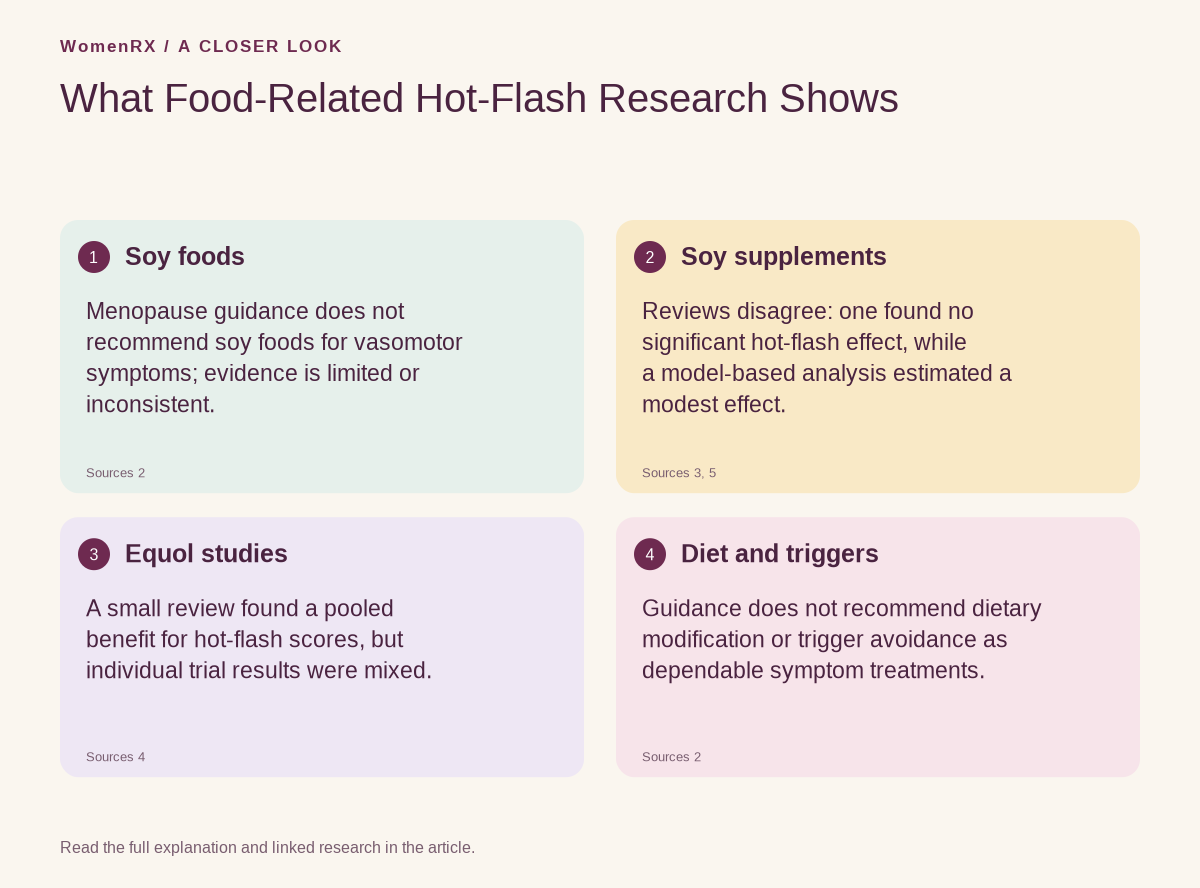
What Food-Related Hot-Flash Research Shows
Soy foods: Menopause guidance does not recommend soy foods for vasomotor symptoms; evidence is limited or inconsistent.2
Soy supplements: Reviews disagree: one found no significant hot-flash effect, while a model-based analysis estimated a modest effect.35
Equol studies: A small review found a pooled benefit for hot-flash scores, but individual trial results were mixed.4
Diet and triggers: Guidance does not recommend dietary modification or trigger avoidance as dependable symptom treatments.2
Read the figure as text
These approaches differ in what was tested and how strongly the findings support using them for menopausal hot flashes.- Soy foods: Menopause guidance does not recommend soy foods for vasomotor symptoms; evidence is limited or inconsistent.2
- Soy supplements: Reviews disagree: one found no significant hot-flash effect, while a model-based analysis estimated a modest effect.35
- Equol studies: A small review found a pooled benefit for hot-flash scores, but individual trial results were mixed.4
- Diet and triggers: Guidance does not recommend dietary modification or trigger avoidance as dependable symptom treatments.2
More questions, answered
Are soy foods and soy-isoflavone supplements interchangeable?
No. They are different interventions, and a finding about an extract or supplement doesn’t establish the same effect from eating soy foods. Menopause guidance does not recommend either soy foods or soy extracts as a dependable treatment for hot flashes. 2
Should I avoid foods that might trigger a hot flash?
There’s no evidence in current menopause guidance for a universal trigger-avoidance plan. If you notice a consistent personal pattern, you can decide whether avoiding that item is useful, but broad food restriction isn’t an established treatment. 2
Sources you can check
- The 2022 hormone therapy position statement of The North American Menopause Society.“The 2022 Hormone Therapy Position Statement of The North American Menopause Society” Advisory Panel. · Menopause (New York, N.Y.) · 2022Return to first citation
- The 2023 nonhormone therapy position statement of The North American Menopause Society.Menopause (New York, N.Y.) · 2023Return to first citation
- Quantitative efficacy of soy isoflavones on menopausal hot flashes.Li L, Lv Y, Xu L, Zheng Q. · British journal of clinical pharmacology · 2015Return to first citation
- Equol Decreases Hot Flashes in Postmenopausal Women: A Systematic Review and Meta-Analysis of Randomized Clinical Trials.Daily JW, Ko BS, Ryuk J, Liu M, Zhang W, Park S. · Journal of medicinal food · 2019Return to first citation
- Effect of isoflavone supplementation on menopausal symptoms: a systematic review and meta-analysis of randomized controlled trials.Kang I, Rim CH, Yang HS, Choe JS, Kim JY, Lee M. · Nutrition research and practice · 2022Return to first citation