Soy for Menopause: Foods, Supplements, and Hot Flashes
Some soy preparations have shown promise in individual studies, but menopause guidance does not recommend soy foods or extracts as hot-flash treatments.
Soy foods and isoflavone supplements aren’t dependable treatments for hot flashes. Some trials found fewer hot flashes with particular preparations, but results have varied, and the 2023 North American Menopause Society guidance does not recommend soy foods or extracts for this purpose. Eating soy as food is a different decision from taking a concentrated supplement. 2 3
Food and supplements are different choices
Tofu, edamame, and soy milk can be foods you enjoy without needing to treat them as menopause remedies. An isoflavone supplement is a more specific choice: products may contain different preparations and ingredients, and a result for one cannot be assumed to apply to another. Even the food-based trial highlighted in one systematic review tested soy nuts as a particular preparation, not an ordinary serving of every soy food. 3
For the symptom most often associated with soy, hot flashes and night sweats, the broader evidence assessment matters more than a promising product claim. The 2023 North American Menopause Society position statement does not recommend soy foods, soy extracts, or the soy-related compound equol as treatments for vasomotor symptoms. That’s not a recommendation to avoid soy foods. It means you shouldn’t count on them to relieve hot flashes. 2
Why the hot-flash studies can sound promising
A systematic review of trials conducted during the menopausal transition and early postmenopause found that two of five trials of soy-isoflavone preparations reported significant reductions in hot flashes. The other three did not. Neither of the two positive soy trials found improvements in the other symptoms they measured, and the reviewers called for larger studies with better attention to outcome measurement. 3
Preparation matters here. S-equol is a compound related to the soy isoflavone daidzein, but an equol supplement is not the same as eating soy or taking a soy-isoflavone extract. In an eight-week randomized trial of 102 postmenopausal women who had at least five hot flashes a day, hot-flash reductions at week eight were similar across the equol and soy-isoflavone groups. An analysis spanning the full eight weeks favored one equol group over isoflavones, but the study did not compare either product with a placebo. It cannot tell you whether either worked better than taking neither. 4
These results aren’t necessarily contradictory. An individual study asks whether that preparation helped that group under its study conditions. A guideline weighs whether the evidence is consistent and useful enough to recommend a treatment more broadly. For a decision about everyday symptom relief, that broader judgment is the better starting point. 2 3 4
Sleep, mood, and other symptoms need their own evidence
A positive result for hot flashes doesn’t automatically mean better sleep or mood. In the systematic review, some improvements in other symptoms came from non-soy isoflavone products, rather than the soy preparations. 3
One observational pilot study followed 29 perimenopausal and 21 postmenopausal women taking soy isoflavones for 12 weeks and reported improved menopause-rating scores. Without a comparison group, though, the study cannot establish that the supplement caused the improvement. 6
A separate study in 44 postmenopausal women reported improvements while participants took a product combining soy isoflavones, 8-prenylnaringenin, and melatonin. It was open-label and tested the ingredients together, so it cannot establish what soy isoflavones alone did. 5
If you’re deciding whether to try a supplement
Start with the symptom you want to change. If hot flashes are interrupting sleep or daily life, a soy supplement has less dependable evidence than several other options. The menopause society recommends cognitive behavioral therapy and clinical hypnosis, as well as certain prescription nonhormone treatments, for vasomotor symptoms. Hormone therapy remains the most effective treatment for these symptoms, although whether it fits depends on the individual. 1 2
If you still want to consider a soy supplement, look at the specific product, not just the word “soy” on the front. Is it a food, an isoflavone extract, equol, or a combination with other ingredients? Those aren’t interchangeable in the studies. If you take medication or have a cancer history, bringing the ingredient label to a clinician or pharmacist lets you ask about that product in your circumstances. The symptom studies discussed here don’t establish its safety for every medication combination or cancer history.
Soy foods can stay a food choice. A supplement deserves a separate decision about its uncertain symptom benefit and its exact ingredients.
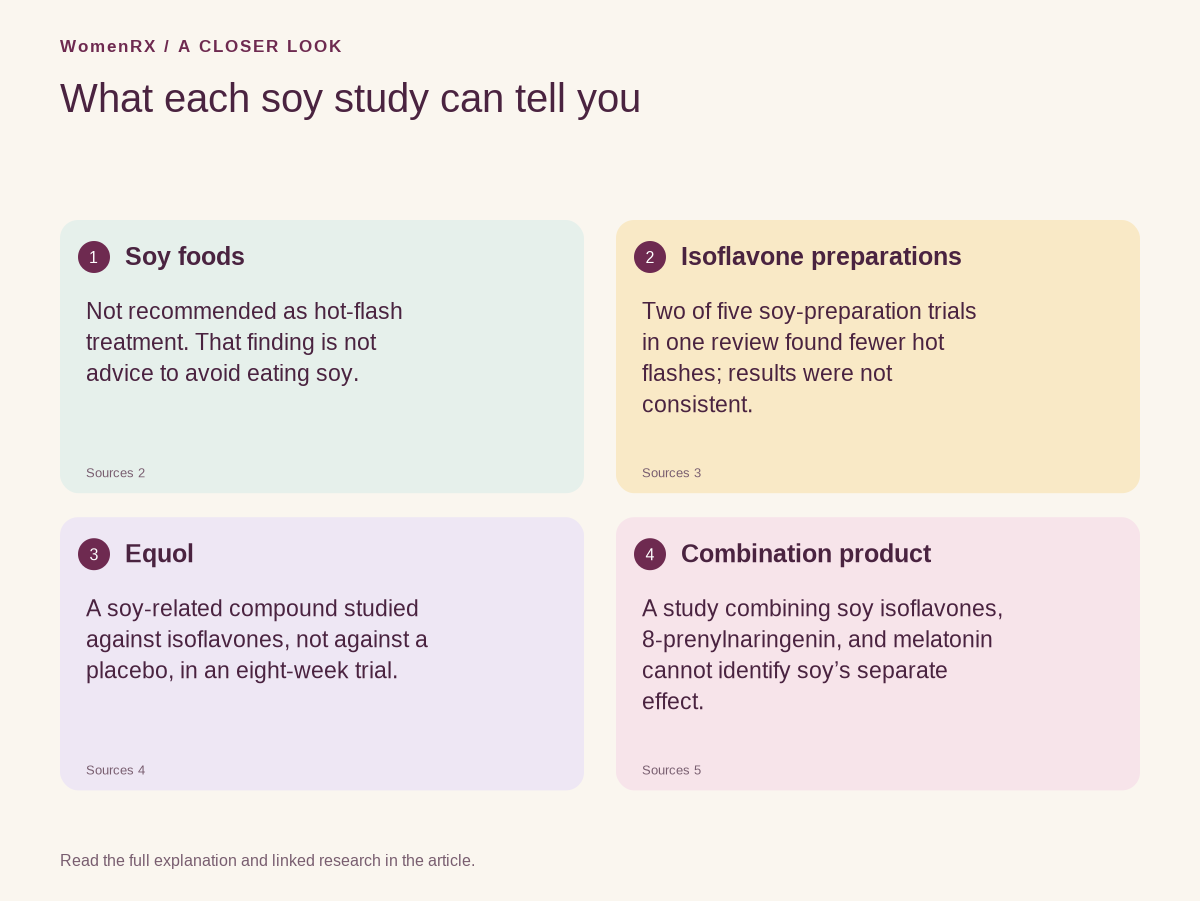
What each soy study can tell you
Soy foods: Not recommended as hot-flash treatment. That finding is not advice to avoid eating soy.2
Isoflavone preparations: Two of five soy-preparation trials in one review found fewer hot flashes; results were not consistent.3
Equol: A soy-related compound studied against isoflavones, not against a placebo, in an eight-week trial.4
Combination product: A study combining soy isoflavones, 8-prenylnaringenin, and melatonin cannot identify soy’s separate effect.5
Read the figure as text
The form tested determines which question a study can answer.- Soy foods: Not recommended as hot-flash treatment. That finding is not advice to avoid eating soy.2
- Isoflavone preparations: Two of five soy-preparation trials in one review found fewer hot flashes; results were not consistent.3
- Equol: A soy-related compound studied against isoflavones, not against a placebo, in an eight-week trial.4
- Combination product: A study combining soy isoflavones, 8-prenylnaringenin, and melatonin cannot identify soy’s separate effect.5
Sources you can check
- The 2022 hormone therapy position statement of The North American Menopause Society.“The 2022 Hormone Therapy Position Statement of The North American Menopause Society” Advisory Panel. · Menopause (New York, N.Y.) · 2022Return to first citation
- The 2023 nonhormone therapy position statement of The North American Menopause Society.Menopause (New York, N.Y.) · 2023Return to first citation
- Effects of isoflavones and amino acid therapies for hot flashes and co-occurring symptoms during the menopausal transition and early postmenopause: a systematic review.Thomas AJ, Ismail R, Taylor-Swanson L, Cray L, Schnall JG, Mitchell ES, Woods NF. · Maturitas · 2014Return to first citation
- A pilot study on the effects of S-equol compared to soy isoflavones on menopausal hot flash frequency.Jenks BH, Iwashita S, Nakagawa Y, Ragland K, Lee J, Carson WH, Ueno T, Uchiyama S. · Journal of women's health (2002) · 2012Return to first citation
- Combination of Soy Isoflavones, 8-Prenylnaringenin and Melatonin Improves Hot Flashes and Health-Related Quality of Life Outcomes in Postmenopausal Women: Flavie Study.Estrugo CP, Rodríguez MT, de Guevara NM, Gómez JG, Ridocci F, Moro-Martín MT, Guinot M, Saz-Leal P, Nieto Magro C. · Journal of menopausal medicine · 2023Return to first citation
- The Effect of Soy Isoflavones on the Menopause Rating Scale Scoring in Perimenopausal and Postmenopausal Women: A Pilot Study.Ahsan M, Mallick AK. · Journal of clinical and diagnostic research : JCDR · 2017Return to first citation