Can food ease menopause hot flashes?
One small trial found improvement with a whole-diet change, but current guidance doesn’t recommend soy or dietary changes as established hot-flash treatments.
A low-fat vegan diet that included daily cooked soybeans reduced moderate-to-severe hot flashes in one 12-week trial, but the study tested a full eating pattern, not soy alone. Current menopause guidance doesn’t recommend soy foods or dietary modification as treatments. If you suspect a personal food trigger, look for a repeatable pattern rather than changing your diet based on one episode. 1 3
A possible trigger isn’t the same as a treatment
It’s reasonable to wonder whether a meal or drink sets off a hot flash. But that’s a different question from whether a food can reduce hot flashes overall. The 2023 North American Menopause Society position statement does not recommend soy foods or dietary modification as treatments for vasomotor symptoms. It grades soy foods as Level II, meaning limited or inconsistent scientific evidence, and dietary modification as Level III, meaning consensus and expert opinion. 3
That guidance doesn’t prove food can never affect an individual’s symptoms. It does mean that claims that a particular food reliably prevents or relieves hot flashes go beyond what the evidence establishes.
What the promising diet trial tested
A randomized trial included 84 postmenopausal women who reported at least two moderate-to-severe hot flashes a day. For 12 weeks, one group followed a low-fat vegan diet and ate cooked soybeans daily; the comparison group made no dietary changes. Participants recorded hot-flash frequency and severity. Moderate-to-severe hot flashes decreased by 88% in the diet group and 34% in the control group. These are reductions within each group, not a comparison showing that one specific food caused the difference. 1
The trial is a meaningful signal, but it tested a package: a whole eating pattern plus soybeans. It can’t tell us whether soy, another part of the diet, or the combination mattered. The results also apply to the postmenopausal participants studied, not automatically to people in perimenopause. 1
Other soy research doesn’t make soy a proven remedy. In a 12-week study of 101 postmenopausal women, different amounts of soy drink did not produce a significant between-group difference in vasomotor symptom scores. The study assessed broader menopause symptoms rather than reporting a specific count of hot flashes. 2 Together, these findings help explain why guidance does not recommend soy foods as an established treatment. 2 3
How to check a suspected food trigger
Avoiding a suspected trigger aims to prevent a hot flash that might follow a particular exposure. A treatment aims to reduce symptoms more generally. The 2023 position statement does not recommend avoiding triggers as a treatment, but you can still look for a pattern in your own experience. 3
For example, you could note what you ate or drank, when a hot flash happened, and how strong it felt. Look for the same food or situation preceding symptoms repeatedly, rather than drawing a conclusion from one episode. If a pattern seems consistent, you might change that one thing and see whether your symptoms also change. This is personal observation, not a validated test. Avoid broad food restrictions based on a hunch alone.
Food experiments shouldn’t crowd out care options
If hot flashes are disrupting sleep or daily life, you don’t have to rely on diet experiments. The 2023 position statement lists evidence-supported nonhormonal options, including cognitive behavioral therapy, clinical hypnosis, and certain prescription treatments. It describes hormone therapy as the most effective treatment for vasomotor symptoms. Which options fit depends on your health and preferences, so it’s reasonable to discuss them rather than waiting for a dietary change to work. 3
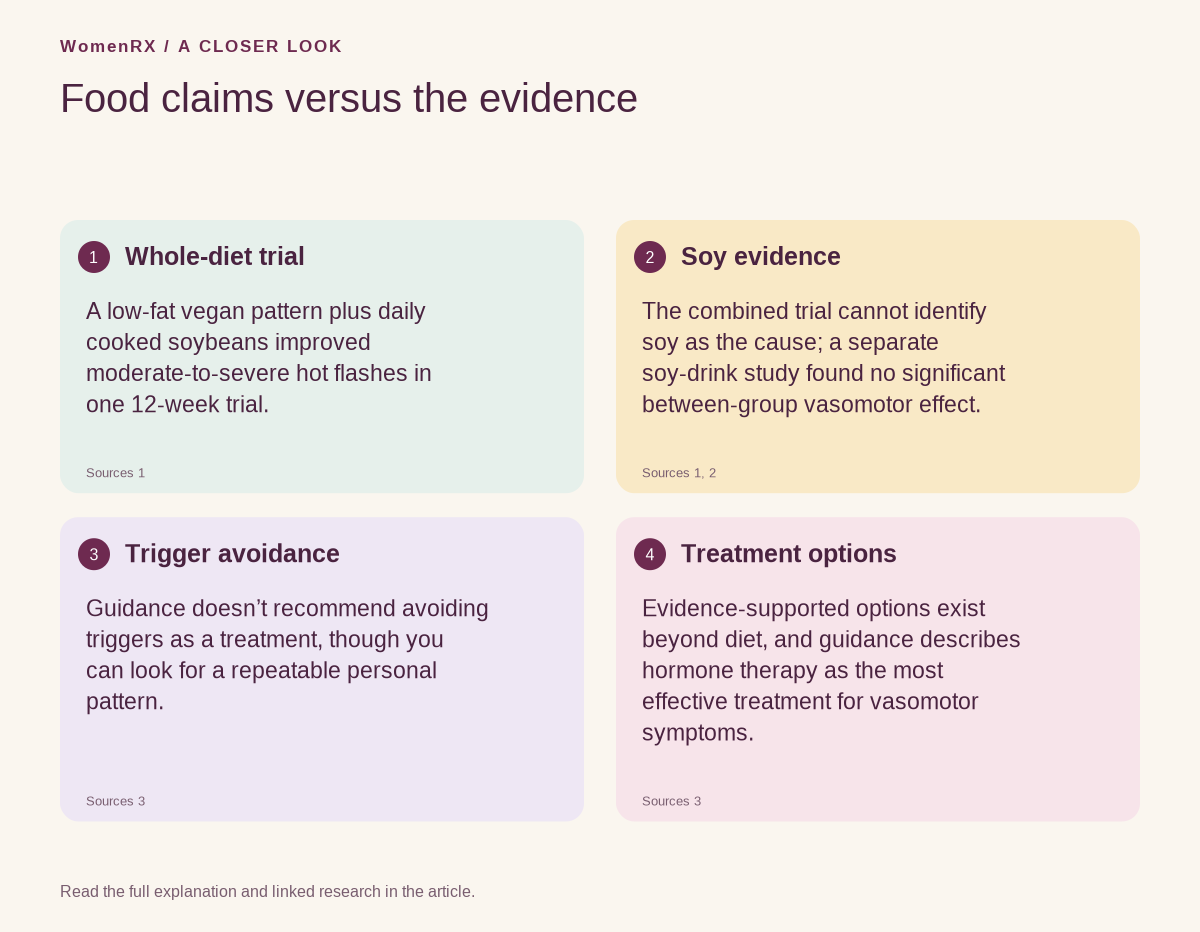
Food claims versus the evidence
Whole-diet trial: A low-fat vegan pattern plus daily cooked soybeans improved moderate-to-severe hot flashes in one 12-week trial.1
Soy evidence: The combined trial cannot identify soy as the cause; a separate soy-drink study found no significant between-group vasomotor effect.12
Trigger avoidance: Guidance doesn’t recommend avoiding triggers as a treatment, though you can look for a repeatable personal pattern.3
Treatment options: Evidence-supported options exist beyond diet, and guidance describes hormone therapy as the most effective treatment for vasomotor symptoms.3
Read the figure as text
These distinctions show why one promising whole-diet trial doesn’t establish a specific food as a hot-flash treatment.- Whole-diet trial: A low-fat vegan pattern plus daily cooked soybeans improved moderate-to-severe hot flashes in one 12-week trial.1
- Soy evidence: The combined trial cannot identify soy as the cause; a separate soy-drink study found no significant between-group vasomotor effect.12
- Trigger avoidance: Guidance doesn’t recommend avoiding triggers as a treatment, though you can look for a repeatable personal pattern.3
- Treatment options: Evidence-supported options exist beyond diet, and guidance describes hormone therapy as the most effective treatment for vasomotor symptoms.3
More questions, answered
Should I add soy specifically for hot flashes?
Current menopause guidance doesn’t recommend soy foods as an established hot-flash treatment. One trial found improvement with a combined low-fat vegan diet and daily cooked soybeans, but it can’t show that soy alone produced the change. 1 3
Does a food diary prove that a food causes hot flashes?
No. A diary can help you notice whether a possible trigger repeatedly comes before symptoms, but it can’t establish cause on its own. A repeated pattern is more informative than a single hot flash after a meal.
Sources you can check
- A dietary intervention for vasomotor symptoms of menopause: a randomized, controlled trial.Barnard ND, Kahleova H, Holtz DN, Znayenko-Miller T, Sutton M, Holubkov R, Zhao X, Galandi S, Setchell KDR. · Menopause (New York, N.Y.) · 2023Return to first citation
- The effect of a randomized 12-week soy drink intervention on everyday mood in postmenopausal women.Simpson EEA, Furlong ON, Parr HJ, Hodge SJ, Slevin MM, McSorley EM, McCormack JM, McConville C, Magee PJ. · Menopause (New York, N.Y.) · 2019Return to first citation
- The 2023 nonhormone therapy position statement of The North American Menopause Society.Menopause (New York, N.Y.) · 2023Return to first citation