Do Food and Daily Habits Trigger Hot Flashes?
A meal or stressful moment may seem linked to a hot flash, but a repeating pattern tells you more than one episode.
If coffee, spicy food, alcohol, or a stressful day seems to precede a hot flash, you don’t need to cut everything out. Research on daily stress and diet doesn’t establish which foods or situations trigger an immediate flash for an individual woman. A brief diary, followed by one change at a time, can help you check whether your suspected pattern repeats. 2 4
A hot flash after a meal or stressful moment can feel like a clear clue. But hot flashes also vary from day to day, and a coincidence isn’t proof that one food, drink, or situation set one off.
That doesn’t mean your observations are useless. It means they’re most helpful as clues to test, not rules you have to follow. If you suspect coffee, a spicy dinner, or a glass of wine, start with the one that seems most relevant to you rather than avoiding all three.
What the research says about possible patterns
A daily-diary analysis of 130 women ages 42 to 60 who experienced hot flashes found that, on days when a woman reported a flash, greater perceived stress was associated with greater flash severity. Stress was not significantly associated with whether a flash occurred that day. This is a same-day association, not proof that stress caused a more severe flash. 2
Alcohol findings don’t point to a reliable personal rule. Observational studies have reported different associations: one found higher alcohol intake associated with lower odds of some hot-flash outcomes, while another found alcohol use associated with higher odds of hot flashes in women in their late reproductive years. These results don’t show that drinking prevents flashes or whether it triggers an immediate one. 1 3
Diet research asks a different question from yours. In a 12-week trial of 84 postmenopausal women, researchers compared a low-fat vegan diet supplemented with soybeans with an omnivorous diet. A secondary analysis linked reduced consumption of unprocessed or minimally processed animal foods with fewer severe hot flashes. It did not separately demonstrate that reducing ultra-processed animal foods had that effect, or identify a food that triggers a flash right after eating. 4
None of those findings tells you to eliminate caffeine or spicy food. If either seems linked to your flashes, the useful next step is to check whether that link holds up in your own routine.
Try a small personal test, not a restrictive diet
If you suspect a pattern, keep a brief record of what was happening around the flash. You might note the time, food or drink, activity, room warmth, stress, and how strong the flash felt. Include days without a flash, too. Otherwise, it’s easy to remember the suspected trigger and overlook occasions when it didn’t seem to matter.
Two entries might look like this. They’re observations, not a test of one factor, because several things changed:
| Time | What was happening? | Flash? How strong? |
|---|---|---|
| Evening | Dinner, warm room, stressful day | Yes, moderate |
| Next evening | Similar dinner, cooler room, calmer day | No |
This is a practical way to organize your observations, not a validated test. After you’ve noticed a possible pattern, change one thing at a time if it feels worthwhile. For example, if flashes seem to follow a particular drink, try changing that one habit while keeping the rest of your routine as steady as you reasonably can. Look for a pattern that repeats, not a single before-and-after example.
There’s no need to remove several foods or entire food groups based on a hunch. If a change doesn’t make a noticeable difference, you can reconsider whether it’s worth keeping. The aim is to find out whether a specific change helps you, not to build a longer list of things you’re afraid to eat or do.
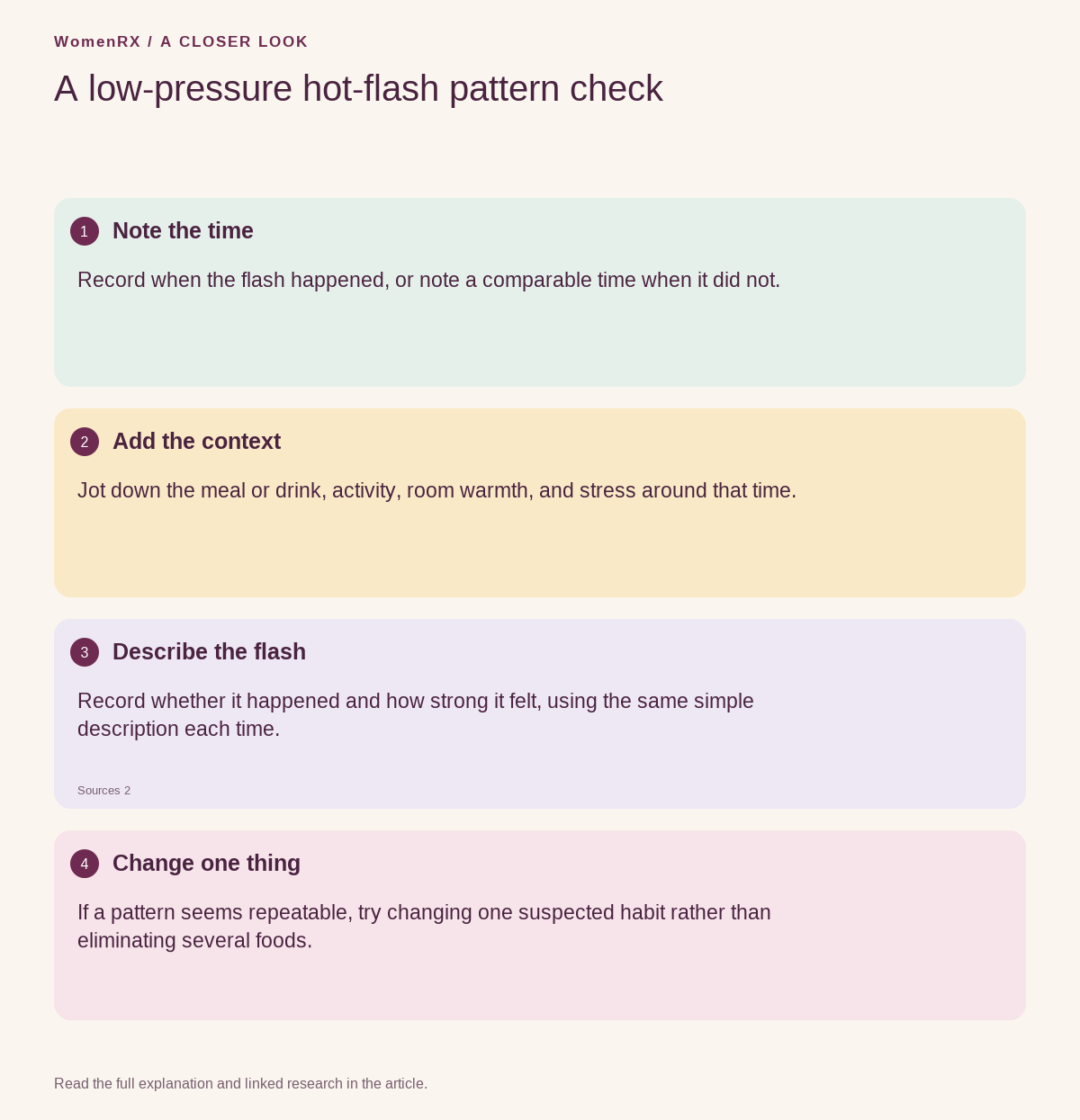
A low-pressure hot-flash pattern check
Note the time: Record when the flash happened, or note a comparable time when it did not.
Add the context: Jot down the meal or drink, activity, room warmth, and stress around that time.
Describe the flash: Record whether it happened and how strong it felt, using the same simple description each time.2
Change one thing: If a pattern seems repeatable, try changing one suspected habit rather than eliminating several foods.
Read the figure as text
Use a few consistent details to see whether a suspected trigger repeats. This is a personal observation aid, not a validated test.- Note the time: Record when the flash happened, or note a comparable time when it did not.
- Add the context: Jot down the meal or drink, activity, room warmth, and stress around that time.
- Describe the flash: Record whether it happened and how strong it felt, using the same simple description each time.2
- Change one thing: If a pattern seems repeatable, try changing one suspected habit rather than eliminating several foods.
More questions, answered
Does stress cause hot flashes?
In a daily-diary analysis, higher stress was associated with greater hot-flash severity on days women reported flashes, but it wasn’t significantly associated with whether a flash occurred. The finding suggests a possible same-day relationship, not proof of cause. 2
Should I stop drinking alcohol to prevent hot flashes?
Observational findings point in different directions and don’t show that alcohol prevents hot flashes or causes an immediate one. They don’t provide a reason to drink, or a personal hot-flash rule about avoiding alcohol. 1 3
Sources you can check
- Hot flashes in the late reproductive years: risk factors for Africa American and Caucasian women.Freeman EW, Sammel MD, Grisso JA, Battistini M, Garcia-Espagna B, Hollander L. · Journal of women's health & gender-based medicine · 2001Return to first citation
- The Relationship Between Daily Stress and Hot Flashes in Women of Menopausal Age.Fan YA, Behar E, Cohen AI, Law C, Gunthert KC. · Journal of clinical psychology · 2026Return to first citation
- Risk factors for hot flashes among women undergoing the menopausal transition: baseline results from the Midlife Women's Health Study.Gallicchio L, Miller SR, Kiefer J, Greene T, Zacur HA, Flaws JA. · Menopause (New York, N.Y.) · 2015Return to first citation
- Processed foods in the context of a vegan diet, and changes in body weight and severe hot flashes in postmenopausal women: a secondary analysis of a randomized clinical trial.Kahleova H, Znayenko-Miller T, Jayaraman A, Motoa G, Chiavaroli L, Holubkov R, Barnard ND. · Menopause (New York, N.Y.) · 2025Return to first citation