Hot Flashes at Work: Plan for the Moment
A few job-specific choices can make a hot flash easier to handle, even when you can’t change the room temperature.
Plan for the part of your workday that gives you the fewest options: a long meeting, a shared room, or a shift in a uniform. Keep a permitted comfort item within reach, decide how you’d pause if needed, and check which clothing or seating choices are available. If you want a workplace change, you can start by asking for the specific change rather than explaining menopause.
A hot flash is inconvenient enough without having to manage it in front of coworkers or customers. In a US study at one pharmaceutical company, employees described interruptions from regulating their body temperature and worry about unpredictable symptoms at work. Their jobs, flexibility, and preferences for privacy differed. 1
The aim here isn’t to prevent every episode. It’s to give yourself a next move that fits the work you actually do.
Build around what you control
At a desk, you might keep water and a small cloth within reach, use a personal fan if it’s permitted, or choose a seat near existing airflow. In a shared space, a fan may bother someone else or not be allowed, while a drink or a brief step away may be simpler. Pick the option you could use without rearranging the room.
If you work on your feet, move between locations, or can’t leave a station unattended, a desk setup won’t help much. Think instead about where you could keep a permitted item and whether your usual coverage arrangements allow a short pause. A workplace review identifies inflexible conditions and high-stress jobs as factors that may make menopausal symptoms harder to manage, so limited options aren’t a failure of planning. 2
Give yourself an exit from a meeting
Before a long meeting, make two small decisions: where you’ll sit and what you’ll have handy. A seat near the door may make a brief exit less disruptive. Water, an agenda, or a few notes can help you pick up where you left off. If you’re leading, you could ask a colleague in advance to take the next agenda item should you need a moment, if that fits how your team works.
You don’t need to prepare a personal explanation for the room. “I’ll be right back” is enough for an ordinary brief pause. If leaving isn’t possible, having your notes in front of you still gives you something concrete to return to.
Work with uniform and safety rules, not around them
If you wear a uniform, check whether there’s an approved lighter layer, an alternative uniform option, or a place to keep a spare layer for a break. Don’t alter required protective gear to cool down. In a role where clothing can’t change, a permitted drink, seating choice, or covered break may be more realistic than a wardrobe solution.
The same tradeoff applies to temperature control: changing a thermostat may affect everyone, while asking about a different work position or meeting space may be easier to discuss. What’s possible depends on your role and workplace.
Ask for a change on your terms
You might want to tell your manager about menopause. You might not. In the US workplace study, some interview participants valued privacy, while others wanted more openness; some worried about judgment or ageism. Those experiences came from one company, but they’re a good reason not to assume there’s one right way to have this conversation. 1
If you decide to ask, begin with the work situation and one specific option: “Could I sit near the door during longer meetings?” or “Is there an approved uniform option that feels less warm?” If your station needs coverage, you might ask how a brief step away could work during a shift. These are requests to explore, not changes every employer can provide or promises about what information a workplace may require.
Choose the hardest recurring moment first. A plan for that one meeting or shift is more useful than a bag of supplies you can’t use at work.
Pick what fits your shift
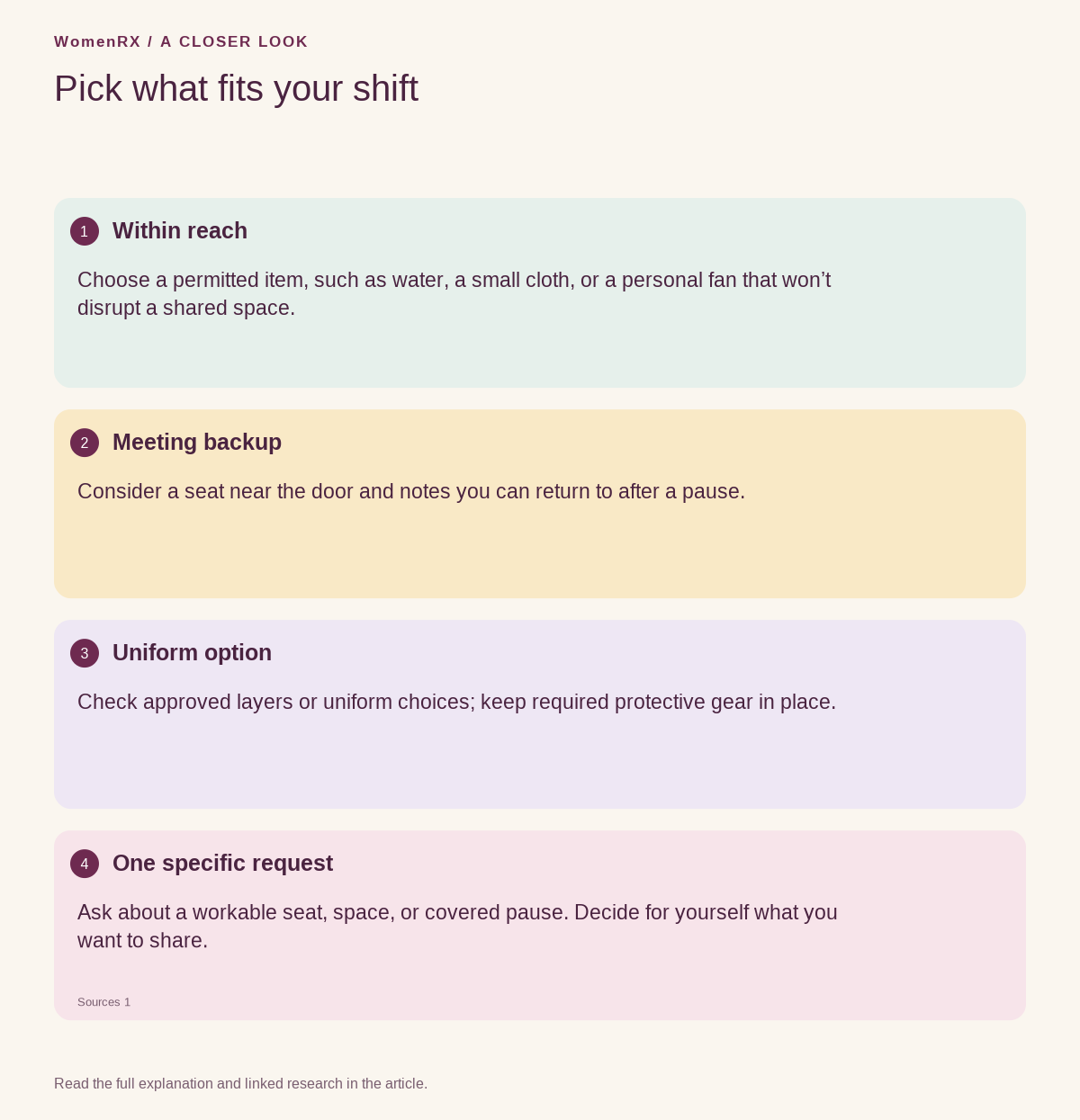
Within reach: Choose a permitted item, such as water, a small cloth, or a personal fan that won’t disrupt a shared space.
Meeting backup: Consider a seat near the door and notes you can return to after a pause.
Uniform option: Check approved layers or uniform choices; keep required protective gear in place.
One specific request: Ask about a workable seat, space, or covered pause. Decide for yourself what you want to share.1
Read the figure as text
Choose the options your role and workplace allow, rather than trying to use every item.- Within reach: Choose a permitted item, such as water, a small cloth, or a personal fan that won’t disrupt a shared space.
- Meeting backup: Consider a seat near the door and notes you can return to after a pause.
- Uniform option: Check approved layers or uniform choices; keep required protective gear in place.
- One specific request: Ask about a workable seat, space, or covered pause. Decide for yourself what you want to share.1
Sources you can check
- "I did not recognize myself": a mixed methods study to better understand the experiences of menopause in a US workplace.Mallen S, Coppola J, Shaffer N, Minkin MJ, Ward A, Snow S. · Menopause (New York, N.Y.) · 2025Return to first citation
- Menopause in the workplace: Challenges, impact, and next steps.Safwan N, Saadedine M, Shufelt CL, Kapoor E, Kling JM, Chaudhry R, Faubion SS. · Maturitas · 2024Return to first citation