Cooling Products for Hot Flashes: How to Choose What to Try
Choose a fan, layer, or wearable cooler for the place you need comfort, while keeping product claims about reducing hot flashes in perspective.
A cooling product may help you feel more comfortable during a hot flash, but that doesn’t mean it reduces how often flashes happen. Choose by where you’ll use it and what matters there: portability, noise, washable fabric, easy controls, or a workable return policy. A small wrist-cooling trial is promising but too limited to establish reliable benefit for menopause-related hot flashes. 2
A fan beside the bed, a light layer you can remove, or a small device in your bag may make a hot flash easier to manage in the moment. The best fit depends on when and where you want comfort. Cooling products are different from treatments studied to reduce hot-flash symptoms, so be cautious about marketing that promises fewer or milder episodes.
Cooling techniques and removable clothing layers have been suggested as ways to stay more comfortable. Evidence for cooling techniques as a way to reduce vasomotor symptoms is limited; one small wrist-device study is not enough to establish that consumer cooling products reliably reduce hot flashes. 23
Start with where you’ll use it
At home during the day: A fan is a straightforward option to consider if you want air movement directed at you. Think about its footprint, how easy it is to aim, and whether its sound would bother you or someone sharing the room.
At night: If you tend to wake up hot, consider whether you want something you can switch on quickly or a fabric layer you can adjust. Check the noise level and controls for a powered item. For bedding or clothing, look at the care label and whether the fabric is machine washable. Removable layers are one suggested cooling technique. 3
At work or on the go: A small fan or wearable cooler may be easier to carry than something designed to stay at home. Before buying, check its size, how it’s powered, how it attaches, and whether you’d feel comfortable using it in the setting where you need it. Portable doesn’t necessarily mean discreet or convenient.
For cooling you can switch on during an episode: A wrist-cooling device has been tested in a small randomized crossover trial. The 27 participants included 10 people with breast cancer, 12 with prostate cancer, and five postmenopausal women. The study reported fewer severe episodes compared with participants’ baseline, but the small menopause subgroup means the result can’t show how reliably the device works for women in menopause. 2
Five checks before you buy
- Portability: Decide whether it will live by your bed, on a desk, or in a bag. Match its size and power requirements to that use.
- Noise: If you want it for sleep or focused work, look for noise information and consider whether the sound would keep you awake or distract you.
- Washability: For fabric items, check the care instructions before buying. Don’t assume a fabric can be washed like ordinary bedding just because it’s marketed as cooling.
- Temperature control and ease of use: Consider whether you want adjustable settings or a simple on/off control. If you expect to use it during a hot flash, controls that are easy to reach may matter more than extra features.
- Returns: Read the return policy, including any conditions for trying or returning an item that touches the skin. This is especially useful if you’re unsure whether its feel, noise, or fit will suit you.
These are shopping considerations, not a clinical score. If you already own a fan or have removable layers, you could see whether they make the situation more comfortable before spending money on a specialized product.
Comfort in the moment isn’t the same as treatment
The wrist-device result is preliminary: it came from a very small, mixed-population study, and only five participants were postmenopausal women. It doesn’t establish that fans, cooling pillows, blankets, or other consumer products reduce hot-flash frequency or severity. That’s a reason to weigh a product by its practical comfort and cost, rather than by a promise to stop symptoms. 2
If hot flashes are repeatedly disrupting sleep or daily life, cooling aids aren’t the only option to consider. In a randomized trial of 250 postmenopausal women, a six-week self-administered hypnosis program reduced a combined hot-flash frequency-and-severity score by 53.4% from baseline, compared with a 40.9% decrease in the white-noise control group. Both groups improved; this is evidence about hypnosis, not cooling products, and the study does not tell us whether the result applies during perimenopause. 1
Your needs may also change by setting: a quiet option may matter most at night, while portability may matter more at work or while traveling. Choose for the moment you want to make easier, and treat claims about reducing the underlying hot flashes separately from claims about cooling your skin.
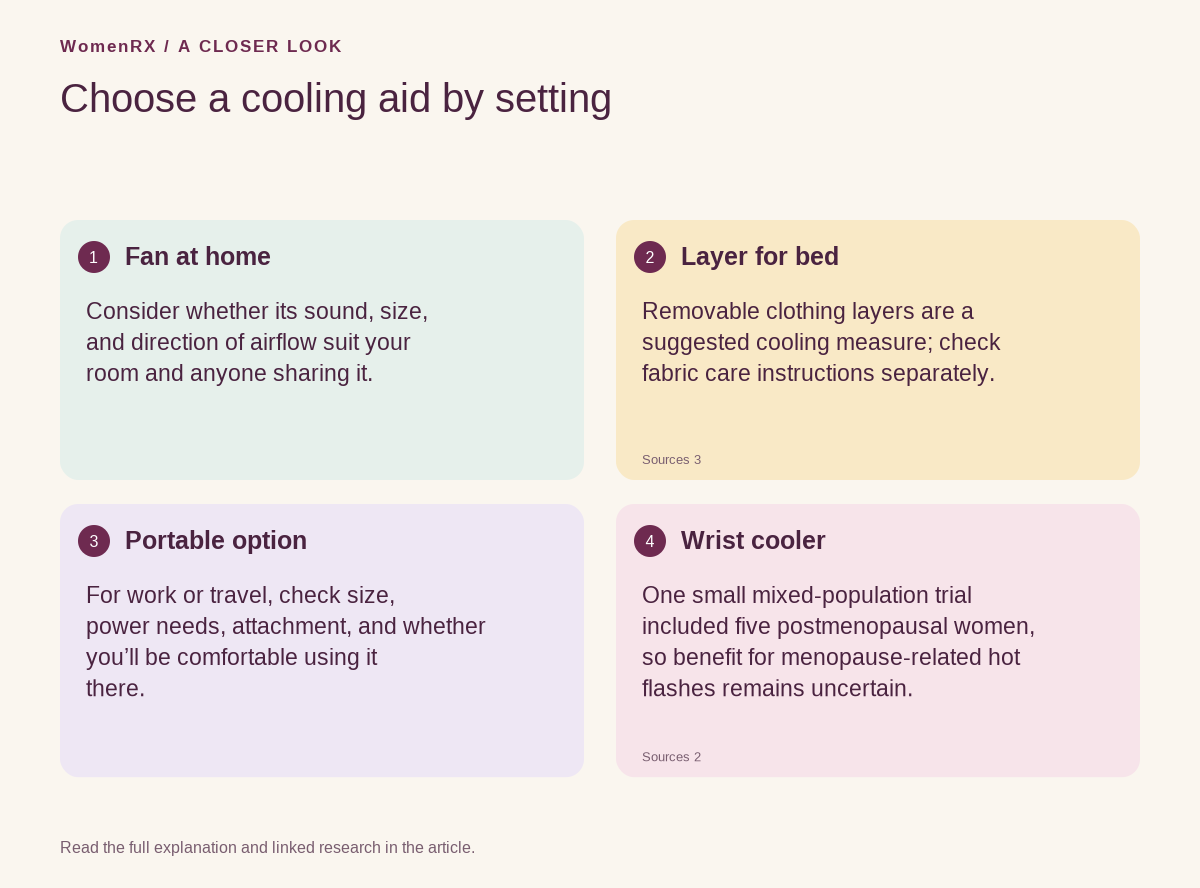
Choose a cooling aid by setting
Fan at home: Consider whether its sound, size, and direction of airflow suit your room and anyone sharing it.
Layer for bed: Removable clothing layers are a suggested cooling measure; check fabric care instructions separately.3
Portable option: For work or travel, check size, power needs, attachment, and whether you’ll be comfortable using it there.
Wrist cooler: One small mixed-population trial included five postmenopausal women, so benefit for menopause-related hot flashes remains uncertain.2
Read the figure as text
Compare possible comfort aids by where you might use them and what to check before buying.- Fan at home: Consider whether its sound, size, and direction of airflow suit your room and anyone sharing it.
- Layer for bed: Removable clothing layers are a suggested cooling measure; check fabric care instructions separately.3
- Portable option: For work or travel, check size, power needs, attachment, and whether you’ll be comfortable using it there.
- Wrist cooler: One small mixed-population trial included five postmenopausal women, so benefit for menopause-related hot flashes remains uncertain.2
More questions, answered
Does a wrist cooler prevent hot flashes?
A small trial reported fewer severe episodes compared with baseline, but it included only five postmenopausal women alongside participants with breast or prostate cancer. That is not enough to establish that wrist cooling reliably prevents hot flashes during menopause. 2
Are cooling techniques worth trying if they don’t treat the cause?
They may still be worth considering for comfort. Removable layers and cooling techniques have been suggested as practical measures, but that advice doesn’t establish that a particular consumer product reduces hot-flash frequency. 23
Sources you can check
- Self-Administered Hypnosis vs Sham Hypnosis for Hot Flashes: A Randomized Clinical Trial.Elkins G, Arring N, Morgan G, Lorenz T, Muniz V, Lafferty C, Scheffrahn K, Alldredge C, Barton D. · JAMA network open · 2025Return to first citation
- Peripheral Thermoregulatory Modulation for Hot Flash Management: Efficacy of Novel Wrist Cooling Device in Cancer Treatment-Induced and Menopausal Vasomotor Symptoms.Uçar N, Shirvani A, Holick MF. · AACE endocrinology and diabetes · 2025Return to first citation
- [Ovarian Ablation in Breast Cancer Patients and the Possibility of Influencing Treatment Side Effects].Palácová M. · Klinicka onkologie : casopis Ceske a Slovenske onkologicke spolecnosti · 2016Return to first citation