What Helps During a Hot Flash, and What Works Over Time?
Comfort measures may make an episode easier to tolerate, while treatments for frequent flashes are meant to reduce symptoms over time.
During a hot flash, moving somewhere cooler, loosening a layer, or using a fan or cool cloth may feel helpful, but these aren’t proven ways to stop an episode. For frequent or disruptive symptoms, hormone therapy is the most effective treatment; evidence-backed nonhormonal options include certain antidepressants, gabapentin, fezolinetant, oxybutynin, cognitive behavioral therapy, and clinical hypnosis. The choice depends on your health history and preferences. 2 3
A quick comfort measure isn’t the same as treatment
When a hot flash hits, you might loosen a layer, move to a cooler spot, or use a fan or cool cloth. Try these if they feel comfortable, but don’t count on them to shorten the episode or prevent the next one. The Menopause Society’s evidence review does not recommend cooling techniques as a treatment for reducing hot flashes. That’s different from using something cool simply because it feels good in the moment. 3
There isn’t an established instant fix among the options discussed here. Treatments for frequent symptoms are aimed at reducing hot flashes, or how much they interfere with life, over time.
For recurring flashes, compare treatments by purpose
Hormone therapy is the most effective treatment for menopausal hot flashes. Whether it’s a suitable choice depends on personal health factors and when treatment begins. The Menopause Society describes the benefit-risk balance as generally favorable for women younger than 60 or within 10 years of menopause who have no contraindications. It appears less favorable when therapy is started later. The statement also recommends individualizing treatment and periodically reassessing its benefits and risks. 2
If hormone therapy isn’t a good fit or isn’t your preference, evidence-backed nonhormonal choices include certain SSRIs or SNRIs, gabapentin, fezolinetant, and, in some cases, oxybutynin. These aren’t interchangeable options. A useful comparison is what you most want to improve, your health history, and the particular considerations of each treatment. 3
Fezolinetant is a nonhormonal prescription treatment for moderate to severe hot flashes related to menopause. In two phase 3 trials, it reduced symptom frequency and severity more than placebo at weeks 4 and 12. That’s a measured benefit over time, not a rescue treatment for an episode already underway. Its prescribing information includes liver-safety precautions, including blood-test follow-up when certain liver enzyme elevations occur; reports of serious liver injury after approval are also included. 1
Behavioral treatments target symptoms and their impact
Clinical hypnosis and cognitive behavioral therapy (CBT) are also among the nonhormonal options recommended by the Menopause Society. They’re structured approaches studied for reducing symptoms or their effect on daily life, not a promise that a relaxation technique will stop a flash in the moment. 3
In a randomized trial of 250 postmenopausal women, hot-flash scores decreased from baseline by 53.4% after six weeks of self-administered hypnosis, compared with 40.9% with a sham program. Because the comparison group also improved, the difference between the groups matters more than either percentage alone. The hypnosis group also reported a greater reduction in daily interference. The study tested a six-week program, not immediate relief. 4
If nighttime flashes go hand in hand with insomnia, CBT tailored to menopausal insomnia may be relevant. A small pilot trial in 43 perimenopausal and postmenopausal women who had insomnia and nighttime hot flashes found greater improvement in insomnia and hot-flash interference with the CBT program than with menopause education. That finding applies to a specific group and is promising, but it’s from a pilot study. 5
Match the next step to what’s bothering you most
If you’re weighing options, start with the problem you most want to change: the flashes themselves, disrupted sleep, or how much symptoms interrupt your day. Hormone therapy and nonhormonal treatments aim to reduce symptoms over time; behavioral treatments may be an option for symptoms or their impact. Comfort measures are for the moment, and aren’t established treatments for reducing hot flashes. Your menopause stage, health history, and preferences help shape which longer-term options are worth considering. 2 3
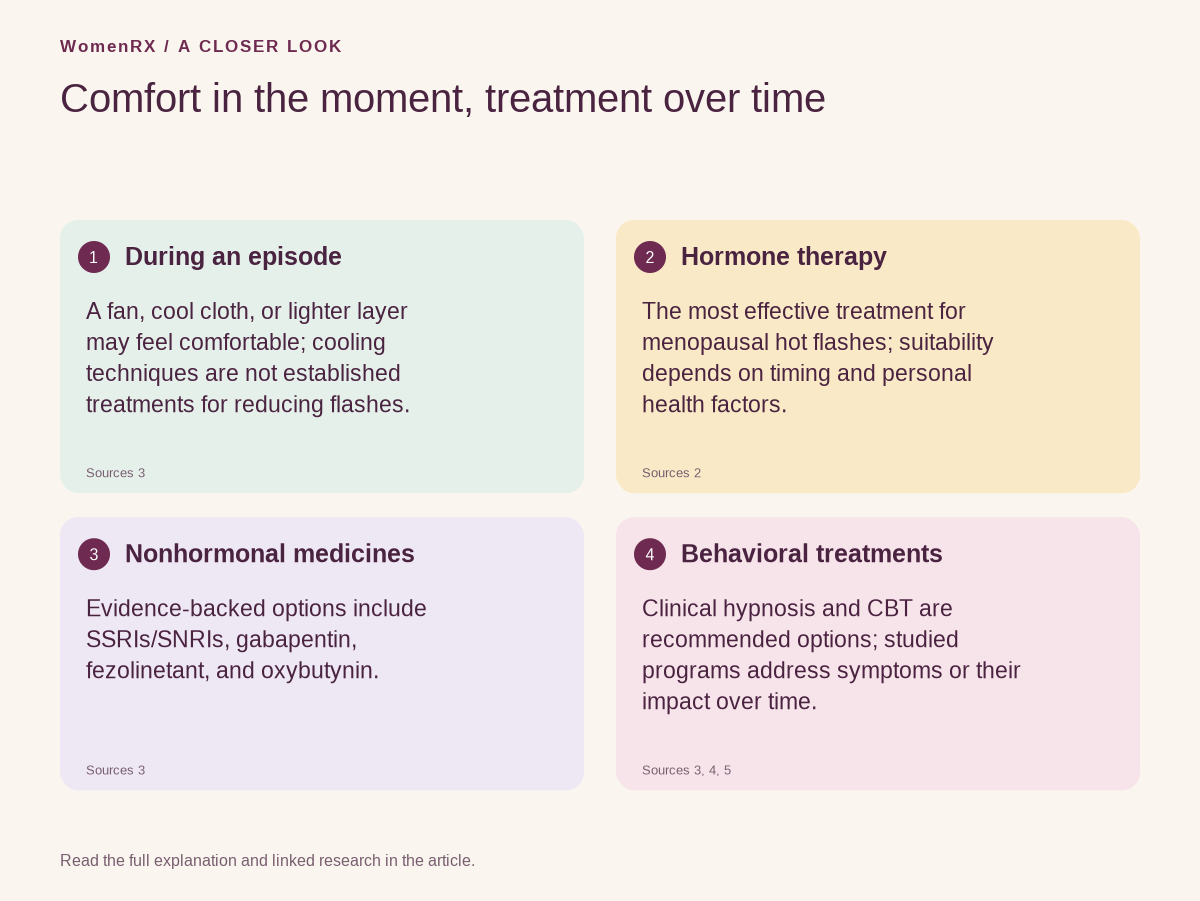
Comfort in the moment, treatment over time
During an episode: A fan, cool cloth, or lighter layer may feel comfortable; cooling techniques are not established treatments for reducing flashes.3
Hormone therapy: The most effective treatment for menopausal hot flashes; suitability depends on timing and personal health factors.2
Nonhormonal medicines: Evidence-backed options include SSRIs/SNRIs, gabapentin, fezolinetant, and oxybutynin.3
Behavioral treatments: Clinical hypnosis and CBT are recommended options; studied programs address symptoms or their impact over time.345
Read the figure as text
These options have different aims: comfort measures may feel helpful during an episode, while studied treatments target recurring symptoms or their impact.- During an episode: A fan, cool cloth, or lighter layer may feel comfortable; cooling techniques are not established treatments for reducing flashes.3
- Hormone therapy: The most effective treatment for menopausal hot flashes; suitability depends on timing and personal health factors.2
- Nonhormonal medicines: Evidence-backed options include SSRIs/SNRIs, gabapentin, fezolinetant, and oxybutynin.3
- Behavioral treatments: Clinical hypnosis and CBT are recommended options; studied programs address symptoms or their impact over time.345
More questions, answered
Are supplements or herbal remedies proven to reduce hot flashes?
The Menopause Society’s evidence review does not recommend supplements or herbal remedies as treatments for menopausal hot flashes. That doesn’t mean every product has been studied in the same way; it means supplements aren’t among the options this review supports for reducing symptoms. 3
Sources you can check
- VEOZAH (FEZOLINETANT) TABLET, FILM COATED [ASTELLAS PHARMA US, INC.] | US prescribing information and patient instructionsAccessed 2026-09-25Return to first citation
- The 2022 hormone therapy position statement of The North American Menopause Society.“The 2022 Hormone Therapy Position Statement of The North American Menopause Society” Advisory Panel. · Menopause (New York, N.Y.) · 2022Return to first citation
- The 2023 nonhormone therapy position statement of The North American Menopause Society.Menopause (New York, N.Y.) · 2023Return to first citation
- Self-Administered Hypnosis vs Sham Hypnosis for Hot Flashes: A Randomized Clinical Trial.Elkins G, Arring N, Morgan G, Lorenz T, Muniz V, Lafferty C, Scheffrahn K, Alldredge C, Barton D. · JAMA network open · 2025Return to first citation
- Cognitive behavioral therapy for menopausal insomnia in perimenopausal and postmenopausal women with insomnia and nocturnal hot flashes: a randomized-controlled pilot trial.Arentson-Lantz EJ, Muench A, Kokonda M, Meers JM, Swartz M, Manber R, Thurston RC, Nowakowski S. · Menopause (New York, N.Y.) · 2026Return to first citation