Hot Flash Relief: Comparing Hormones, Medicines, and Supplements
Hormone therapy offers the strongest hot flash relief, while several nonhormonal options have evidence behind them too.
For disruptive menopausal hot flashes, hormone therapy is the most effective treatment, but it isn’t the right choice for everyone. Evidence-supported alternatives include certain prescription medicines, cognitive behavioral therapy, and clinical hypnosis. Timing since menopause, whether you have a uterus, your health history, and your preferences can help narrow the choices. Black cohosh has not shown reliable benefit. 4 5 2
A hot flash that wakes you once in a while may be something you can live with. Hot flashes that repeatedly interrupt sleep, work, or time with other people call for a different conversation. The choice isn’t simply hormones versus “natural” remedies. There are treatments between those two, with different evidence and safety considerations.
Hormone therapy: the strongest relief, with timing that matters
Hormone therapy is the most effective treatment for menopausal hot flashes. The Menopause Society’s position statement describes its benefit-risk balance as favorable for bothersome symptoms in women younger than 60 or within 10 years of menopause onset who have no contraindications. Starting after age 60 or more than 10 years after menopause onset appears less favorable because the absolute risks of certain conditions, including stroke and blood clots, are greater. The type of therapy, route, duration, and your health history matter too. These are reasons for an individual discussion, not an automatic yes or no based on a birthday. 4
Whether you have a uterus changes that discussion. Estrogen used without a progestogen can raise the risk of cancer of the uterine lining in someone with a uterus. If hormone therapy is an option for you, ask how a proposed plan accounts for that risk. 3
A history of an estrogen-dependent cancer or cardiovascular disease may make hormone therapy a poor fit. Your preferences count as well: you may be eligible for it and still prefer a nonhormonal approach. 5
Nonhormonal prescriptions: more than one kind of medicine
The Menopause Society recommends several nonhormonal medicines for hot flashes: SSRIs or SNRIs, gabapentin, and fezolinetant have strong supporting evidence; oxybutynin is also recommended, with evidence rated from strong to more limited. They aren’t interchangeable. A useful question is which option fits your other health conditions, medicines, and concerns about side effects. 5
Fezolinetant is a nonhormonal prescription medicine for moderate to severe hot flashes due to menopause. Its distinguishing safety check is liver monitoring: US prescribing information calls for blood tests before treatment, monthly for the first three months, then at months six and nine. The label says not to use it with cirrhosis, severe kidney problems or kidney failure, or certain medicines called CYP1A2 inhibitors. That makes a review of your medicines and supplements particularly relevant before choosing it. 1
The label also tells people taking fezolinetant to stop it and call their healthcare provider if signs of liver problems develop. Yellowing of the eyes or skin and dark urine are examples; unusual tiredness, itching, nausea, and abdominal pain are also listed. This is a specific action point for this medicine, not a reason to assume every nonhormonal treatment needs the same monitoring. 1
Behavioral treatment is different from a comfort trick
Cognitive behavioral therapy and clinical hypnosis are recommended nonhormonal approaches for hot flashes. That’s different from suggesting that you simply cool the room, avoid a suspected trigger, or try to relax. The Menopause Society’s evidence review did not recommend those common measures as treatments for hot flashes. If a fan or lighter bedding makes a particular night more comfortable, you can still use it without expecting it to do the work of a proven treatment. 5
Where black cohosh fits
Black cohosh is sold for menopausal symptoms, but products vary in composition, and its active ingredients aren’t established. A 2016 meta-analysis of randomized trials found no significant association between black cohosh supplementation and fewer vasomotor symptoms or better self-reported menopausal symptom scores. The Menopause Society does not recommend herbal remedies or supplements as hot flash treatments. “Natural” isn’t a shortcut to an effective or automatically safe choice. 2 5
Turn the comparison into a useful conversation
Start with what you want to change. For example, is the main problem being woken by night sweats, or are daytime flashes interrupting meetings? Then compare the options against your circumstances: your age and time since menopause for a hormone-therapy discussion; whether you have a uterus if estrogen is being considered; and your health conditions and current medicines for any prescription choice. If fezolinetant interests you, include its liver tests and medication restrictions in that comparison. You can choose an approach based on what matters most now and revisit it if your symptoms or priorities change. 1 3 4 5
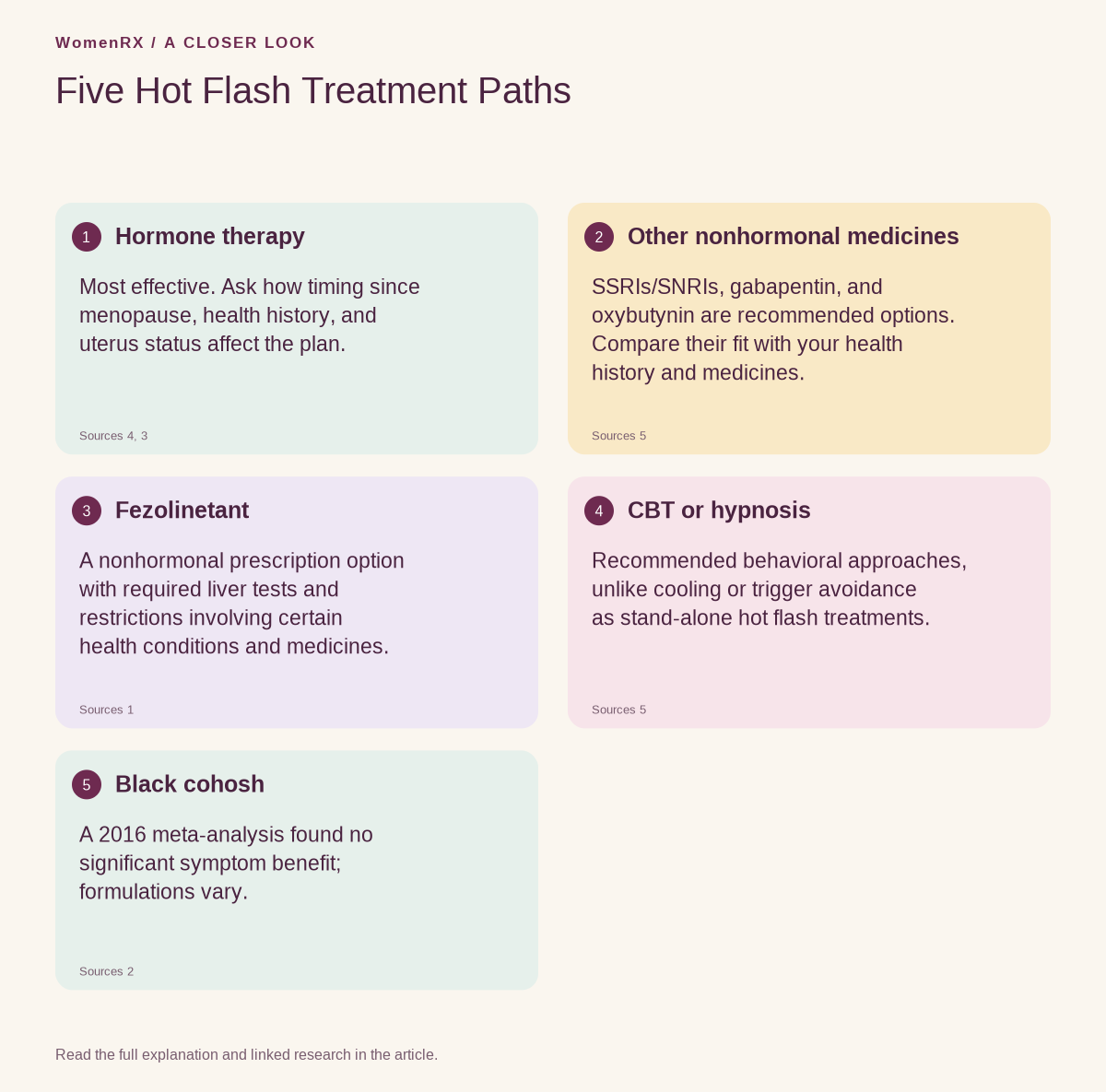
Five Hot Flash Treatment Paths
Hormone therapy: Most effective. Ask how timing since menopause, health history, and uterus status affect the plan.43
Other nonhormonal medicines: SSRIs/SNRIs, gabapentin, and oxybutynin are recommended options. Compare their fit with your health history and medicines.5
Fezolinetant: A nonhormonal prescription option with required liver tests and restrictions involving certain health conditions and medicines.1
CBT or hypnosis: Recommended behavioral approaches, unlike cooling or trigger avoidance as stand-alone hot flash treatments.5
Black cohosh: A 2016 meta-analysis found no significant symptom benefit; formulations vary.2
Read the figure as text
Compare what supports each approach and the question most likely to affect your choice.- Hormone therapy: Most effective. Ask how timing since menopause, health history, and uterus status affect the plan.43
- Other nonhormonal medicines: SSRIs/SNRIs, gabapentin, and oxybutynin are recommended options. Compare their fit with your health history and medicines.5
- Fezolinetant: A nonhormonal prescription option with required liver tests and restrictions involving certain health conditions and medicines.1
- CBT or hypnosis: Recommended behavioral approaches, unlike cooling or trigger avoidance as stand-alone hot flash treatments.5
- Black cohosh: A 2016 meta-analysis found no significant symptom benefit; formulations vary.2
Sources you can check
- VEOZAH (FEZOLINETANT) TABLET, FILM COATED [ASTELLAS PHARMA US, INC.] | US prescribing information and patient instructionsAccessed 2026-09-25Return to first citation
- Black Cohosh - Health Professional Fact SheetAccessed 2026-09-25Return to first citation
- CLIMARA PRO (ESTRADIOL AND LEVONORGESTREL) PATCH [BAYER HEALTHCARE PHARMACEUTICALS INC.] | US prescribing information and patient instructionsAccessed 2026-09-25Return to first citation
- The 2022 hormone therapy position statement of The North American Menopause Society.“The 2022 Hormone Therapy Position Statement of The North American Menopause Society” Advisory Panel. · Menopause (New York, N.Y.) · 2022Return to first citation
- The 2023 nonhormone therapy position statement of The North American Menopause Society.Menopause (New York, N.Y.) · 2023Return to first citation