Can Hormone Therapy Help With Menopause Hot Flashes?
Systemic hormone therapy offers the strongest hot-flash relief, while timing, health history, and uterus status shape whether it fits you.
Yes. Systemic menopausal hormone therapy is the most effective treatment for bothersome hot flashes. Specific estrogen-based regimens relieved moderate to severe hot flashes better than placebo in trials. Your decision also depends on when you start, your health history, and whether you have a uterus. Evidence-supported nonhormone options are available; low-dose vaginal estrogen serves a different purpose. 1 2 4 5
Start with the symptom you want to relieve
Hot flashes can interrupt a meeting, wake you at night, or make it hard to get comfortable again. If they’re the symptom you want to treat, the key distinction is systemic versus local treatment. Systemic hormone therapy is the most effective treatment for hot flashes and night sweats, also called vasomotor symptoms. In a trial subset of postmenopausal women with frequent moderate to severe hot flashes, specific oral estrogen regimens, alone or combined with a progestin, reduced hot-flash frequency and severity more than placebo at weeks 4 and 12. Those results establish benefit for the regimens studied, not identical results for every hormone product. 1 2 4
Low-dose vaginal estrogen has a different job: treating bothersome symptoms in and around the vagina when over-the-counter approaches haven’t helped and systemic therapy isn’t needed. It isn’t the local version of hot-flash treatment. If you have both hot flashes and vaginal symptoms, name both when discussing options so neither gets overlooked. 1 4
Why timing and medical history change the conversation
The North American Menopause Society’s 2022 position statement describes the benefit-risk balance of hormone therapy as favorable for bothersome hot flashes in women younger than 60 or within 10 years of menopause onset who have no contraindications. Starting after 60 or more than 10 years after menopause has a less favorable balance because the absolute risks of coronary heart disease, stroke, blood clots, and dementia are greater. That age-and-timing distinction helps frame a discussion; it can’t tell you your individual risk. 4
The treatment itself matters too. Risks vary by hormone type, dose, route, duration, timing, and whether a progestogen is used. In the Women’s Health Initiative trial of one daily oral conjugated estrogen regimen, postmenopausal women ages 50 to 79 had higher risks of stroke and deep vein thrombosis than those taking placebo during 7.1 years of treatment. A separate trial of a daily oral conjugated estrogen plus medroxyprogesterone acetate regimen found higher risks of blood clots, stroke, and heart attack than placebo in postmenopausal women ages 50 to 79 during 5.6 years of treatment. These findings matter, but they aren’t precise risk estimates for every formulation or route. 1 2 4
Whether you have a uterus is another decision point. The major estrogen-alone trial enrolled women who had had a hysterectomy; the estrogen-plus-progestin trial enrolled women with a uterus. If you’re considering systemic estrogen, ask whether your uterus status means a progestogen needs to be part of your regimen. 3
Hot flashes can also occur during the menopausal transition, before periods have stopped. The hot-flash treatment trials described above enrolled postmenopausal women, so their results aren’t a separate comparison of options for perimenopause. If you’re still having periods, say so when discussing which approach fits your symptoms and stage of life. 1 2 6
What if you don’t want systemic hormones?
There are evidence-supported nonhormone choices. The North American Menopause Society’s 2023 review recommends cognitive behavioral therapy, clinical hypnosis, certain antidepressants known as SSRIs or SNRIs, gabapentin, and fezolinetant for hot flashes, with its strongest evidence rating for these options. It also recommends oxybutynin, while assigning more limited or mixed evidence to weight loss. These aren’t interchangeable: one woman may prefer a behavioral approach, while another wants to discuss a prescription option. The same review does not recommend herbal supplements as a proven hot-flash treatment. 5
A useful way to narrow the choice is to bring the actual tradeoff into the conversation: How much are the flashes affecting sleep or daily life? Do you want to consider systemic hormones, or would you rather start with a nonhormone option? How do your age, time since menopause, uterus status, and history of cardiovascular disease or an estrogen-dependent cancer affect what fits? If a hormone regimen is an option, ask what is known about the specific treatment and route being proposed, rather than assuming all hormone therapy has the same benefits and risks. 4 5
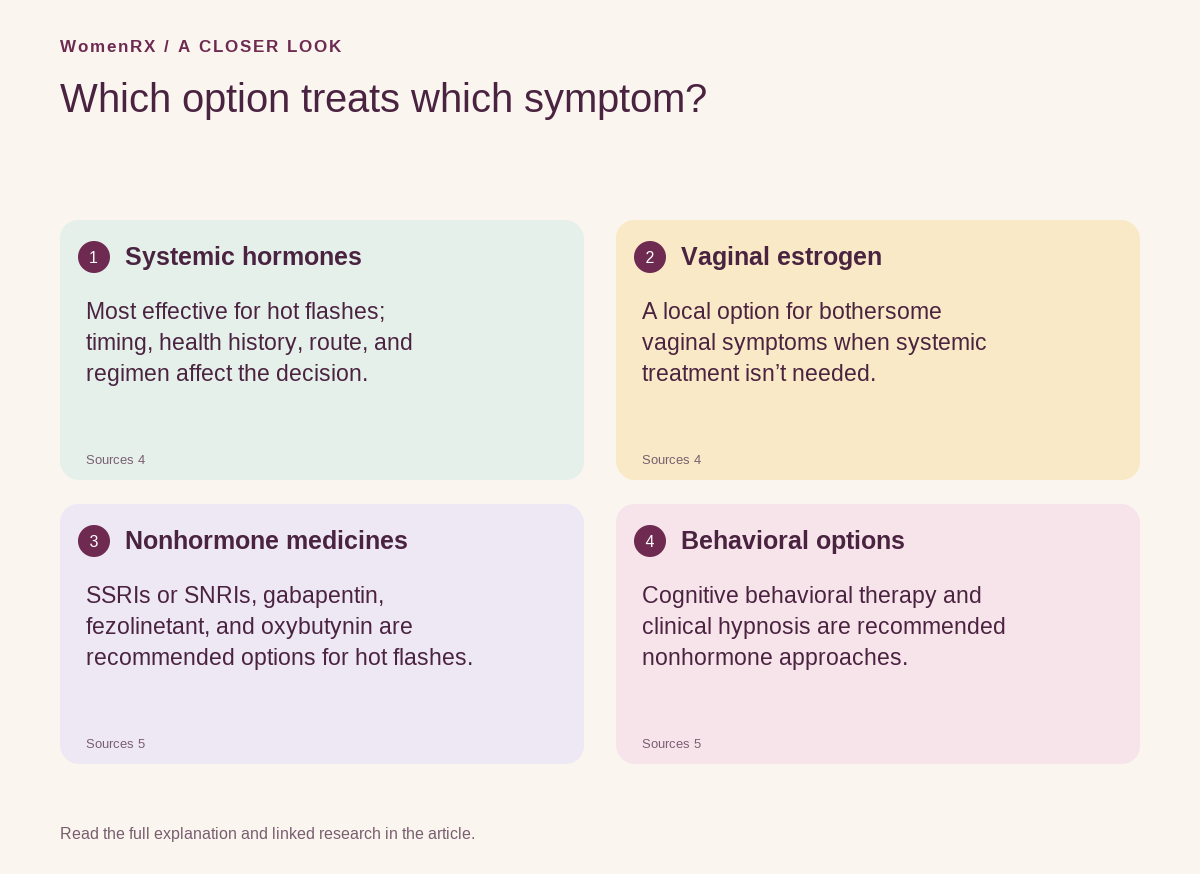
Which option treats which symptom?
Systemic hormones: Most effective for hot flashes; timing, health history, route, and regimen affect the decision.4
Vaginal estrogen: A local option for bothersome vaginal symptoms when systemic treatment isn’t needed.4
Nonhormone medicines: SSRIs or SNRIs, gabapentin, fezolinetant, and oxybutynin are recommended options for hot flashes.5
Behavioral options: Cognitive behavioral therapy and clinical hypnosis are recommended nonhormone approaches.5
Read the figure as text
This comparison separates hot-flash treatments from local vaginal treatment and shows what shapes the choice.- Systemic hormones: Most effective for hot flashes; timing, health history, route, and regimen affect the decision.4
- Vaginal estrogen: A local option for bothersome vaginal symptoms when systemic treatment isn’t needed.4
- Nonhormone medicines: SSRIs or SNRIs, gabapentin, fezolinetant, and oxybutynin are recommended options for hot flashes.5
- Behavioral options: Cognitive behavioral therapy and clinical hypnosis are recommended nonhormone approaches.5
More questions, answered
Could vaginal estrogen help if I also have hot flashes?
Low-dose vaginal estrogen is an option for bothersome vaginal symptoms, not the systemic hormone treatment identified as most effective for hot flashes. If both are bothering you, discuss both symptoms rather than expecting a local treatment to address them all. 4
Sources you can check
- PREMARIN (ESTROGENS, CONJUGATED) TABLET, FILM COATED [WYETH PHARMACEUTICALS LLC, A SUBSIDIARY OF PFIZER INC.] | US prescribing information and patient instructionsAccessed 2026-09-25Return to first citation
- PREMPHASE (CONJUGATED ESTROGENS AND MEDROXYPROGESTERONE ACETATE) KIT PREMPRO (CONJUGATED ESTROGENS AND MEDROXYPROGESTERONE ACETATE) TABLET, SUGAR COATED [WYETH PHARMACEUTICALS LLC, A SUBSIDIARY OF PFIZER INC.] | US prescribing information and patient instructionsAccessed 2026-09-25Return to first citation
- A Reappraisal of Women's Health Initiative Estrogen-Alone Trial: Long-Term Outcomes in Women 50-59 Years of Age.Roehm E. · Obstetrics and gynecology international · 2015Return to first citation
- The 2022 hormone therapy position statement of The North American Menopause Society.“The 2022 Hormone Therapy Position Statement of The North American Menopause Society” Advisory Panel. · Menopause (New York, N.Y.) · 2022Return to first citation
- The 2023 nonhormone therapy position statement of The North American Menopause Society.Menopause (New York, N.Y.) · 2023Return to first citation
- Elinzanetant for the Treatment of Menopausal Hot Flashes: A Plain Language Review of the OASIS-1-4 Clinical Trial Results.Pinkerton JV, Nappi RE, Soares CN, Maki PM, Cardoso F, Donders G, Brennan D, Caetano C, Seitz C, Haseli-Mashhadi N, Haberland C, Brown G, Simon JA. · Women's health (London, England) · 2026Return to first citation