What Menopausal Hormone Therapy Can Help With Beyond Hot Flashes
Beyond hot flashes, hormone therapy can treat menopause-related vaginal and urinary symptoms and help protect bone, but it isn’t a general prescription for preventing chronic disease.
Menopausal hormone therapy can relieve genitourinary symptoms and help prevent bone loss and fractures. If symptoms are mainly vaginal or urinary, low-dose vaginal estrogen may be an option without using systemic therapy. The balance depends on your age, time since menopause, uterus status, treatment route and regimen, and personal health risks. 3
Two benefits with a clear treatment goal
Menopausal hormone therapy (MHT) has recognized uses beyond hot flashes: treating genitourinary symptoms of menopause and helping prevent bone loss and fractures. Genitourinary symptoms affect the vagina and urinary tract; bone protection is a separate potential benefit to weigh when considering treatment. Neither benefit means hormones are a general-purpose way to prevent disease. 3
That distinction can help clarify your reason for considering MHT. Are you hoping to ease symptoms that are bothering you now, to address bone loss, or to prevent a future illness? The first two are recognized treatment goals. A broad promise of protection from heart disease or dementia is not a reason to assume MHT is right for you. Findings about risks and benefits vary by age and time since menopause, and aren’t a universal prevention plan. 3 4
When symptoms are mainly vaginal or urinary
If vaginal or urinary symptoms are your main concern, ask whether treatment needs to act throughout the body or whether a local option could address your symptoms. For bothersome genitourinary symptoms not relieved with over-the-counter therapies, the North American Menopause Society recommends considering low-dose vaginal estrogen or other therapies when there isn’t another reason to use systemic hormone therapy. 3
This is a useful distinction, not a rule that one approach suits everyone. US prescribing information for conjugated estrogens also advises discussing whether a topical vaginal product may be more appropriate when treatment is being used only for changes in and around the vagina. 1
Bone protection is a benefit to weigh, not a blanket prescription
MHT has been shown to prevent bone loss and fractures. For women younger than 60 or within 10 years of menopause onset who have no contraindications, the position statement describes the benefit-risk balance as favorable for preventing bone loss. That makes bone health relevant to the decision, but doesn’t mean every woman needs MHT or that it should be used as a lifelong prevention strategy. 3
If bone protection is your main goal, the practical question is how much that benefit matters alongside your personal risk profile and any other symptoms you want treated. MHT’s possible bone benefit is one part of that balance, not a substitute for considering the treatment’s risks and your health history. 3
Timing and route can change the balance
Age and time since menopause matter. For women starting MHT more than 10 years after menopause began or after age 60, the overall balance appears less favorable, in part because the absolute risks of coronary heart disease, stroke, venous blood clots, and dementia are greater in these groups. This is why the same treatment can have a different benefit-risk balance at different stages of life. 3
Route matters too: MHT risks vary with the route, as well as hormone type, dose, duration, timing, and whether a progestogen is used. The available guidance supports considering these factors together, but doesn’t establish that one route is the best choice for every woman. 3
Uterus status affects the regimen discussion. In a woman with a uterus, estrogen without adequate progestogen can increase the risk of endometrial hyperplasia, which can be a precursor to endometrial cancer. Adding a progestogen has been shown to reduce that risk. So the question isn’t just whether estrogen might help; it’s also which approach fits your body and treatment goal. 1 2
Keep prevention claims specific
Reviews discuss age-related differences in hormone therapy outcomes, but a signal in a particular group isn’t the same as evidence to take MHT to prevent heart disease or dementia. The menopause position statement identifies treatment of symptoms and prevention of bone loss as uses, and emphasizes individualized decisions based on treatment factors and personal risks. 3 4
A focused conversation can start with three questions: What problem am I treating? Would a local or systemic approach fit that goal? How do my age, time since menopause, uterus status, and health history affect the balance? Those answers help separate a concrete potential benefit from a broader promise that hormones can’t make for everyone. 3
MHT benefits and what they mean
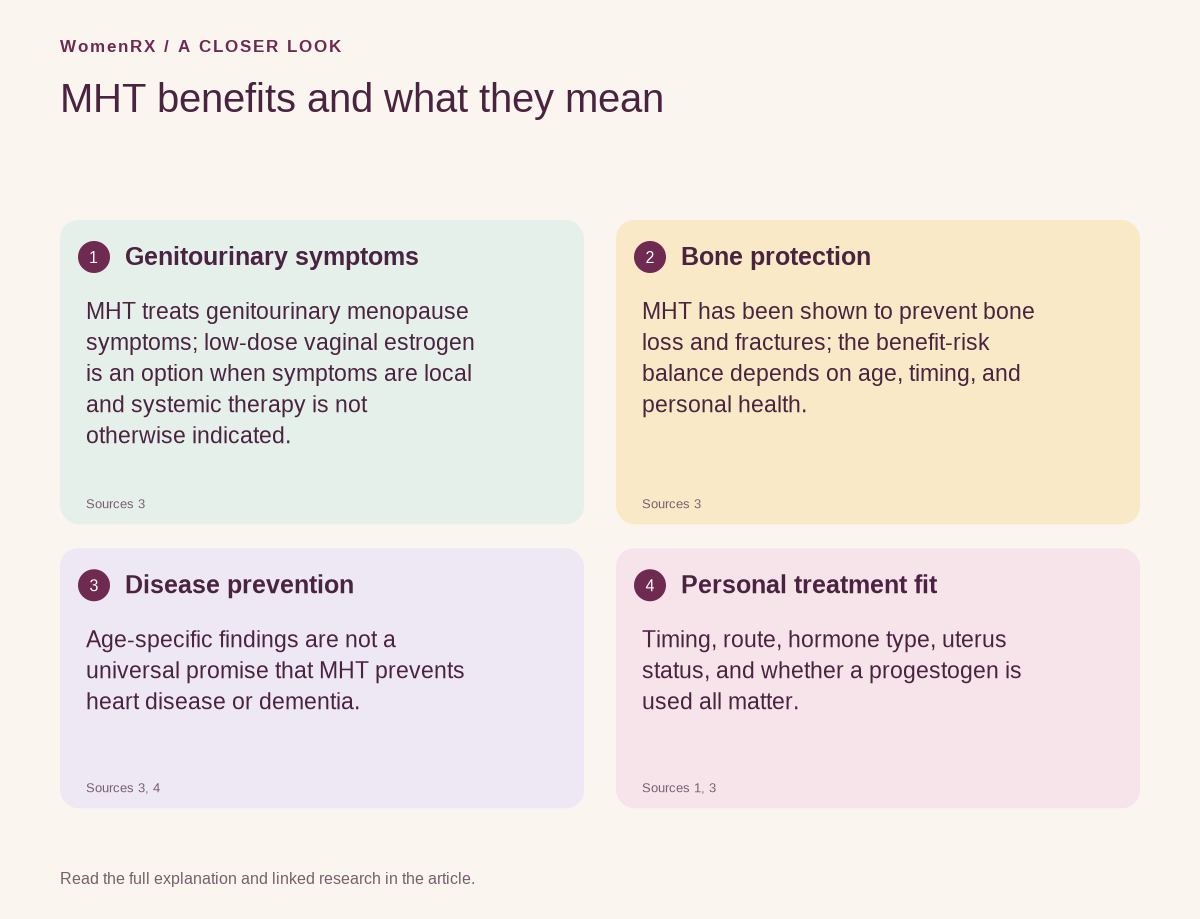
Genitourinary symptoms: MHT treats genitourinary menopause symptoms; low-dose vaginal estrogen is an option when symptoms are local and systemic therapy is not otherwise indicated.3
Bone protection: MHT has been shown to prevent bone loss and fractures; the benefit-risk balance depends on age, timing, and personal health.3
Disease prevention: Age-specific findings are not a universal promise that MHT prevents heart disease or dementia.34
Personal treatment fit: Timing, route, hormone type, uterus status, and whether a progestogen is used all matter.13
Read the figure as text
Compare recognized treatment goals with the personal factors that shape whether a potential benefit is worth pursuing.- Genitourinary symptoms: MHT treats genitourinary menopause symptoms; low-dose vaginal estrogen is an option when symptoms are local and systemic therapy is not otherwise indicated.3
- Bone protection: MHT has been shown to prevent bone loss and fractures; the benefit-risk balance depends on age, timing, and personal health.3
- Disease prevention: Age-specific findings are not a universal promise that MHT prevents heart disease or dementia.34
- Personal treatment fit: Timing, route, hormone type, uterus status, and whether a progestogen is used all matter.13
More questions, answered
Does having a uterus affect hormone therapy?
Yes. Estrogen without adequate progestogen can increase the risk of endometrial hyperplasia in a woman with a uterus, and adding a progestogen has been shown to reduce that risk. Uterus status is part of deciding which regimen fits. 1 2
Is vaginal estrogen the same as systemic hormone therapy?
They are different approaches. For bothersome genitourinary symptoms not relieved with over-the-counter therapies, low-dose vaginal estrogen is an option to consider when there isn’t another reason to use systemic hormone therapy. 3
Sources you can check
- PREMARIN (ESTROGENS, CONJUGATED) TABLET, FILM COATED [WYETH PHARMACEUTICALS LLC, A SUBSIDIARY OF PFIZER INC.] | US prescribing information and patient instructionsAccessed 2026-09-25Return to first citation
- PREMPHASE (CONJUGATED ESTROGENS AND MEDROXYPROGESTERONE ACETATE) KIT PREMPRO (CONJUGATED ESTROGENS AND MEDROXYPROGESTERONE ACETATE) TABLET, SUGAR COATED [WYETH PHARMACEUTICALS LLC, A SUBSIDIARY OF PFIZER INC.] | US prescribing information and patient instructionsAccessed 2026-09-25Return to first citation
- The 2022 hormone therapy position statement of The North American Menopause Society.“The 2022 Hormone Therapy Position Statement of The North American Menopause Society” Advisory Panel. · Menopause (New York, N.Y.) · 2022Return to first citation
- Hormone Therapy in Menopause: Concepts, Controversies, and Approach to Treatment.Flores VA, Pal L, Manson JE. · Endocrine reviews · 2021Return to first citation