Menopausal Hormone Therapy and Weight: What Studies Show
Two small trials don’t show that combined hormone therapy reliably causes weight gain, but they can’t settle how every formulation affects weight or body shape.
Abdominal fat can increase after menopause, but a change you notice while using hormone therapy isn’t necessarily a treatment effect. In one randomized trial, combined therapy and placebo groups did not differ in weight, total fat, or abdominal fat over two years. A smaller trial found no significant weight gain in its treatment group, but had substantial dropout. Neither trial can separate aging from menopause in an individual’s weight change. 3 4
The scale and body shape aren’t the same outcome
A scale measures total body mass. It can’t show whether a change came from fat, muscle, bone, or water. Body composition and fat distribution are separate questions: someone’s weight could stay similar while the amount or location of body fat changes. 1
That distinction matters when weighing claims about menopausal hormone therapy (MHT). A study that finds no change in scale weight hasn’t necessarily tested every aspect of body composition. And a change in abdominal fat, if found, wouldn’t automatically mean a change in total weight.
What two trials found
In a randomized, double-blind trial, 76 early postmenopausal women were assigned to daily conjugated estrogens plus medroxyprogesterone acetate or placebo. Fifty-one completed the study and were included in the analysis. Over two years, researchers found no difference between groups over time in weight, total fat, percentage of body fat, fat-free mass, or abdominal and under-the-skin abdominal fat. 3
A second, smaller trial followed women ages 45 to 56 for two years. It compared a low-dose combined conjugated-estrogen and medroxyprogesterone regimen plus calcium with calcium alone. The treatment group’s 1.3% increase in body weight was not statistically significant; the control group gained 3% relative to its starting weight. But the study was open-label, and only 23 of 30 women in the treatment group and 15 of 30 in the control group were evaluated at two years. Those limits make the apparent difference less conclusive. 4
Taken together, these trials don’t support a simple claim that combined MHT makes women gain weight. They also don’t prove that MHT prevents weight gain. The studies were small and tested particular combined regimens; neither tells us whether results are the same for other formulations or routes.
What the evidence can’t separate
Abdominal fat can increase after menopause, even when the question isn’t about treatment. The randomized trial’s researchers described that pattern as background for their study; their comparison tested whether one combined hormone regimen changed abdominal fat relative to placebo, and it found no difference. It did not test how much aging or the menopausal transition contributed to either group’s changes. 3
Weight changes around menopause can happen at the same time as treatment, but timing alone doesn’t show that treatment caused them. Body weight can reflect several things, including diet and family history, and the scale doesn’t identify which component of the body changed. 1 The trials above compare treatment groups, which is more informative about a treatment effect than simply observing that weight changed during the menopausal years.
There’s also no basis here for treating all MHT as interchangeable. The trials studied conjugated estrogens with medroxyprogesterone acetate. The North American Menopause Society notes that MHT risks vary with the type, dose, duration, route, timing, and whether a progestogen is used, and recommends individualizing treatment. That guidance is about overall treatment decisions, not proof that these factors change weight outcomes. 2
A practical way to interpret a weight change
If your weight shifts while you’re using MHT, the change by itself can’t tell you whether the medicine is responsible or whether body composition has changed. Consider the time course and other changes in your life, and remember that the scale is only one measure. An unexpected gain or loss is worth discussing with your care team, especially if it’s sudden; MedlinePlus recommends talking with a provider about weight changes that happen without trying. 1
MHT is used for specific menopausal concerns, not as a weight-loss or weight-control treatment. These findings aren’t a reason to start it for weight or to stop it on your own. If weight is the main concern, ask how the expected benefits of your particular regimen compare with its risks and whether another explanation for the change should be considered. MHT decisions should be individualized and revisited over time. 2
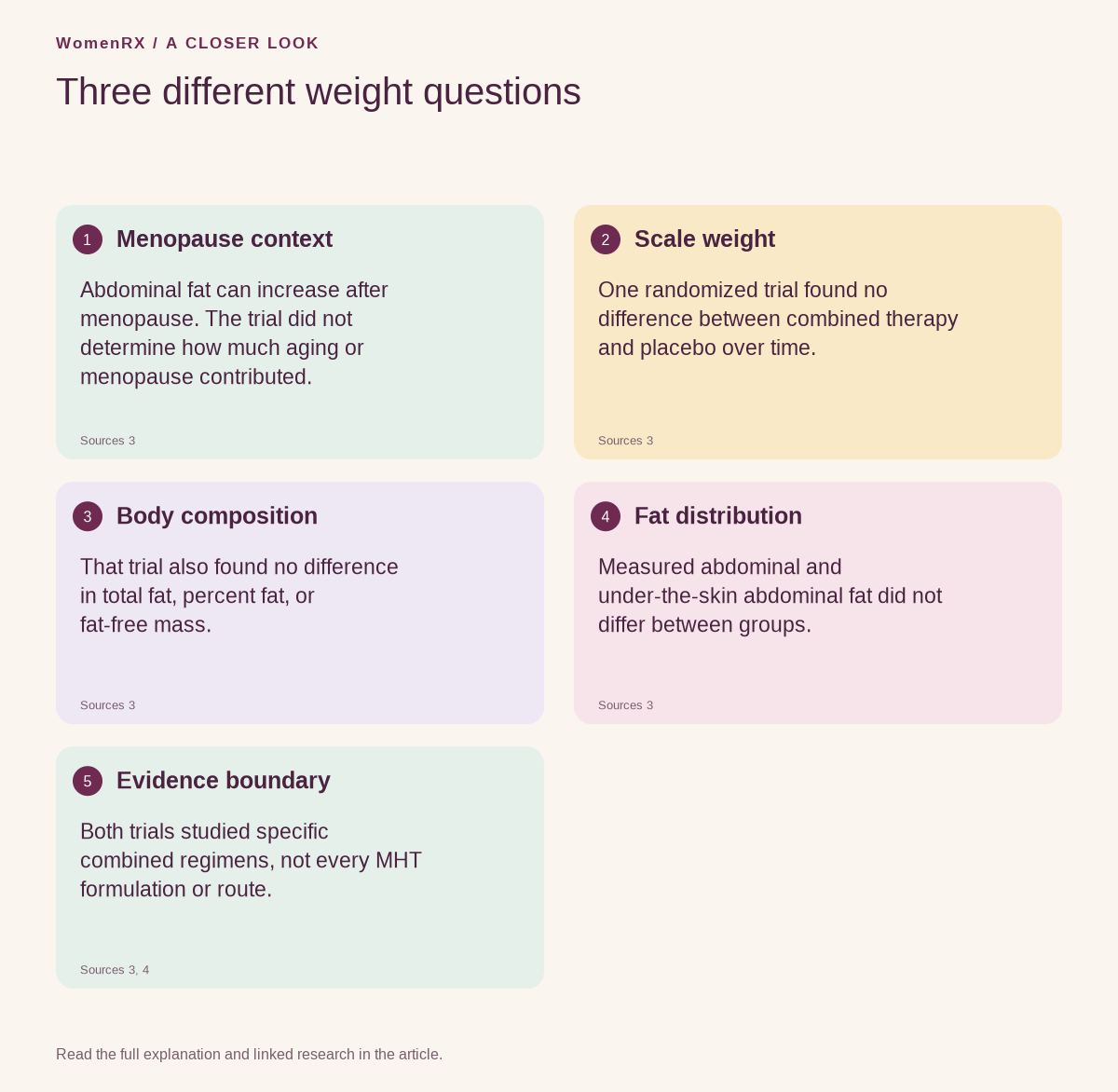
Three different weight questions
Menopause context: Abdominal fat can increase after menopause. The trial did not determine how much aging or menopause contributed.3
Scale weight: One randomized trial found no difference between combined therapy and placebo over time.3
Body composition: That trial also found no difference in total fat, percent fat, or fat-free mass.3
Fat distribution: Measured abdominal and under-the-skin abdominal fat did not differ between groups.3
Evidence boundary: Both trials studied specific combined regimens, not every MHT formulation or route.34
Read the figure as text
The trial results are easier to interpret when scale weight, body composition, and fat distribution are kept separate.- Menopause context: Abdominal fat can increase after menopause. The trial did not determine how much aging or menopause contributed.3
- Scale weight: One randomized trial found no difference between combined therapy and placebo over time.3
- Body composition: That trial also found no difference in total fat, percent fat, or fat-free mass.3
- Fat distribution: Measured abdominal and under-the-skin abdominal fat did not differ between groups.3
- Evidence boundary: Both trials studied specific combined regimens, not every MHT formulation or route.34
More questions, answered
Does the research show that MHT prevents weight gain?
It doesn’t establish that. In one small open-label trial, the treatment group’s weight increased by 1.3%, which was not statistically significant; the control group had a reported 3% gain from baseline. The abstract doesn’t establish a statistically significant difference between the groups, and substantial dropout limits how confidently the result can be applied. Another randomized trial found no difference in weight between treatment and placebo groups. 3 4
Do these findings apply to patches or other hormone regimens?
The weight trials described here tested regimens containing conjugated estrogens and medroxyprogesterone acetate. They don’t establish weight effects for other formulations or routes. General MHT risks vary by route and other treatment details, but that isn’t the same as evidence of route-specific weight effects. 2 3 4
Sources you can check
- Body Weight: MedlinePlusAccessed 2026-09-25Return to first citation
- The 2022 hormone therapy position statement of The North American Menopause Society.“The 2022 Hormone Therapy Position Statement of The North American Menopause Society” Advisory Panel. · Menopause (New York, N.Y.) · 2022Return to first citation
- The effect of hormone replacement therapy on body composition, body fat distribution, and insulin sensitivity in menopausal women: a randomized, double-blind, placebo-controlled trial.Sites CK, L'Hommedieu GD, Toth MJ, Brochu M, Cooper BC, Fairhurst PA. · The Journal of clinical endocrinology and metabolism · 2005Return to first citation
- Effects of low-dose continuous combined conjugated estrogens and medroxyprogesterone acetate on menopausal symptoms, body weight, bone density, and metabolism in postmenopausal women.Gambacciani M, Ciaponi M, Cappagli B, Genazzani AR. · American journal of obstetrics and gynecology · 2001Return to first citation