Does Menopausal Hormone Therapy Lower Blood Pressure?
Hormone therapy can affect blood-pressure risk, but it isn’t a treatment for hypertension.
Menopausal hormone therapy (MHT) hasn’t been shown to reliably lower blood pressure, so it shouldn’t take the place of hypertension care. Trials found more new hypertension during treatment with specific oral hormone regimens than with placebo. Route may matter, but current comparisons don’t establish that a patch lowers existing high blood pressure. 1 5 6
Two goals, two different decisions
MHT can relieve bothersome menopause symptoms, including hot flashes, and help prevent bone loss. High blood pressure has a separate treatment plan, built around blood-pressure readings, heart-healthy habits and, when needed, medication. A change in menopause symptoms isn’t a measure of whether that plan is working. 4 1
That distinction matters because high blood pressure usually has no symptoms. You might feel better after your hot flashes improve while your blood pressure remains high. Checking it tells you something symptom relief cannot. 1
What the studies actually measured
A Women’s Health Initiative analysis included postmenopausal women aged 50 to 79 who did not report hypertension or take blood-pressure medication at the start. During treatment, those assigned oral conjugated equine estrogens, either alone or with medroxyprogesterone acetate, had an 18% higher hazard of a new hypertension diagnosis or high blood pressure requiring medication than those assigned placebo. That relative difference was not apparent after treatment ended. The finding concerns specific oral regimens and developing hypertension. It does not test whether MHT lowers blood pressure in someone who already has it. 6
A French prospective cohort followed 49,905 menopausal women without hypertension at the start for an average of 10.6 years. Ever-use of MHT was associated with a 7% higher adjusted hazard of developing hypertension than never-use. Oral estrogen was associated with a 9% higher hazard; the estimate for transdermal estrogen was 3% higher, with a confidence interval that included no difference. Crucially, the oral and transdermal estimates did not differ significantly from each other. As an observational study, it cannot show that MHT caused the difference. 5
The practical takeaway is narrower than “hormones raise blood pressure” or “patches protect it.” These studies give a reason to pay attention to blood pressure during MHT, but they don’t identify a hormone regimen that treats hypertension. 5 6
Does a patch change the picture?
Route belongs in the conversation, but it isn’t a promise about your readings. In a community study of 328 postmenopausal women, past or current oral estrogen-only use was associated with higher measured blood pressure than transdermal or vaginal estrogen use or no hormone therapy. Only 16 participants had used oral estrogen. This observational comparison cannot show that changing route would lower one person’s blood pressure. The larger French cohort also did not find a statistically significant difference between its oral and transdermal risk estimates. 7 5
The broader MHT decision involves more than blood pressure alone. According to The Menopause Society, risks vary by hormone type, dose, duration, route, timing and whether a progestogen is used. The balance of symptom relief and risk should be individualized and revisited over time. 4
Keep blood-pressure care on its own track
If you’re weighing MHT and already have high blood pressure, a useful question is: How does this specific hormone option fit my menopause symptoms and cardiovascular risk, and how will we follow my blood pressure? That’s different from asking hormone therapy to do the job of a blood-pressure treatment. Hypertension care may involve heart-healthy eating, physical activity and medication; some people need more than one medicine to control it. 4 1 2 3
For example, if hot flashes improve after starting MHT, keep judging blood-pressure control by your readings and established treatment plan, not by how you feel. If readings are higher than expected, they’re worth reviewing in the context of both treatments rather than assuming menopause or MHT explains them. 1 4
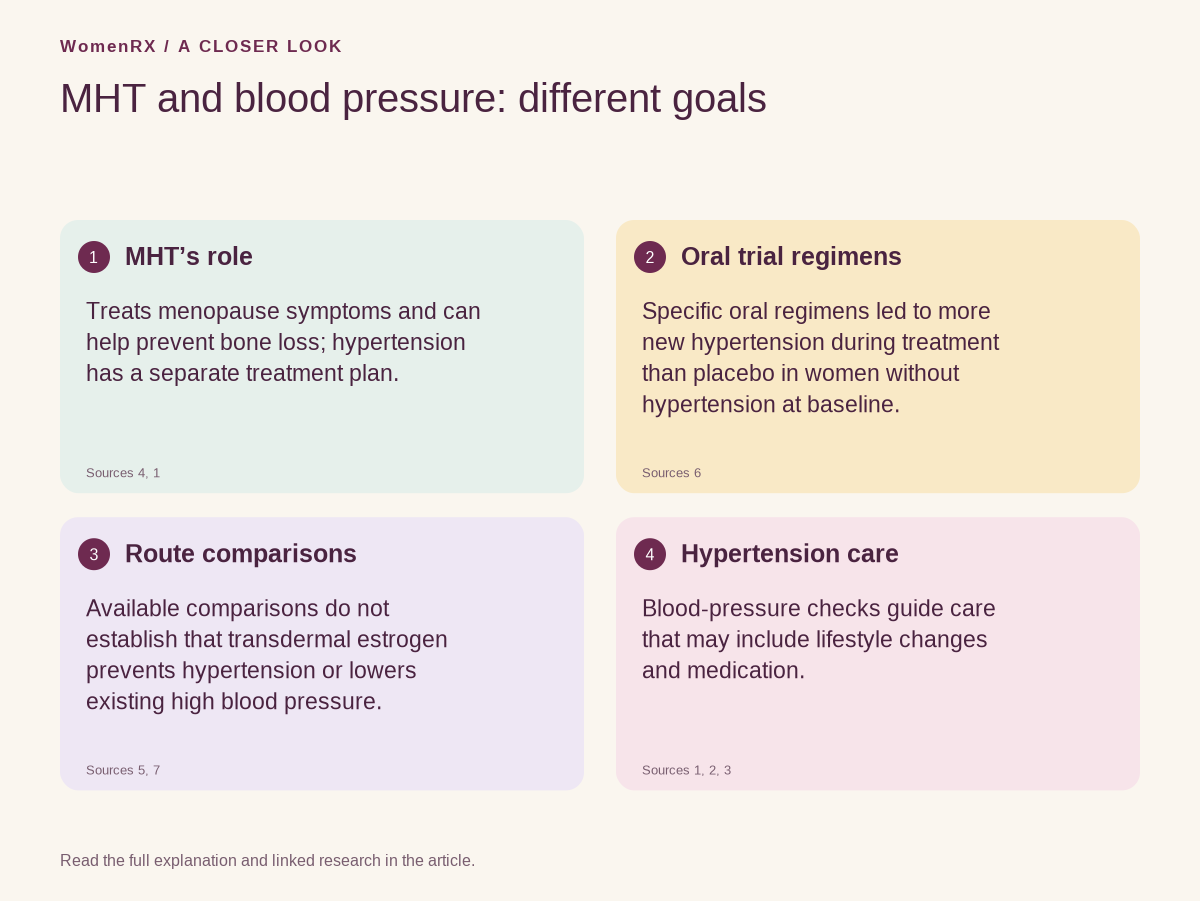
MHT and blood pressure: different goals
MHT’s role: Treats menopause symptoms and can help prevent bone loss; hypertension has a separate treatment plan.41
Oral trial regimens: Specific oral regimens led to more new hypertension during treatment than placebo in women without hypertension at baseline.6
Route comparisons: Available comparisons do not establish that transdermal estrogen prevents hypertension or lowers existing high blood pressure.57
Hypertension care: Blood-pressure checks guide care that may include lifestyle changes and medication.123
Read the figure as text
The evidence about hormone therapy does not replace the steps used to identify and treat hypertension.- MHT’s role: Treats menopause symptoms and can help prevent bone loss; hypertension has a separate treatment plan.41
- Oral trial regimens: Specific oral regimens led to more new hypertension during treatment than placebo in women without hypertension at baseline.6
- Route comparisons: Available comparisons do not establish that transdermal estrogen prevents hypertension or lowers existing high blood pressure.57
- Hypertension care: Blood-pressure checks guide care that may include lifestyle changes and medication.123
More questions, answered
Would a patch be better for blood pressure than oral estrogen?
There isn’t a firm answer. A large observational cohort found that oral and transdermal estimates for developing hypertension did not differ significantly. A smaller study found higher measured readings among oral-estrogen users, but cannot establish that route caused the difference. Neither study shows that a patch lowers existing high blood pressure. 5 7
Sources you can check
- High Blood Pressure | Hypertension | MedlinePlusAccessed 2026-09-25Return to first citation
- How to Prevent High Blood Pressure: MedlinePlusAccessed 2026-09-25Return to first citation
- Blood Pressure Medicines | MedlinePlusAccessed 2026-09-25Return to first citation
- The 2022 hormone therapy position statement of The North American Menopause Society.“The 2022 Hormone Therapy Position Statement of The North American Menopause Society” Advisory Panel. · Menopause (New York, N.Y.) · 2022Return to first citation
- Menopausal hormone therapy and risk of incident hypertension: role of the route of estrogen administration and progestogens in the E3N cohort.Madika AL, MacDonald CJ, Fournier A, Mounier-Vehier C, Béraud G, Boutron-Ruault MC. · Menopause (New York, N.Y.) · 2021Return to first citation
- Effects of oral conjugated equine estrogens with or without medroxyprogesterone acetate on incident hypertension in the Women's Health Initiative hormone therapy trials.Swica Y, Warren MP, Manson JE, Aragaki AK, Bassuk SS, Shimbo D, Kaunitz A, Rossouw J, Stefanick ML, Womack CR. · Menopause (New York, N.Y.) · 2018Return to first citation
- The Association Between Route of Post-menopausal Estrogen Administration and Blood Pressure and Arterial Stiffness in Community-Dwelling Women.Kalenga CZ, Hay JL, Boreskie KF, Duhamel TA, MacRae JM, Metcalfe A, Nerenberg KA, Robert M, Ahmed SB. · Frontiers in cardiovascular medicine · 2022Return to first citation