Estrogen and Weight Gain: Does the Evidence Show a Cause?
Menopause hormone therapy hasn’t been shown to cause more weight gain than placebo, but evidence about body shape and different estrogen routes is less complete.
Randomized trials and reviews don’t show that menopausal estrogen, alone or with a progestogen, causes more weight gain than placebo. That doesn’t mean your weight or shape can’t change while you’re taking it: menopause-related shifts in body composition can happen at the same time. The studies don’t settle whether every route or formulation has the same effect. 3 5

What the scale evidence says
The clearest answer is that prescribed menopausal estrogen has not been shown to cause extra weight gain compared with placebo. In a one-year trial of 2,673 postmenopausal women, women assigned to conjugated estrogen, with or without medroxyprogesterone acetate, gained no more weight than women assigned to placebo. The placebo group had the largest average gain: 1.15 kg. 3
A clinical review also summarizes a Cochrane review of 28 randomized trials involving 28,559 women. It reports no evidence that estrogen alone or estrogen combined with a progestogen added to the weight typically gained around menopause, or that hormone therapy prevented that gain. 5
That’s reassuring evidence against the idea that estrogen inevitably makes the scale go up. It isn’t proof that no individual will gain weight while using it. Weight can change for several reasons, and the scale reflects fat, muscle, bone, and water, not just body fat. 1
Weight and waistline aren’t the same outcome
Menopause-related changes in body composition can be noticeable even when scale weight changes little. A clinical review describes increases in total and abdominal fat alongside decreases in lean mass during the menopause transition. A shift toward more fat around the abdomen can change clothing fit or waist measurement without a large change in total weight. 5
This distinction helps explain why someone might notice a changing shape and wonder whether estrogen is responsible. The change may coincide with treatment, but that timing alone doesn’t show that treatment caused it. The trial findings on body weight don’t tell us precisely what will happen to every person’s waistline or fat distribution.
How far can the treatment evidence take you?
The Women’s HOPE trials tested specific daily conjugated-estrogen regimens, including regimens combined with medroxyprogesterone acetate. In a two-year body-composition substudy of 822 women, weight, fat mass, and percentage body fat increased in the placebo group; changes in those measures were smaller in active-treatment groups. The study’s authors concluded that treatment did not affect body composition. These results shouldn’t be stretched into a claim that every estrogen product, dose, or route changes body shape in the same way. 2
The available evidence here doesn’t provide a reliable head-to-head comparison of estrogen routes, or a clear weight estimate for every formulation and dose. So if you use a different product, these results can’t predict your individual response. They do support a narrower, useful conclusion: the studied menopausal regimens did not produce greater weight gain than placebo. 3 5
What to make of a change while taking estrogen
If your weight changed after starting treatment, consider the scale and body shape separately rather than assuming estrogen is the cause. A trend in weight, a change in waist measurement, or a difference in how clothes fit are related but not identical observations. If you’re concerned, bring the change and its timing to the person who prescribes your treatment; they can weigh it against why you’re taking estrogen and your other health factors.
Menopausal hormone therapy is used for established reasons such as bothersome hot flashes and prevention of bone loss in appropriate patients, not as a weight-loss treatment. Decisions about continuing it depend on individual benefits and risks, which can vary with factors including formulation, dose, route, and timing. 4 5
A sudden, unexplained change in weight is worth discussing with a health care provider, since it can have causes unrelated to menopause treatment. 1
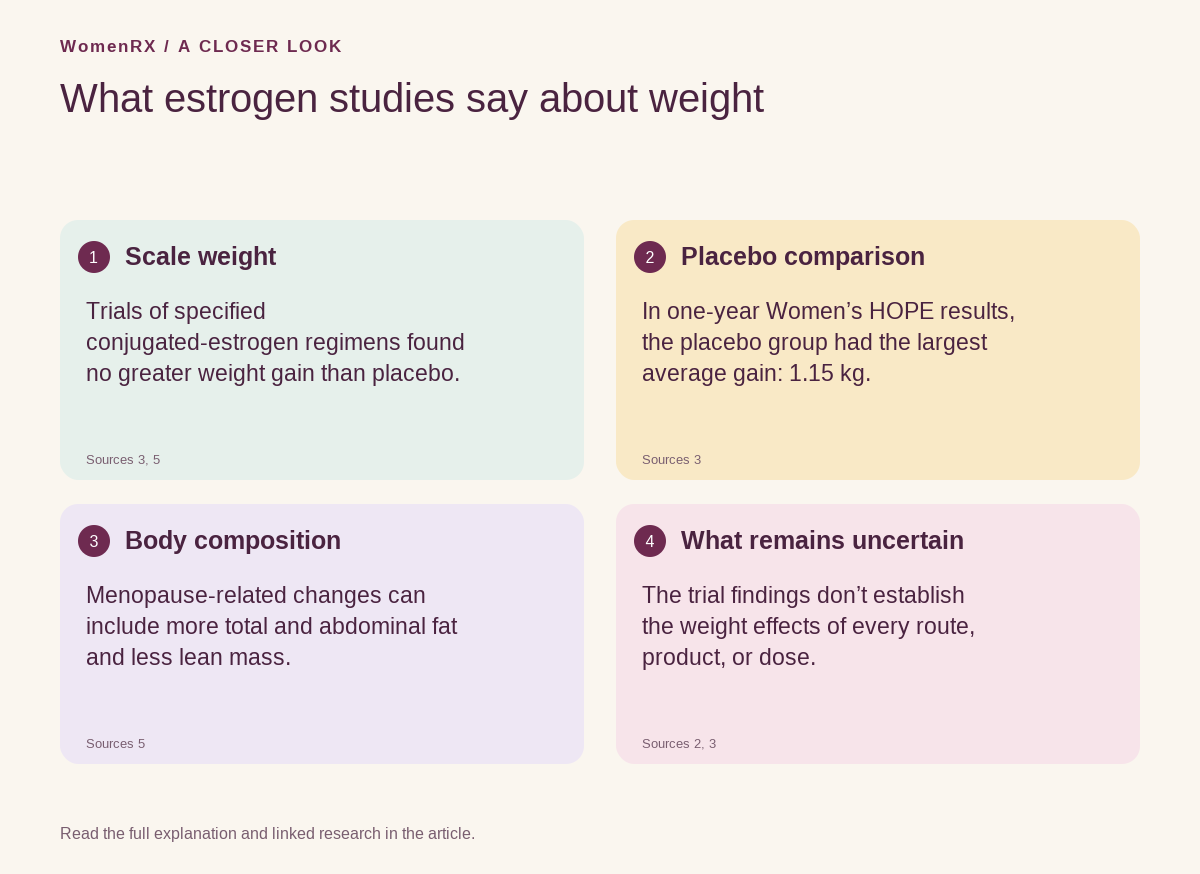
What estrogen studies say about weight
Scale weight: Trials of specified conjugated-estrogen regimens found no greater weight gain than placebo.35
Placebo comparison: In one-year Women’s HOPE results, the placebo group had the largest average gain: 1.15 kg.3
Body composition: Menopause-related changes can include more total and abdominal fat and less lean mass.5
What remains uncertain: The trial findings don’t establish the weight effects of every route, product, or dose.23
Read the figure as text
These findings separate the direct trial evidence on scale weight from body-composition observations and the limits of applying trial results to every product.- Scale weight: Trials of specified conjugated-estrogen regimens found no greater weight gain than placebo.35
- Placebo comparison: In one-year Women’s HOPE results, the placebo group had the largest average gain: 1.15 kg.3
- Body composition: Menopause-related changes can include more total and abdominal fat and less lean mass.5
- What remains uncertain: The trial findings don’t establish the weight effects of every route, product, or dose.23
More questions, answered
Does the evidence apply equally to estrogen pills, patches, and vaginal estrogen?
The weight trials described here don’t provide a dependable comparison across routes. They studied specific conjugated-estrogen regimens, sometimes combined with a progestogen, so their findings can’t establish that every route or product has the same effect on weight. 2 3
Sources you can check
- Body Weight: MedlinePlusAccessed 2026-09-25Return to first citation
- Body composition during treatment with conjugated estrogens with and without medroxyprogesterone acetate: analysis of the women's Health, Osteoporosis, Progestin, Estrogen (HOPE) trial.Thorneycroft IH, Lindsay R, Pickar JH. · American journal of obstetrics and gynecology · 2007Return to first citation
- Body mass index does not influence response to treatment, nor does body weight change with lower doses of conjugated estrogens and medroxyprogesterone acetate in early postmenopausal women.Utian WH, Gass ML, Pickar JH. · Menopause (New York, N.Y.) · 2004Return to first citation
- The 2022 hormone therapy position statement of The North American Menopause Society.“The 2022 Hormone Therapy Position Statement of The North American Menopause Society” Advisory Panel. · Menopause (New York, N.Y.) · 2022Return to first citation
- Clinical review: Menopause hormone therapy in weight management.Younglove C. · Obesity pillars · 2026Return to first citation